
Anthropological studies of magic in the early-to-mid 20th century primarily focused upon pre-industrial societies outside of Europe, the Classical World and the Mediterranean. But can we use the conclusions of their research as analogies for how the use of ‘sympathetic magic’ was understood to function during the Early Modern Period (c. AD 1550-1800) in Europe?

Ethnographic studies have attempted to place each society’s beliefs within its own cultural milieu as it is understood that magic and ritual can only be understood in relation to the prevailing socio-political and economic ‘context’ of that society. Further, any interpretations that we do make should avoid projecting contemporary cultural views onto that of past societies as a whole. Each is unique and only functions by dint of the supporting ‘norms’ of that culture.

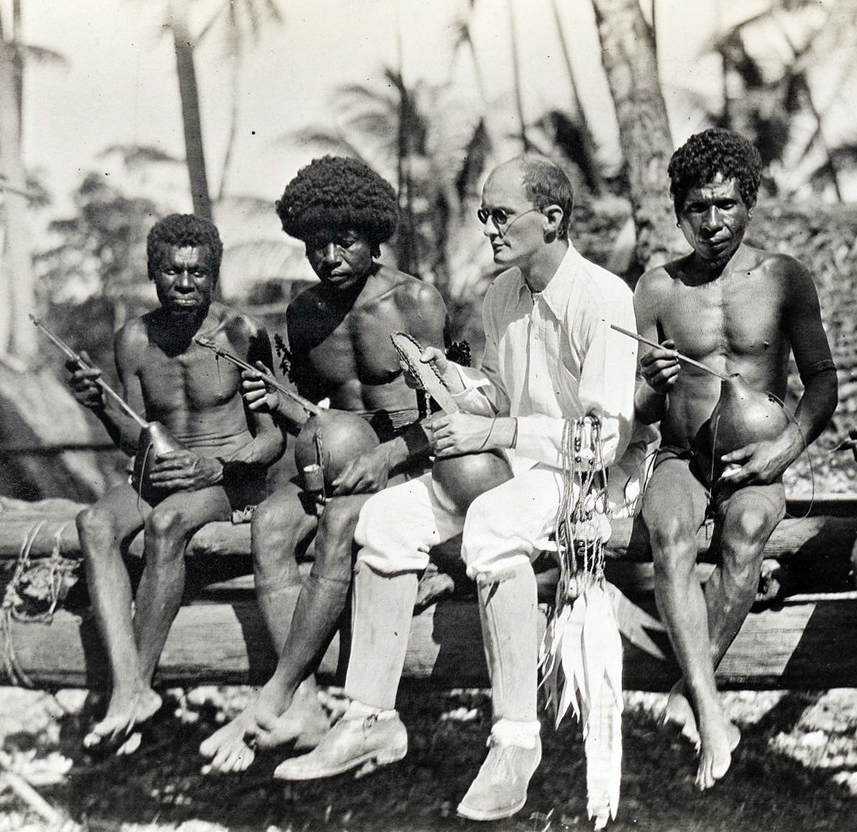
Taking one example which might be useful in this context, Professor Malinowski’s theory of magic and ritual was conceived after studying the cultures of the Trobriand Islands off the coast of New Guinea, detailed in his book, ‘Coral Gardens and their Magic.’ He stated that peoples from pre-industrial societies possessed, ‘a body of empirical knowledge (comparable to modern scientific knowledge) as to the behaviour of nature and the means of controlling it to man’s needs.’ Warner stated: ‘as nature and mortality are mutually dependent, the control of nature lies in the ‘proper’ control and treatment of social organisation (quoted in Homans 1941:170-1).
Credit: Wellcome Library, London. Wellcome Images
For the islanders, magic was applied in a practical manner to get the desired result (although those results were never a matter of certainty). ‘If it failed or seemed to be less efficacious than before then they experienced a sentiment known as anxiety.’ (Malinowski quoted in Homans 1941:164). Magic, therefore, might be defined as the ritual which is closely associated with practical activities (Homans 1941:166). Magic fixes upon those beliefs and rudimentary rites and standardises them into permanent, traditional forms (Malinowski quoted in Homans 1941:167).
Anxiety can manifest itself in ritual behaviour (Homans 1941:166). A state of anxiety would lead to further rites being enacted and, having done so, practical work would be undertaken with renewed energy and determination (Malinowski quoted in Homans (1941:164). Secondary rituals are known as the rituals of purification or expiation (Homans 1941: 170). In other instances it may lead to ‘negative ritual;’ i.e. the avoidance of behaviour rather than undertaking ‘positive’ ritual (Homans 1941: 167). It is also possible that some rituals may have existed to promote anxiety and therefore control behaviour (Radcliffe Browne quoted in Homans 1941:169). The drive towards relief (from anxiety) tends to set in operation implicit or explicit forms of behaviour, the principal characteristic of which is their symbolic character, i.e. ritual (Willoughby quoted in Homans 1941: 166).
Reviewing the theories of both Malinowski and Radcliffe-Browne, Homans (1941) concluded that at least seven elements must be taken into consideration in any study of the rituals we call magic;
- Primary anxiety : when certainty is lacking
- Primary ritual: performs actions which have no practical result (ritual). Society determines the form of the ritual which is expected to be performed on appropriate occasions. Men will invent ritual when they feel anxiety.
- Secondary anxiety: primary anxiety will remain latent, secondary anxiety only arises when rites are not properly performed
- Secondary ritual: ritual of purification and expiation which dispels secondary anxiety. May be socially determined.
- Rationalisation: this element includes the statements which are associated with ritual.
- Symbolisation : each society has its own vocabulary of symbols, some of which make reference to the fundamental myths of that society
- Function : ritual actions do not produce a practical result on the external world as ritual is related to the internal (not external) constitution of the society which disciplines the social organisation
Homans 1941: 171-2).
Is it possible, when reviewing the evidence from the archaeological recovery of magical deposits (such as witch bottles, concealed shoes and spiritual middens) that we can see any of the same motivations outlined in Malinowski’s interpretation pertaining to their manufacture use?
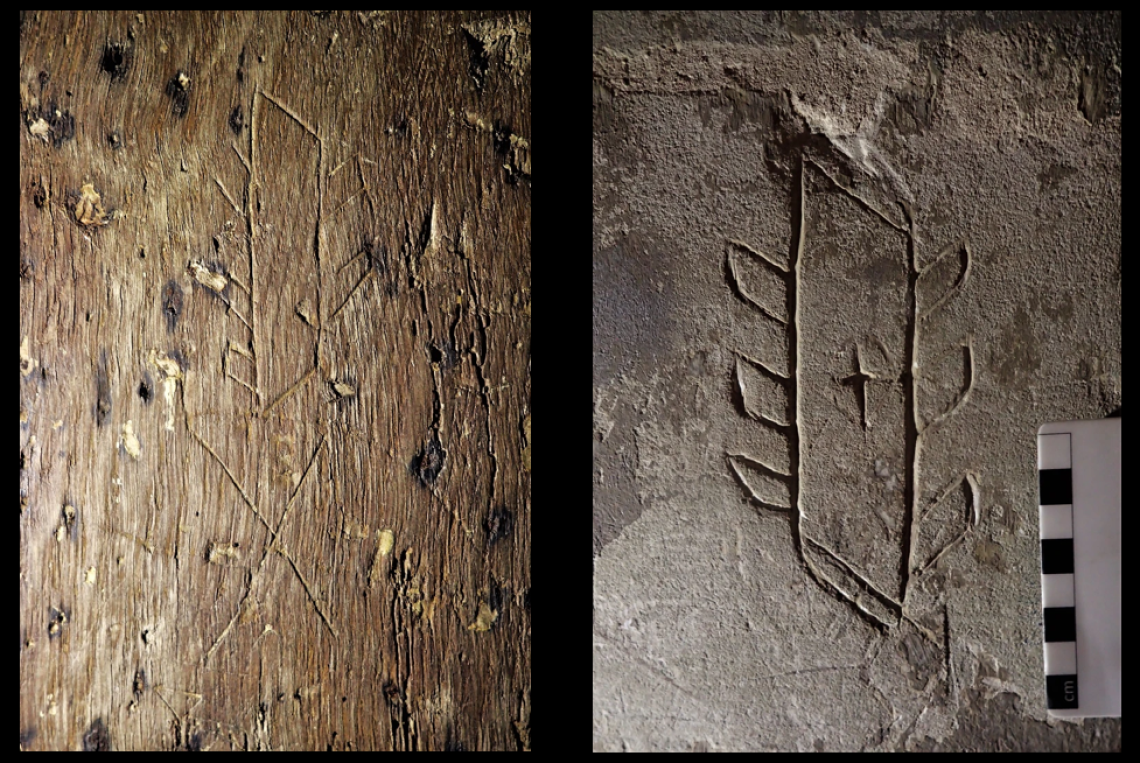
For me, point 6 may be the most pertinent particularly with regard to the narrow repertoire of concealed objects and apotropaic graffiti, the occurrence of symbolisation – that each society has its own vocabulary of symbols, some of which make reference to the fundamental myths of that society. What then are the symbols we find in Early Modern contexts and how do they relate to the foundation myths of European Christianity?
These ideas – and more – will be covered in my forthcoming book, ‘A Consensus of Symbols: Patterns in Ritual Building Protection’ later this year.
Wayne Perkins
October 2023
Further reading
Bronisław Malinowski
https://en.wikipedia.org/wiki/Bronis%C5%82aw_Malinowski
Coral Gardens and Their Magic
https://en.wikipedia.org/wiki/Coral_Gardens_and_Their_Magic
Homans, G C (1941) ‘Anxiety & Ritual: The Theories of Malinowski & Radcliffe-Brown.’ Open Library Project. https://anthrosource.onlinelibrary.wiley.com/doi/abs/10.1525/aa.1941.43.2.02a00020

 Ritual Protection Marks & Ritual Practices