
Main image: south window, Nave, St James’ church. A palimpsest of images with the gallows and several large pentangles being the most obvious motifs. Photo: (c) W Perkins 2024.
The shadow of the gallows hung heavy over Early Modern Europe; an ever-present reminder of the punishment awaiting those who broke the law or committed maleficium (malignant witchcraft). Conversely, the gallows could also facilitate healing and provide magical cures, there was a general belief that the corpse of someone hanged “possessed therapeutic powers, able to cure sickness and heal wounds” (Linebaugh 1975). More than likely, the hangman would have had a sideline in selling body parts and ‘liquids.’ Not only were the human residues considered valuable but also the splinters from the structure and small pieces of the rope were prized curatives.
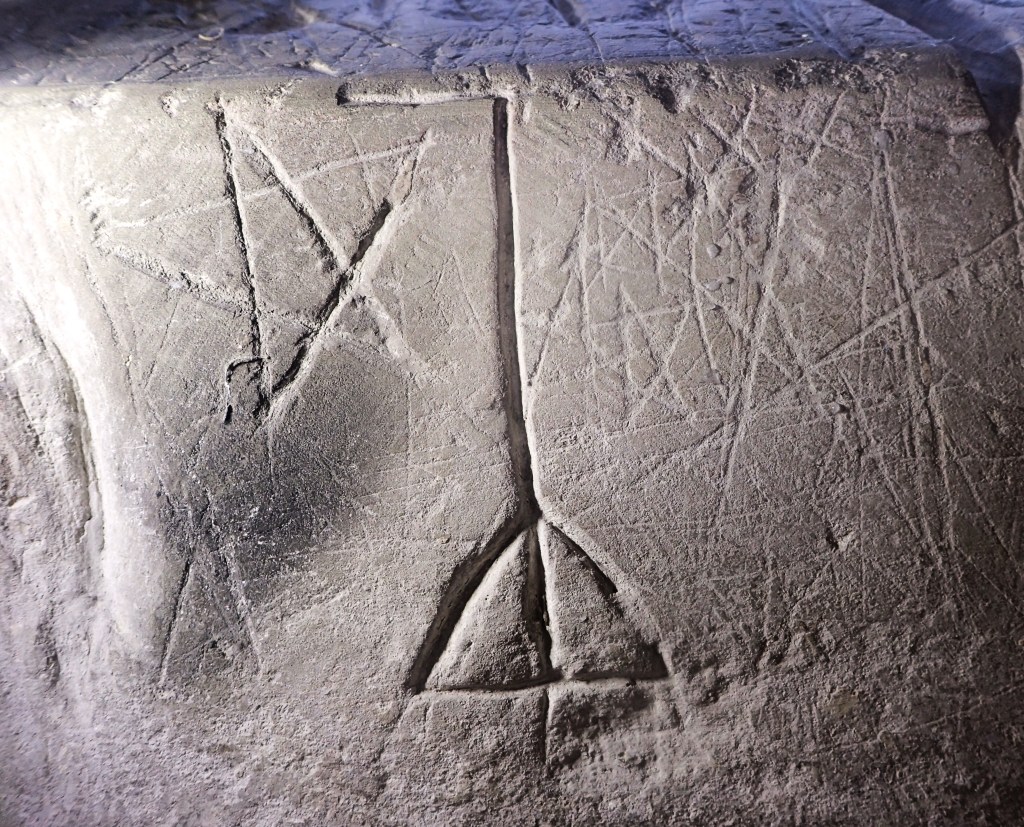
Unusually, at St James’ church in Granborough, Bucks, the graffiti is almost completely confined to the chancel rather than the Nave (the public domain). From this background palimpsest of lighter marks is a deeply cut depiction of the gallows alongside a pentangle; both bear the residue of lime-wash that had once been applied to the walls, suggesting that they are examples of pre-Reformation graffiti. Both had been made by deep, strident incisions but it is impossible to say whether they were made at the same time or if they were meant to be symbolically linked.
It is an intriguing corpus of graffiti that will be examined in more detail in a future post.
Duff, C (2011) A Handbook on Hanging: Being a Short Introduction to the Fine Art of Execution
Duff, C (2024) The History of Hanging
https://www.historic-uk.com/HistoryUK/HistoryofBritain/The-Art-of-Hanging
Harding, R M (2016) ‘Rubbing the Rabbit’s Foot: Gallows Superstitions and Public
Healthcare in England During the Eighteenth and Nineteenth Centuries’
Linebaugh, P (1975) Albion’s Fatal Tree. Pantheon Books.

 Ritual Protection Marks & Ritual Practices