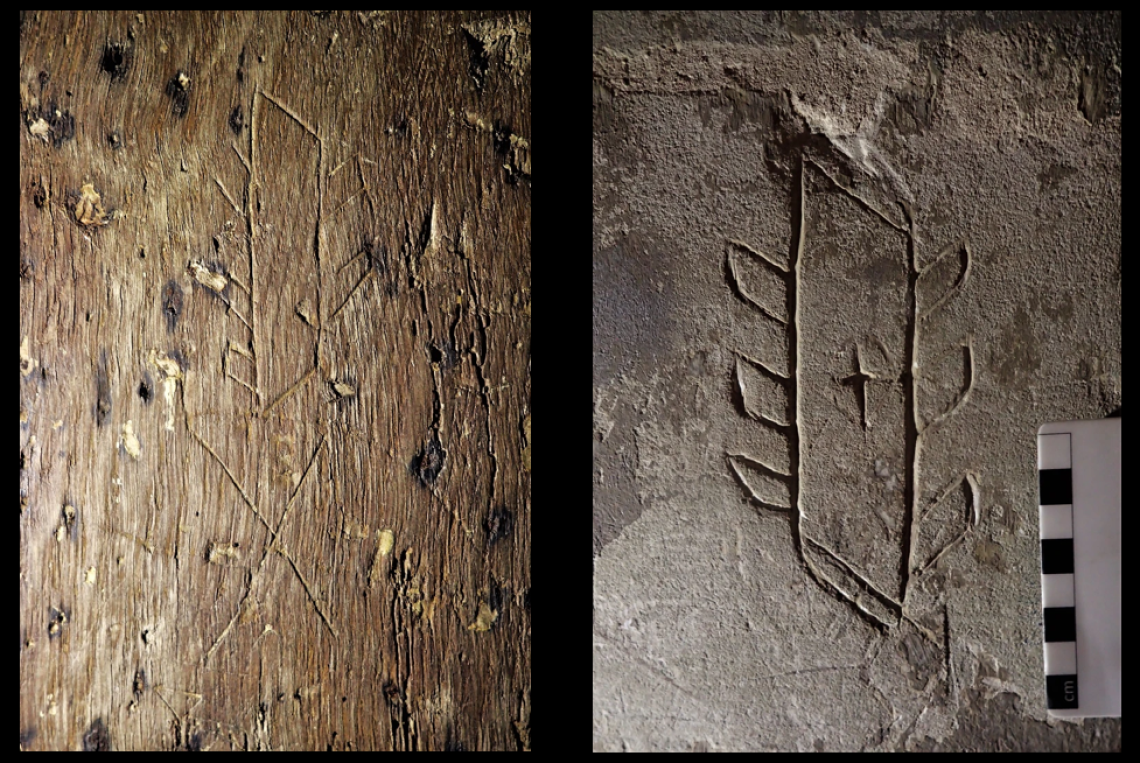

Legends, myths & ritual taper burn marks
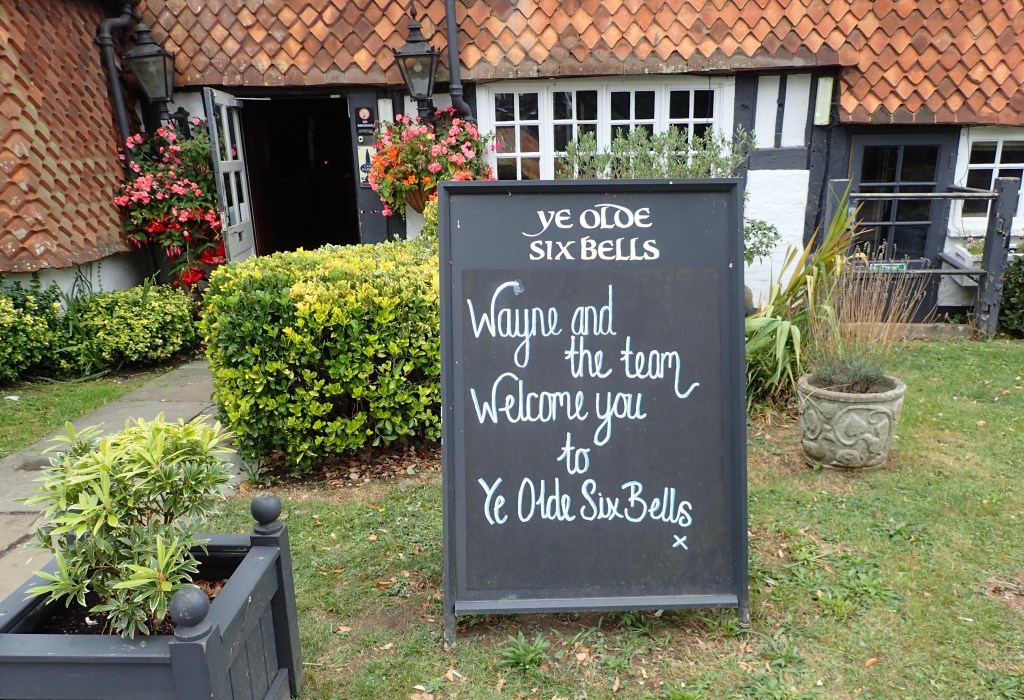
It is believed that the proximity of the Ye Older Six Bells public house to St Bartholomew’s church provided it with its name – the faithful came to pay their respects in both buildings but in very different ways. The buildings are connected not only in their proximity above ground but it is rumoured that there is a subterranean passage which is said to link the pub with the church (Vintage inns 2025). This is a quaint motif, oft-repeated in many villages that I have visited…and rarely has anything to do with reality.

The land upon which it stands was acquired by Chertsey Abbey in 1263 and it is believed that the public house was built c. AD 1450, along with its barn and outbuildings, some of which are also scheduled. Most sources agree on a 15th century date for the building, although Historic England places it as a century later, although their entry is neither very detailed nor makes its case for this later date (Historic England 2025). In fact, Harris (2000:63) is of the opinion that after the early 16th century, they rapidly became scarce and their place was taken by clasp purlin roofs. Therefore, a 15th century date for the building is perfectly tenable.
In its early form, it may have originally functioned as a hospice for the monks of Dorking monastery (Vintage Inns 2025). It is thought that the original buildings may have been built upon wooden piles but this remains unproven through excavation (CAMRA 2025).

The charming, rambling half-timbered public house has many interesting architectural features. On the exterior, it is thought that four niches within a shared wall with the church denote the burial places of the monks (Vintage Inns 2025).

By the late 19th century, records of the landlords (and ladies) note that, following the ownershop of the Meakin’s and Charles Dagnell, carpenter Sam Heuy carved the numbers ‘827’ in one of the ceiling beams in 1896 (Vintage Inns 2025). The relevance of this particular number is unknown.

Entering the pub you will see that immediately to your right is a magnificent bressummer supporting the fireplace. The beam is festooned with ritual taper burn marks. I have written extensively about the historical research into the phenomenon of taper burn marks back in 2022, which detailed how these marks – once thought to be purely accidental – may have been made to confer ‘protection’ upon the building. They were thought to ‘inoculate’ against the threat of fire and from the potential attention of witches or their familiars, working upon the principles of imitation and correspondence (Perkins 2022). In more recent centuries, they may have been made simply ‘for luck’ by customers of the pub – much in the same way that a horseshoe is nowadays placed above the doorway. It is, of course, an act debased from the original intention, when iron was seen as having a ‘magical’ quality that could prevent a witch from passing over the threshold.
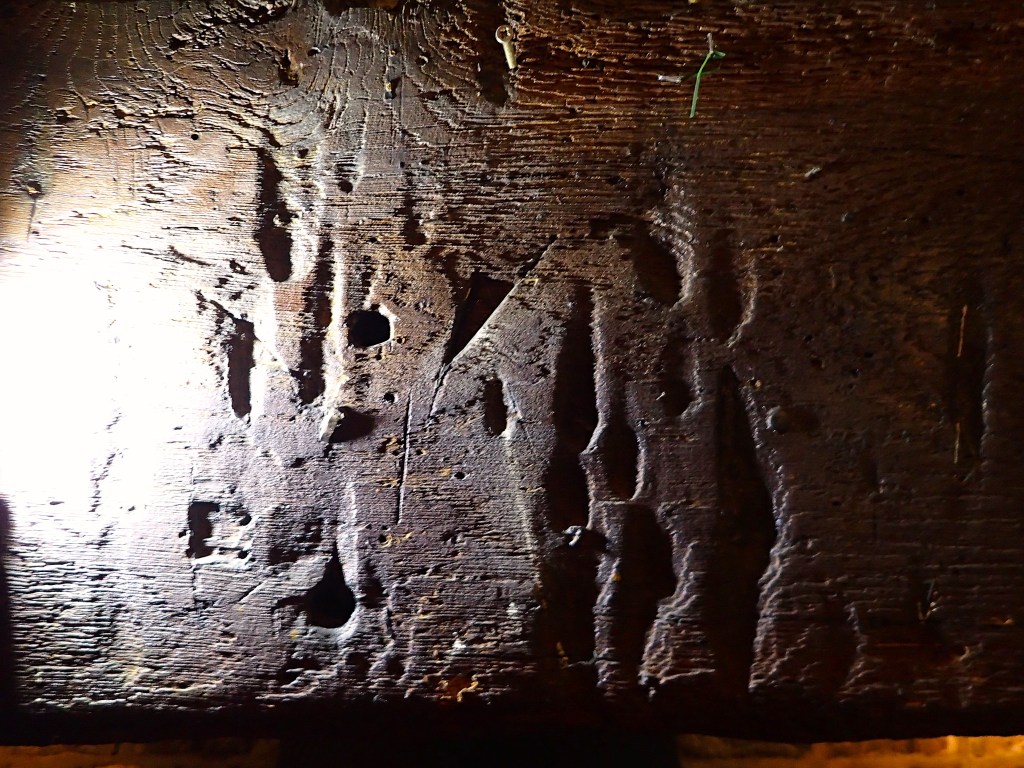
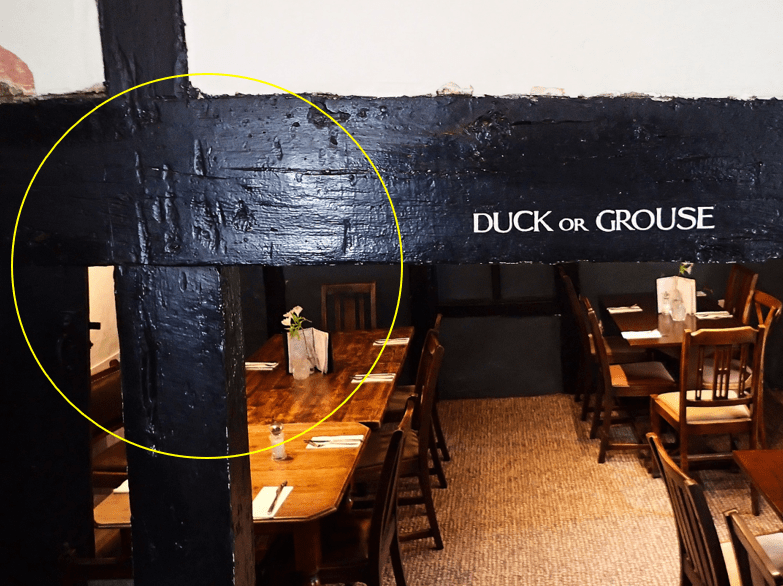
Unfortunately, it would seem that the efficacy of the taper burns made to inoculate the building against fire failed in 2019, when a blaze damaged a good portion of the building (BBC News 2019). Thankfully, the building is now fully restored and functioning.
Epilogue
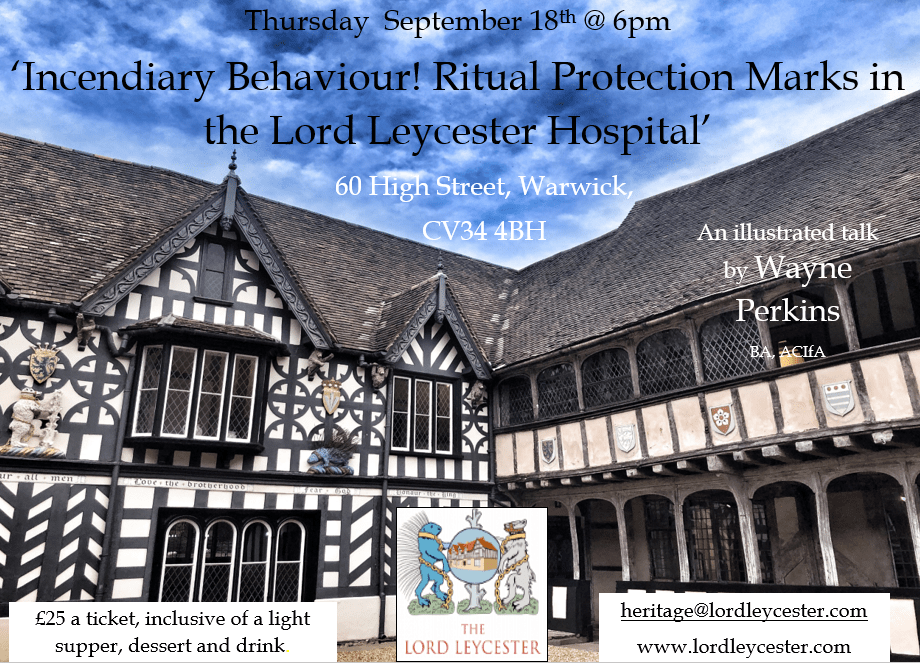
Ritual taper burn marks continue to fascinate and I will be talking again soon at the Lord Leycester Hospital in Warwick about the numerous taper burn marks found throughout that fine building.
For now, let’s hope that Ye Olde Six Bells can continue to serve the community safely for years to come….
Wayne Perkins
London, September 2025
Many thanks to Simon and the staff who generously allowed me to roam the building to take the photographs for this article.
Further reading
BBC News (2019) Ye Olde Six Bells in Horley, Surrey, wrecked by fire
https://www.bbc.co.uk/news/uk-england-surrey-48436679
CAMRA (2025) Ye Olde Six Bells
https://camra.org.uk/pubs/olde-six-bells-horley-191166#google_vignette
Harris, R (2000) Discovering Timber Framed Buildings. Shire Publications Ltd.
Historic England (2025) Ye Olde Six Bells, Church Road, Horley.
Horley Local History Society (1975) A Look Around Horley. Leaflet
A Look Around Horley
chrome-extension://efaidnbmnnnibpcajpcglclefindmkaj/https://www.horleysurrey-tc.gov.uk/uploads/documents/Old%201979%20History%20leaflet.pdf
Lord Leycester (2025) Smart talks: ‘Incendiary Behaviour! Ritual protection marks in the Lord Leycester Hospital’ by Wayne Perkins
Vintage Inns (2025) Ye Olde Six Bells
Perkins, W (2022) Incendiary Behaviour!


 Ritual Protection Marks & Ritual Practices