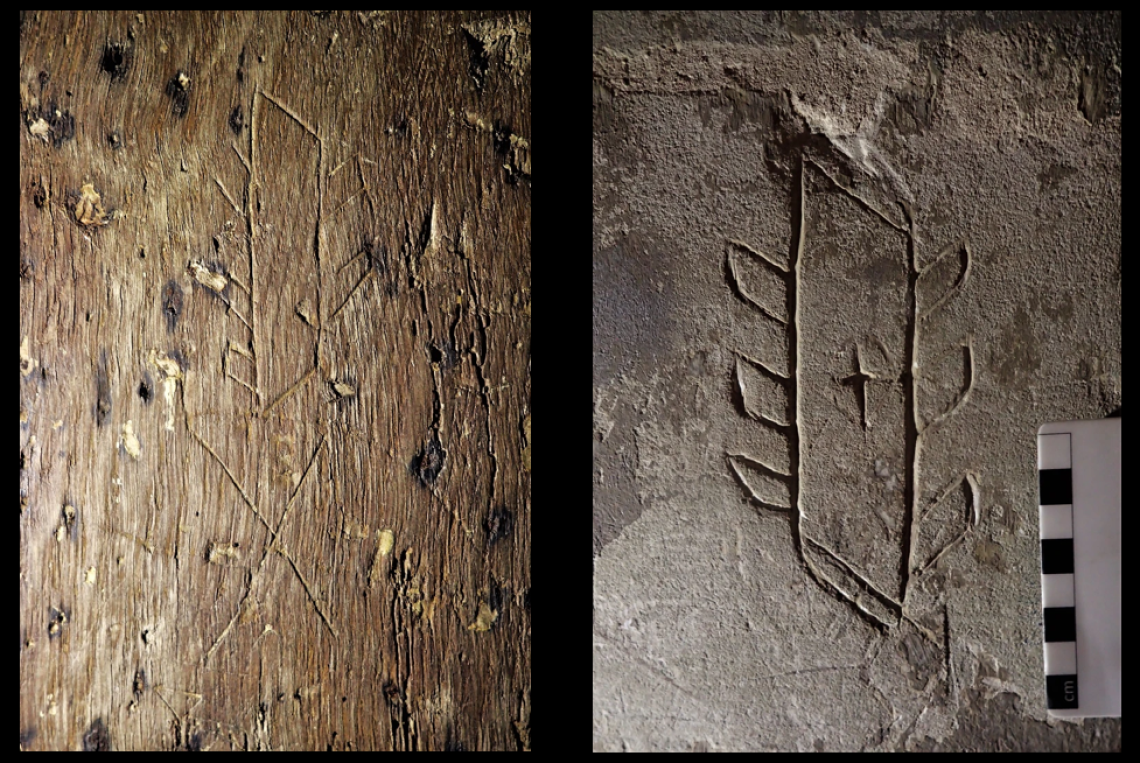
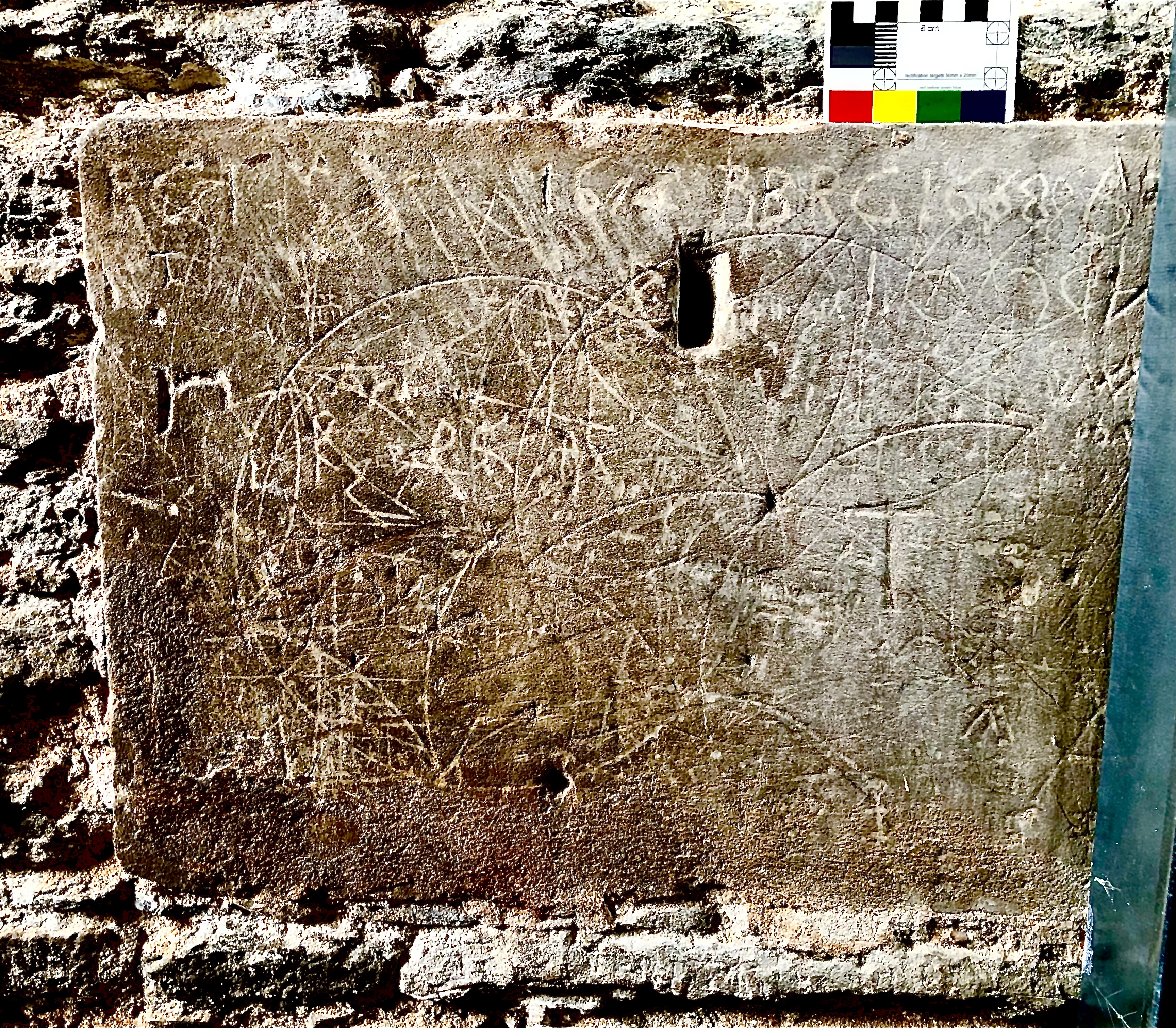
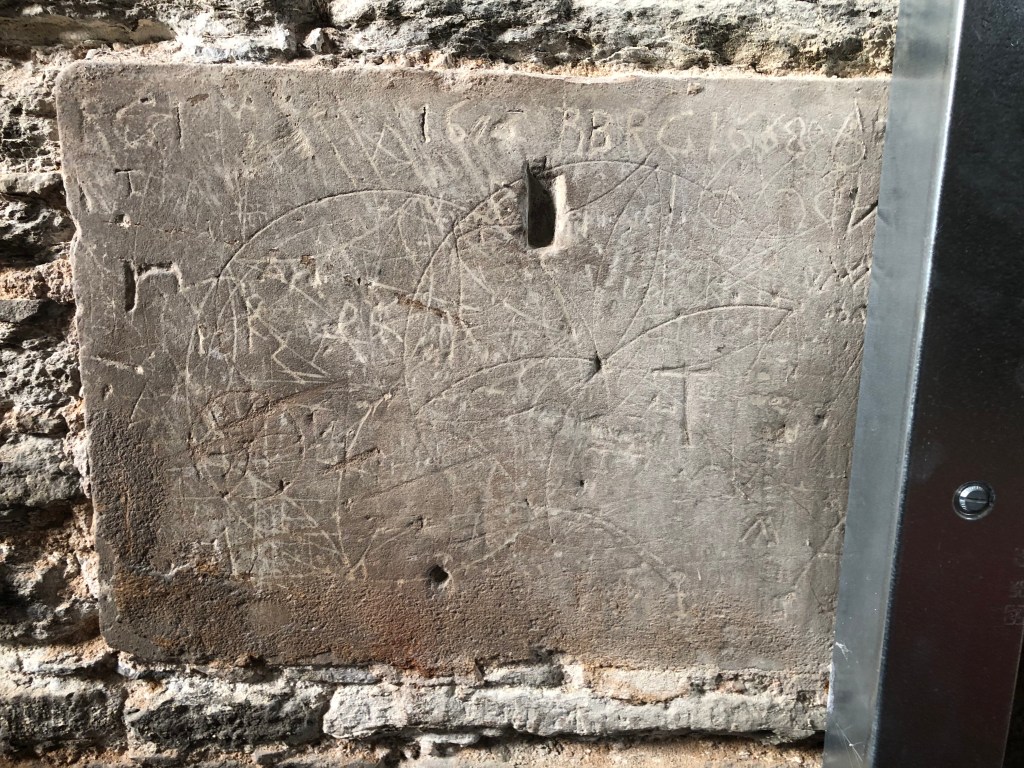
The briefest of visits was made to St Kenelm’s church at Upton Snodsbury, in Worcestershire, which bagged a small but interesting corpus of graffiti. It included one panel within a single masonry block which possessed several overlapping daisy wheels and an example of figurative graffiti – a naïve portrait possibly meant to represent a knight with a shield and possibly executed by a child.
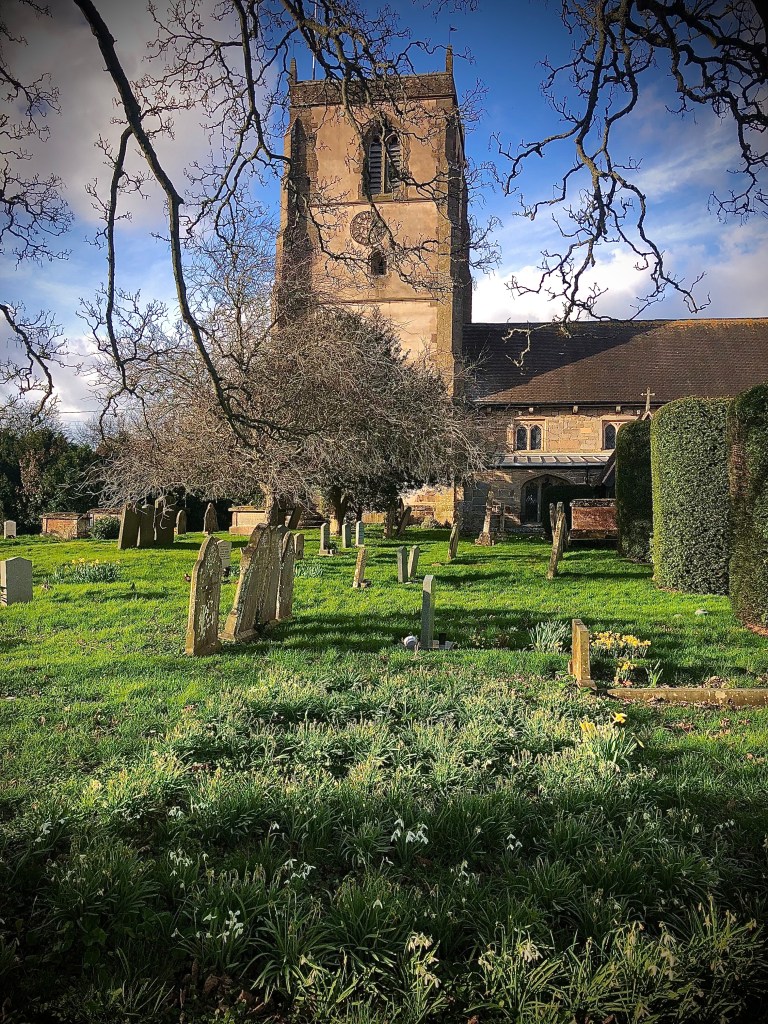
The Church of St Kenelm
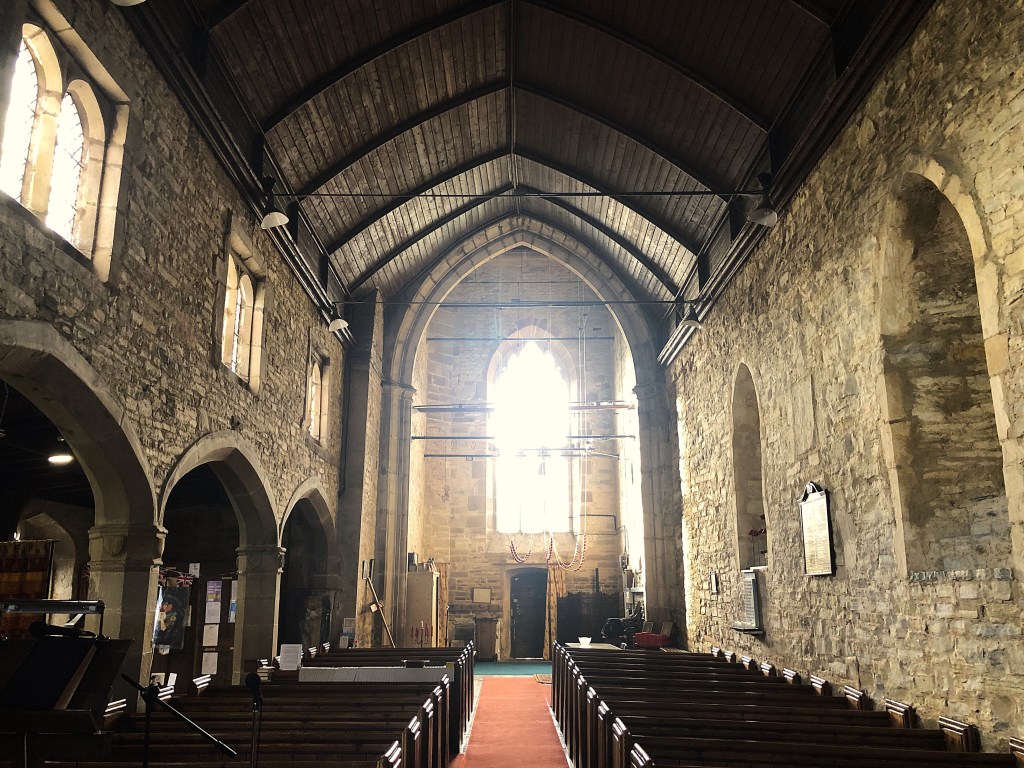
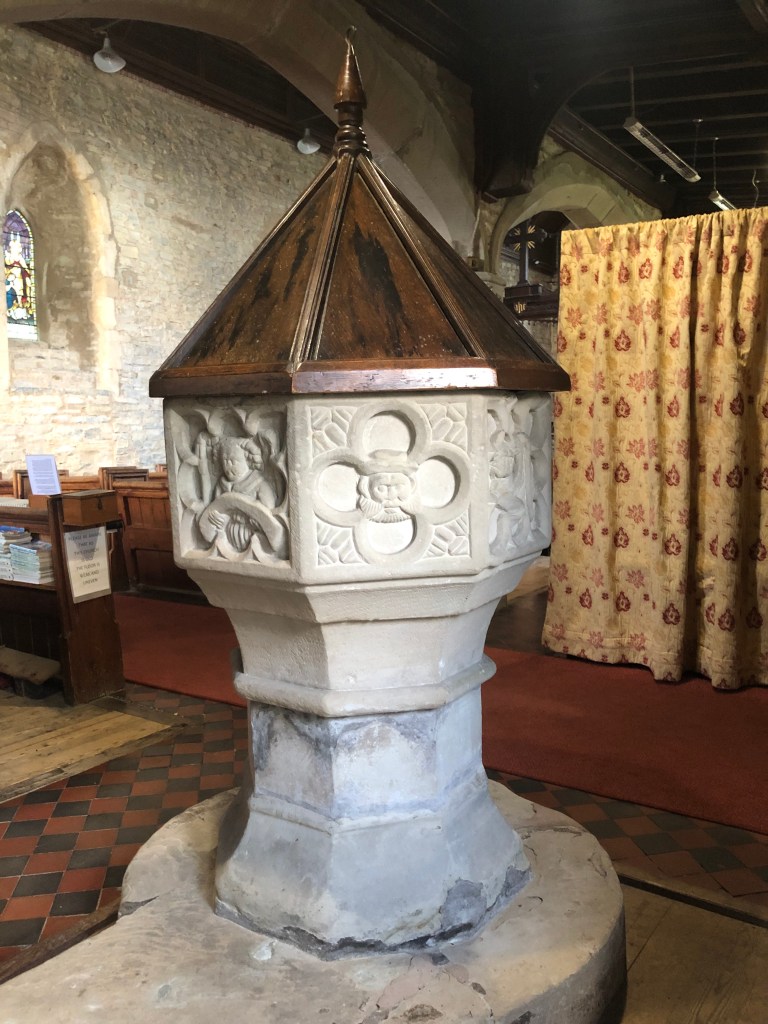
The church of St Kenelm’s claims a 10th century origin but the fabric as its stands today dates back to the 12th century’s ‘simple’ church of a nave and chancel (built c.1160) with its 13th and 14th century additions. There is a notable octagonal 15th century font, featuring the four evangelists alongside a Tudor Rose.
The Golden Legend
St Kenelm (Cynehelm) was an Anglo-Saxon child saint who was venerated throughout medieval England. He was murdered by his sister’s lover who concealed his body in a wood in Romsey in the Clent Hills. The story goes that, as the Pope sang mass at Rome in Saint Peter’s church ‘suddenly’ there came a white dove, which let fall a scroll upon the altar, whereon the Pope said his Mass. According to the Golden Legend, these words were written thereon in letters of gold:
In Clent in Cowbage,*
Kenelm, king born,
Lieth under a thorn,
His head off shorn
- – – – – – – – – – – –
A local rhyme paraphrases,
In Clent the cow pasture,
Kenelm, the king’s child,
lieth under a thorn,
bereft of his head
There are a number of variations of this passage, all with roughly the same meaning. This divine message led to the assembly of a search party which was intent on finding the Royal Prince. The hiding place of his body was revealed to the monks of Winchcombe Abbey through a miraculous intervention, whereby a column of light shone forth from the spot, which guided the monks to the site of his remains. Many miracles followed (including such tropes as flowering staffs and erupting springs) before a shrine was established at the Abbey in Winchcombe.
When his sister Quendryda was told that Kenelm’s body was being brought to the Abbey her disbelief led her to swear that, ‘if this be true then let both my eyes fall upon this book’ – at which point both of her eyes fell out of her head and onto the Psalter she was reading. The story, the legends and the associated miracles vary by source, depending upon which one you read.
Graffiti Corpus
In the church, the graffiti was sparsely distributed but there was a notable concentration under the tower crossing. Perhaps the most significant was the sandstone block cut with multiple overlapping daisy wheels (properly called six-petal rosettes). In general, six-petal rosettes are seen as devotional motifs which may have provided a focus for prayer much in the way that a prayer wheel does, allowing one to channel one’s devotions. Additionally, the six-petal rosette is considered to provide a protective function as an apotropaic but in its deployment its functionality would not have been regarded as mutually exclusive (Perkins 2022).
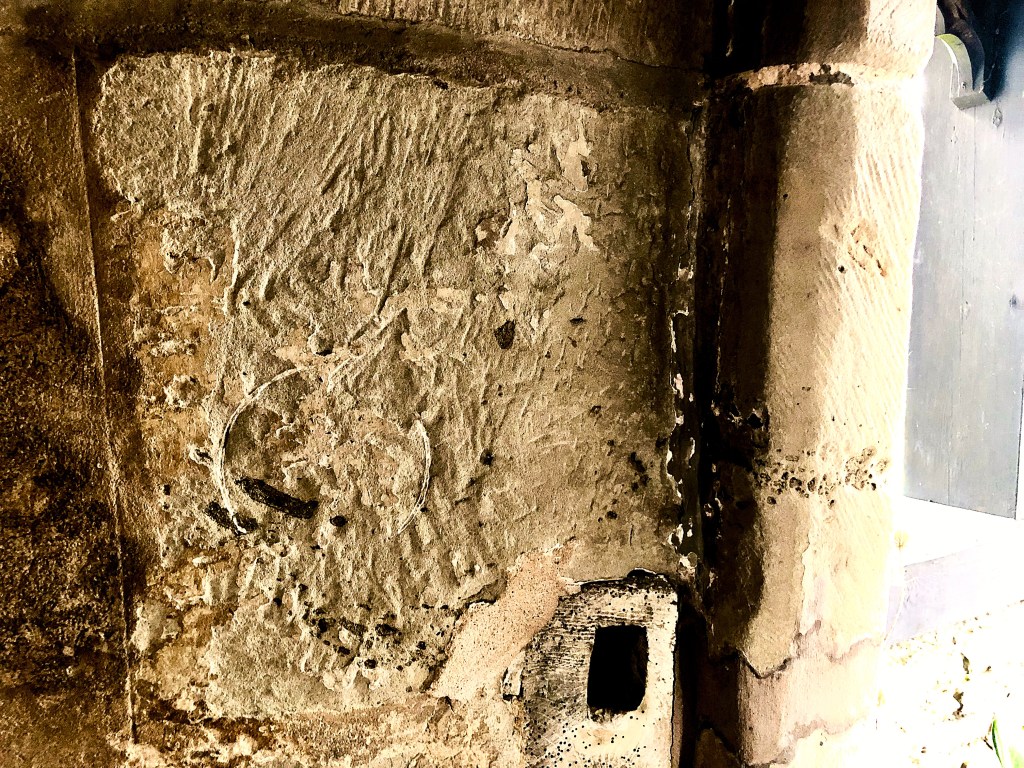
There are a couple of Marian marks of varying sizes.
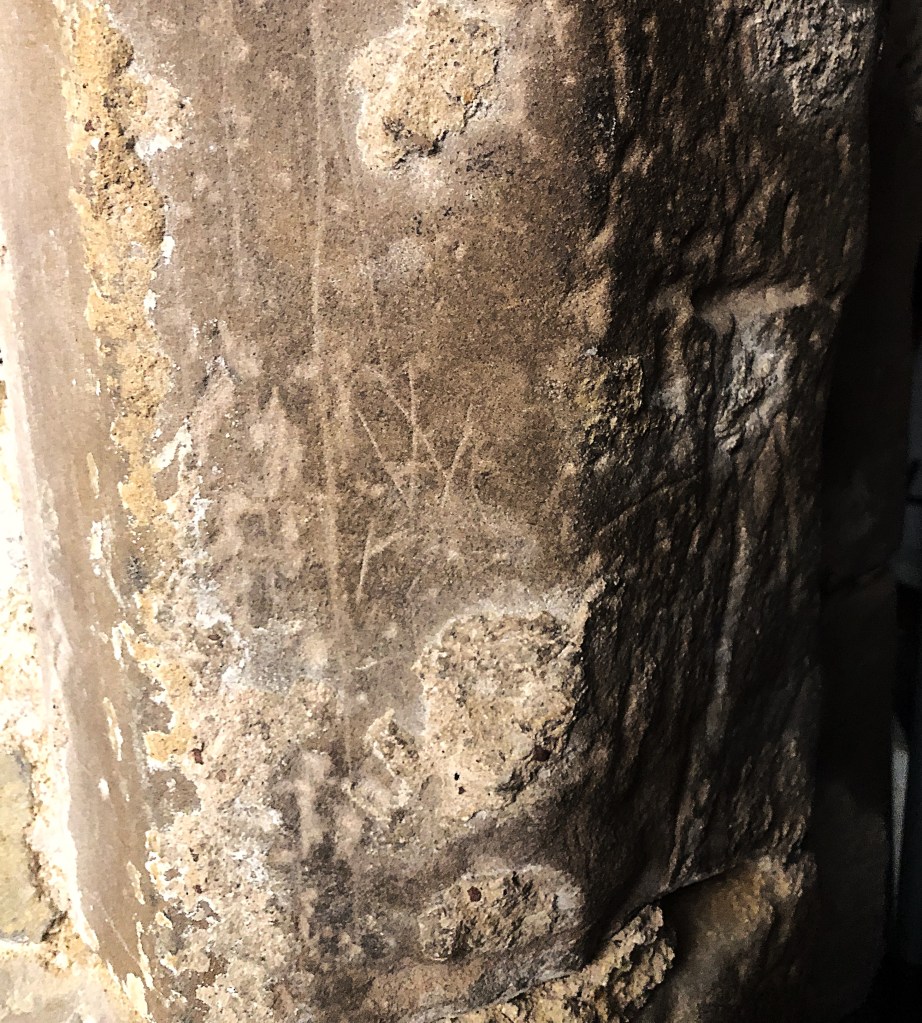
One of the piers in the Nave bears the scar of a vertical striation, probably the result of someone harvesting ‘holy dust’ for use in a potion. It was once believed that dust (or powder) taken from a consecrated buildings possessed curative powers.
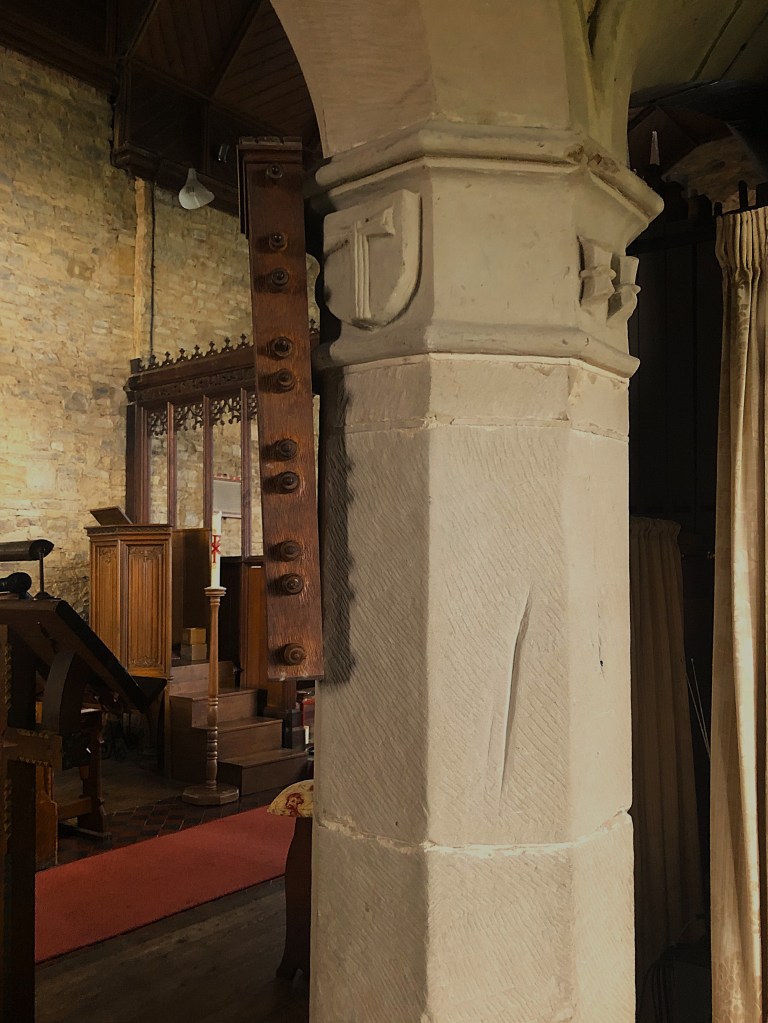
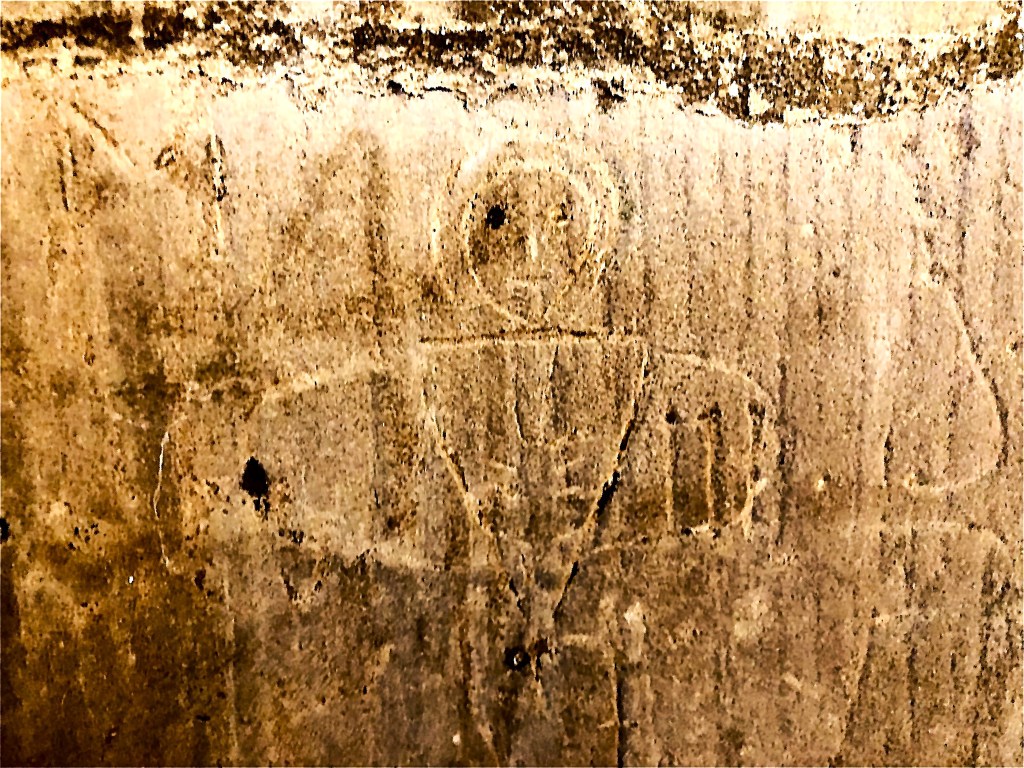
The figurative art in this instance is quaint and a rather naïve depiction of a knight with a shield and may be an example of a child’s contribution to the artwork of the church.
More graffiti resides in the tower which I was unable to access on such a short visit but the building does deserve a full and proper survey at some point in the future.
Wayne Perkins
February 2026

*(Cowbage referring to a small valley)
Further reading:
Baring-Gould, Rev S (1871) Lives of the Saints. Sixteen Volumes: Volume The Eighth. p.427 St Kenelm.
Butler, Rev A (1756) Lives Of the Saints with Reflections for Every Day in the Year Compiled from The “Lives Of The Saints” Rev. Alban Butler
Historic England (2026) St Kenelm’s church, Upton Snodsbury, Worc’s.
Perkins, W (2022) Return to the Source
Voragine, J de (1275) The Golden Legend
Compiled by Jacobus de Voragine, Archbishop of Genoa, 1275. First edition published 1470. Translated into English by William Caxton, first edition 1483. Temple Classics edited by F S Ellis, first issue of this Edition, 1900. Printed in Great Britain by T. and A. Constable LTD. at the University Press, Edinburgh. Reprinted 1922, 1931. Scanned by Robert Blackmon, bob_blackmon@mindspring.com. Part of the Internet Medieval Source Book by Paul Halsall, halsall@fordham.edu
More articles like this in my forthcoming book in June 2026!

 Ritual Protection Marks & Ritual Practices