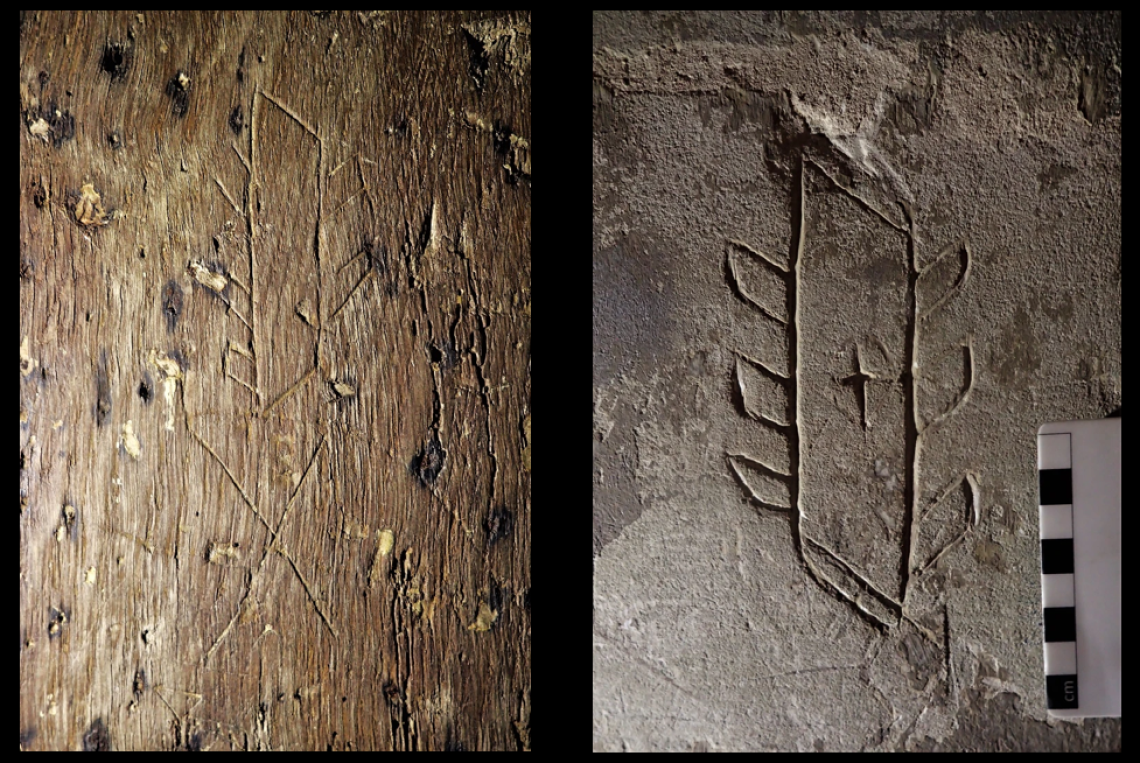


‘Encounter the women of medieval Europe through their own words, visions and experiences, in an exhibition like no other. Discover the rich and complex lives of women in the Middle Ages, with over 140 extraordinary items that reveal their artistry, resourcefulness, courage and struggles.’
British Library programme.
This excellent exhibition throws new light upon the women of Medieval Europe whitewashed out of history by the prevailing patriarchal historiographies. It is heartily recommended for anyone who is interested in medieval history and women’s lives and the contributions that they made to society in the past.
Two items of note may be of interest to RPM devotees; a birthing girdle covered in apotropaic and devotional symbols and the Dartford Retable, an artefact recently restored for Leeds Castle and found to have been both vandalised (during the Iconoclasm) and then subsequently ‘modified’ through the application of compass-drawn circles and graffiti.
The Birthing Girdle
In ‘English Birthing Girdles: Devotions for Women in ‘Travell of Childe,’ Mary Morse examines the texts and images deployed of nine English birth girdles produced between the reigns of Richard II and Henry VIII. She sets out the perceived benefits of the objects; ‘In medieval England, women in labour wrapped birth girdles around their abdomens to protect themselves and their unborn children. These parchment or paper rolls replicated the “girdle relics” of the Virgin Mary and other saints loaned to queens and noblewomen, extending childbirth protection to women of all classes.’
The legendary relic of the Belt (or Girdle) of the Blessed Virgin Mary is today divided into three pieces, is the only remaining relic of her earthly life. According to tradition, the belt was made out of camel hair by the Virgin Mary herself, and at her Assumption, she gave it to the Apostle Thomas. According to Tradition, Thomas was the only apostle absent at the Assumption of the Mother of God. He was grieved to learn of this, but suddenly found himself witnessing the Virgin’s ascent to Heaven. He pleaded with her to give him a blessing; she untied her belt and gave it to him (AC 2022).

Icon depiction the Theotokos giving her girdle to Thomas the Apostle. Below is a stylised representation of Mary’s Tomb, with flowers lying on the sarcophagus. P Barlow. Public domain. Wikicommons.
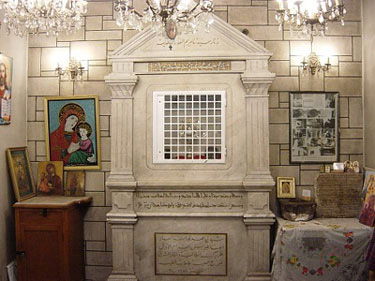
Saint Mary of the Holy Belt is a historical Syriac Orthodox cathedral in Homs, Syria. It is the seat of the Syriac Orthodox Archbishop of Homs and Hama. Public domain. Wikicommons.
The girdles are categorised as, ‘cultural artifacts of lay devotion’ which was practised within the birthing chamber. It was believed that the birth girdles offered, ‘the solace and promise of faith to the parturient woman and her attendants amid religious dissent, political upheaval, recurring epidemics,’ which highlights how the object was a response to the cultural anxieties of the day (Morse 2024).
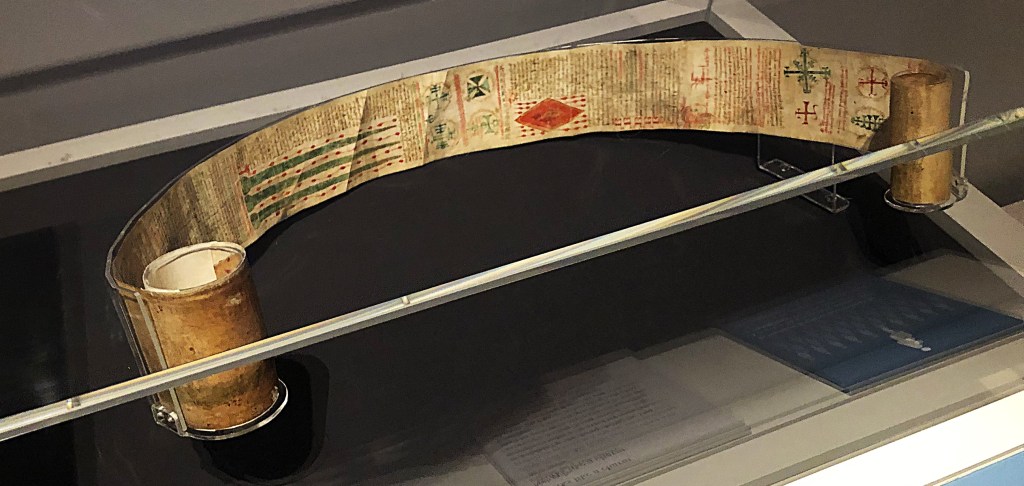
Exhibition label reads: Birth girdle, England, early 15th century. Parchment girdles (waist belts) covered with protective prayers and charms were produced as amulets for use during childbirth. This example includes a life-sized representation (‘measure’) of Christ’s side-wound, through which he gave birth to the Church according to medieval interpretations. Beside it, the text promises ‘if a woman be travailing with child [giving birth] that day, if she has seen the said measure, that day she will not perish’. The British Library, Harley Roll T 11.

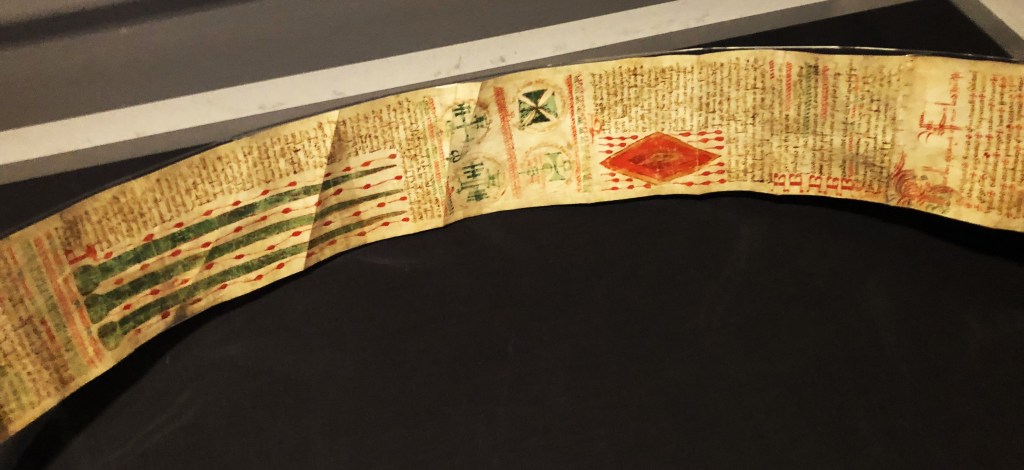

The girdle parchment has been covered in both text and Holy symbols which possessed an apotropaic value, including green crosses and, perhaps, more enigmatically, a representation of the Wound of Christ. The wound (or measure) of Christ is a mandorla which resembles a vulva. A mandorla is an almond shaped aureola used in medieval art to surround the figures of Christ and the Virgin Mary. Geometrically speaking, it is a ‘vesica,’ formed from two overlapping circles. Mandorlas are often painted in several concentric bands of different colour, which become darker in progression to their centre. The Western mandorla first appears in 5th-century mosaics decorating the Church of Santa Maria Maggiore in Rome, where it surrounds certain Old Testament figures. In the late Middle Ages, the mandorla also occasionally enclosed the Virgin in scenes of the Last Judgment and of her Assumption into heaven, reflecting her increased popularity (Britannica 2024).
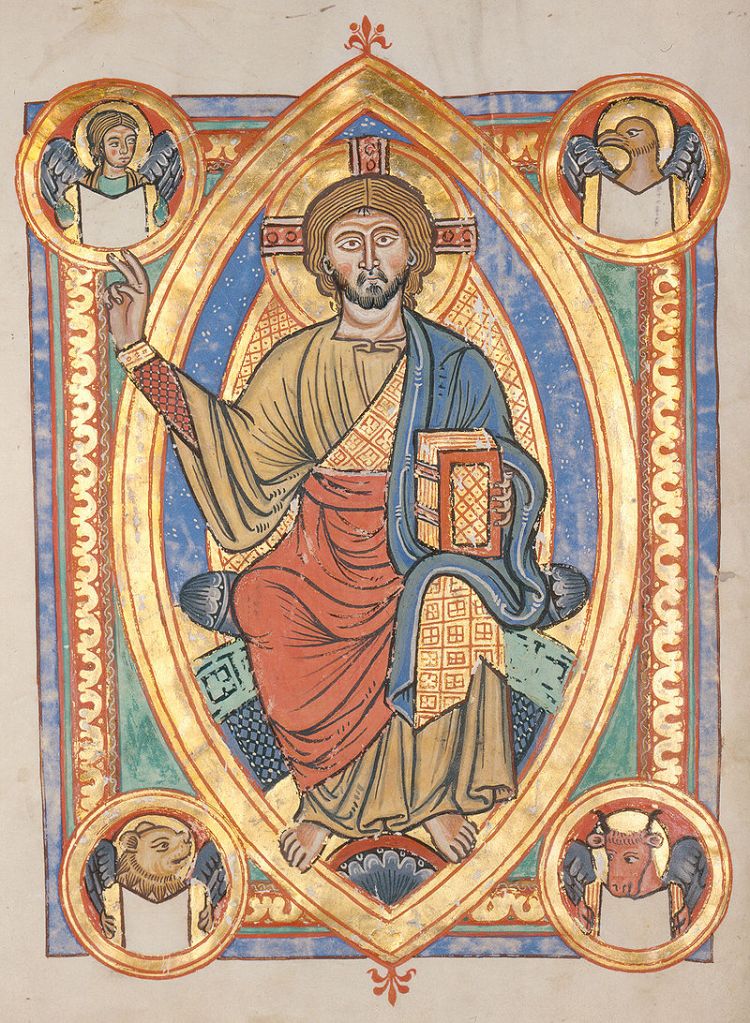
Evangelistar von Speyer, um 1220 Manuscript in the Badische Landesbibliothek, Karlsruhe, Germany Codex. Bruchsal 1, Bl. 1v Shows Christ in vesica shape surrounded by the “animal” symbols of the four evangelists. Public domain. Image © BLB.
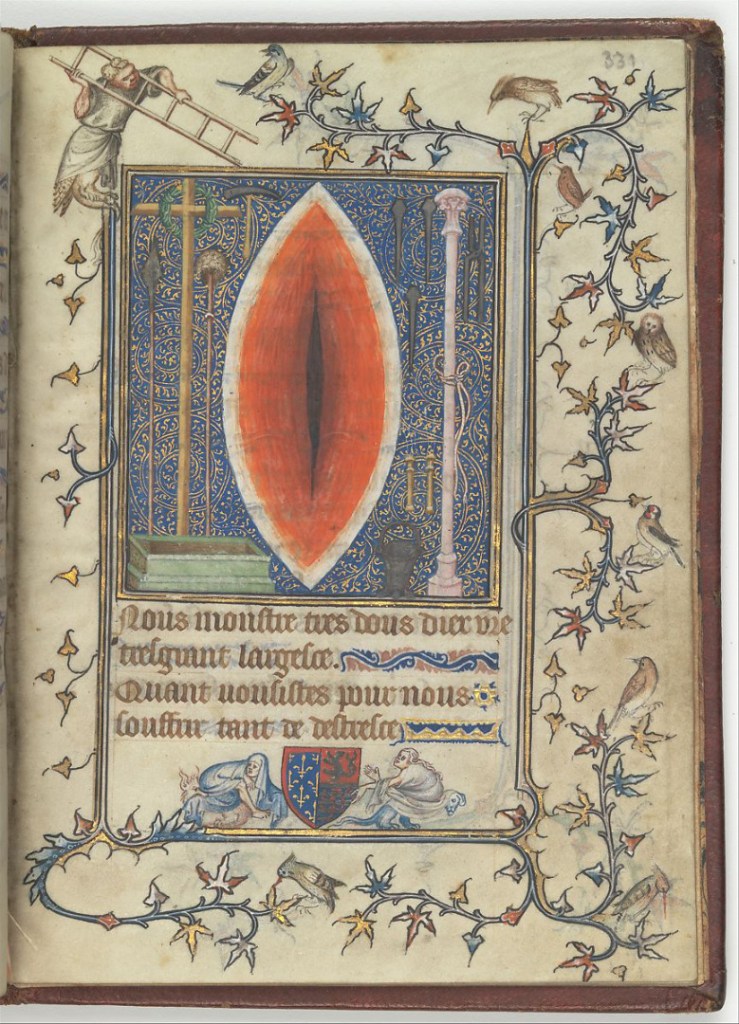
Wound of Christ — Psalter and Prayer Book of Bonne de Luxembourg, Metropolitan Museum of Art, New York, Cloisters Collection
Many of the symbols can be found on other examples of birthing girdles, such as MS 632 which was subject to detailed scientific analysis in 2021.
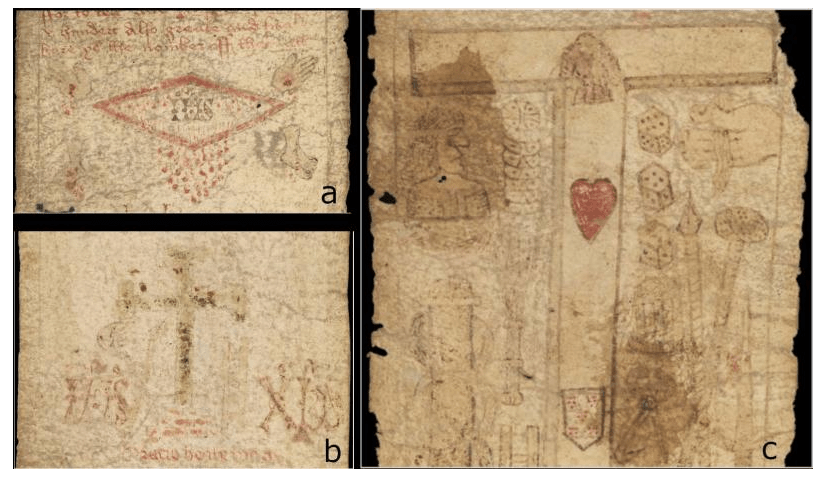
Details taken from MS. 632. (a) MS. 632: the dripping side-wound. (b) MS. 632: rubbed away green cross or crucifix (c) MS. 632: Tau cross with red heart and shield. Images courtesy of Wellcome Collection.
Image C also clearly utilises imagery from the Arma Christi, including dice, Holy Lance and ladder. The ‘weapons of Christ’ otherwise known as the ‘Instruments of the Passion’ are depicted in representations of the Passion of Christ. Although the Passion refers to the short period before the death of Jesus (and several of the events leading up to it), in the minds of the medieval populace it was more literally associated with Christ’s suffering on the cross. It was considered to be the most potent image upon which the devotee should focus, to help direct the intensity of their prayers.
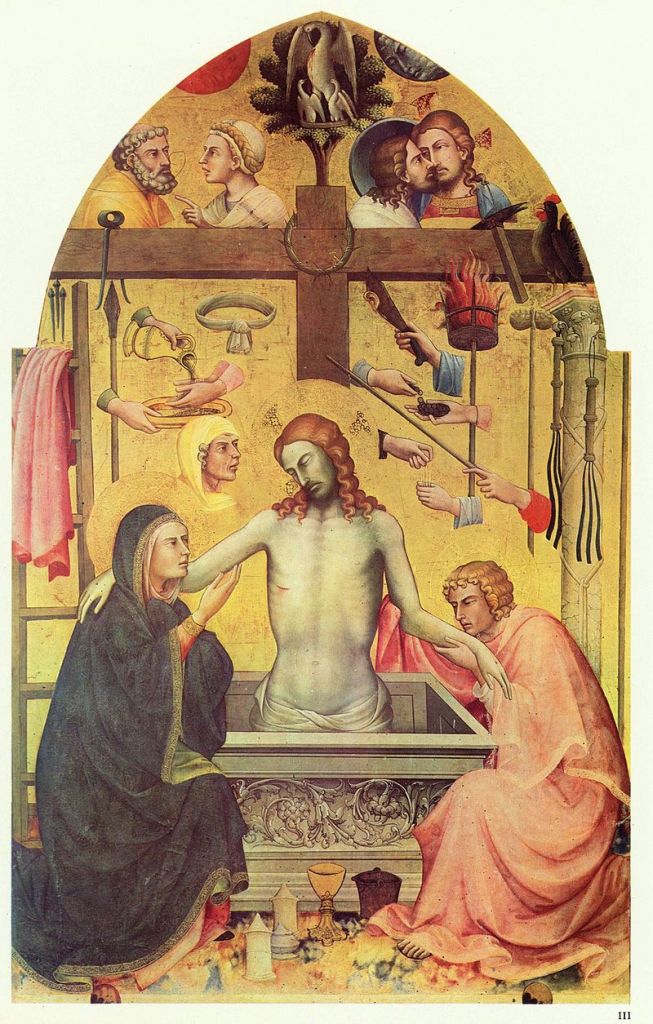
Pietà with Arma Christi, Lorenzo Monaco, 1404. Galleria dell’ Accademia, Florence
The scientific analysis of a 15th century parchment birth girdle (Wellcome Collection Western MS. 632) described the palaeoproteomic evidence obtained from a stained medieval birth girdle using a previously developed dry non-invasive sampling technique. The parchment birth girdle studied was made in England in the late fifteenth century and was thought to be used by pregnant women while giving birth. We were able to extract both human and non-human peptides from the manuscript, including evidence for the use of honey, cereals, ovicaprine milk and legumes. In addition, a large number of human peptides were detected on the birth roll, many of which are found in cervico-vaginal fluid. This suggested that the birth roll was actively used during childbirth (Fiddyment, Goodison et al 2021).
They concluded that, ‘the study was, to their knowledge, the first to extract and analyse non-collagenous peptides from a birth girdle using this sampling method and demonstrates the potential of this type of analysis for stained manuscripts, providing direct biomolecular evidence for active use.’ (Fiddyment, Goodison et al 2021).
This is a significant breakthrough as up to this point academics had argued that manuscript rolls were not created for use in actual childbirth. In her article, ‘‘Yf A Woman Travell Wyth Chylde Gyrdes Thys Mesure Abowte Hyr Wombe’: Reconsidering the English Birth Girdle Tradition,’ Katherine Storm Hindley concluded, ‘I have argued…that the term ‘birth girdle’ has been misapplied to many rolls, obscuring their alternative possible uses as devotional objects or amulets for general protection. Since no evidence remains to suggest that the majority of these rolls were used for girdling women during childbirth, we must reconsider them in the light of other devotional and amuletic rolls: any explanation for the use of the roll format must take into account the existence of rolls containing exclusively non-amuletic prayers’ (Storm Hindley 2023).
But conceded, ‘Even where the ‘birth girdle’ designation is correct, therefore, it is not complete: in order to understand how rolls were used, we must remain sensitive to their full diversity’ (Storm Hindley 2023). Her article really worth look as it is heavily illustrated with examples of surviving girdles.
The birthing girdles are an example of ‘lay devotion’ – a type of ‘sanctioned’ folk magic which was practiced alongside the usual devotions, a kind of syncretism between popular magic and Christianity where, as long as the objects possessed at least some element of Christian iconography, they could pass either unnoticed, tolerated or even encouraged by the clergy. Sometimes referred to as ‘popular’ piety used to designate ‘cultic expressions of a private or community nature,’ according to the Vatican’s Directory On Popular Piety & The Liturgy Principles And Guidelines (2001) , ‘popular piety has rightly been regarded as “a treasure of the people of God” and “manifests a thirst for God known only to the poor and to the humble, rendering them capable of a generosity and of sacrifice to the point of heroism in testifying to the faith while displaying an acute sense of the profound attributes of God: paternity, providence, His constant and loving presence. It also generates interior attitudes otherwise rarely seen to the same degree: patience, an awareness of the Cross in every-day life, detachment, openness to others and devotion”.
References
Armenian Church (2022) Discovery of the belt of St Mary
Britannica (2024) Mandorla
British Library (2024) Medieval Women: In Their Own Words
Fiddyment, S & Goodison, NJ (2021) Girding the loins? Direct evidence of the use of a medieval English parchment birthing girdle from biomolecular analysis. Royal Society
Morse, M (2024) Devotions for Women in “Travell of Childe.” Volume 38 in the series. Research in Medieval and Early Modern Culture.
Storm Hindley, K (2023) ‘Yf A Woman Travell Wyth Chylde Gyrdes Thys Mesure Abowte Hyr Wombe’: Reconsidering the English Birth Girdle Tradition.’ The Courtauld.
Vatican (2001) Directory On Popular Piety & The Liturgy Principles And Guidelines
Further Reading

 Ritual Protection Marks & Ritual Practices
I just came across your blog and this specific post. This very manuscript and Hindley’s argument has been the source of my research! I am so pleased to see energy behind this subject matter!
LikeLike