
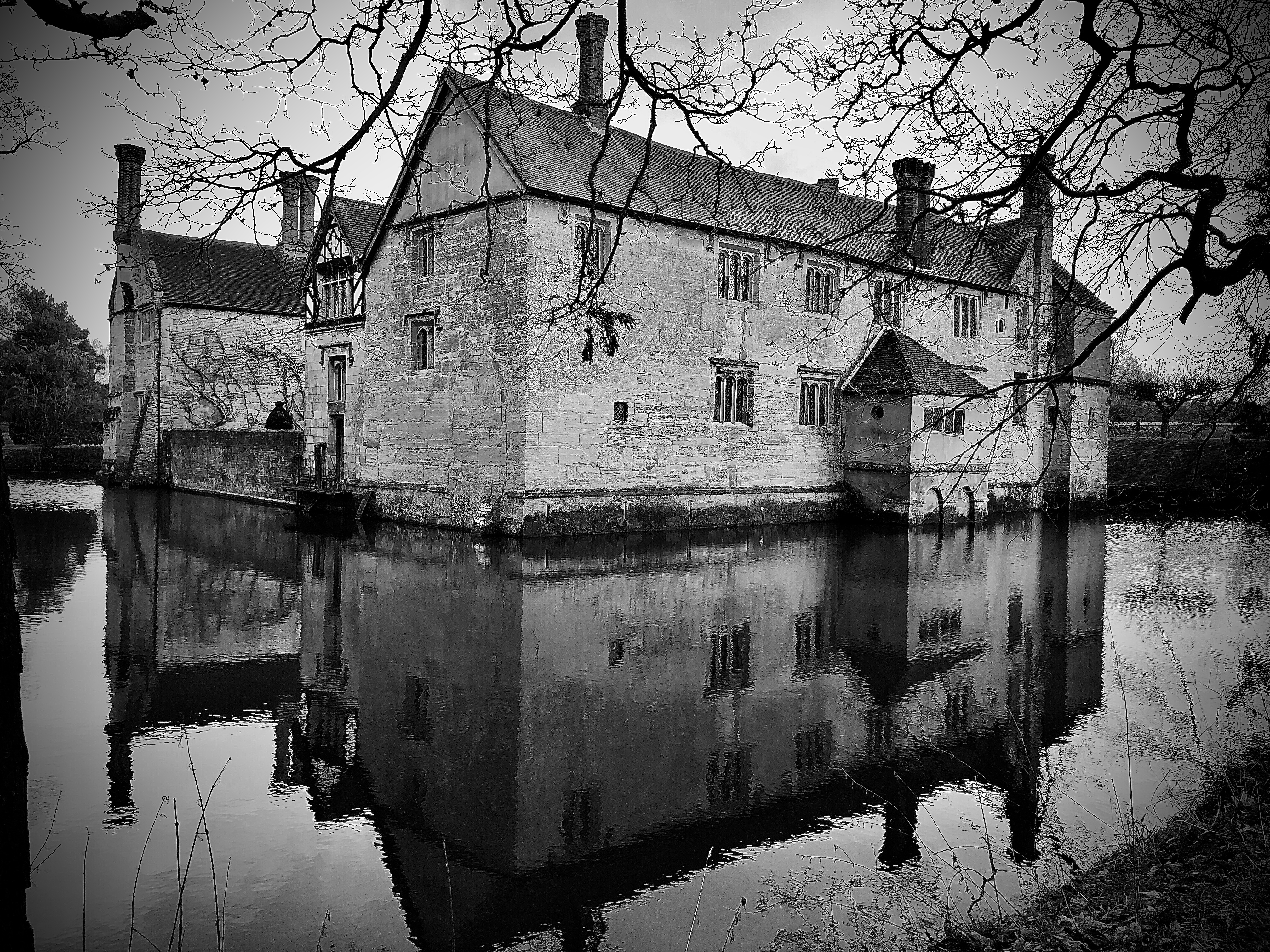
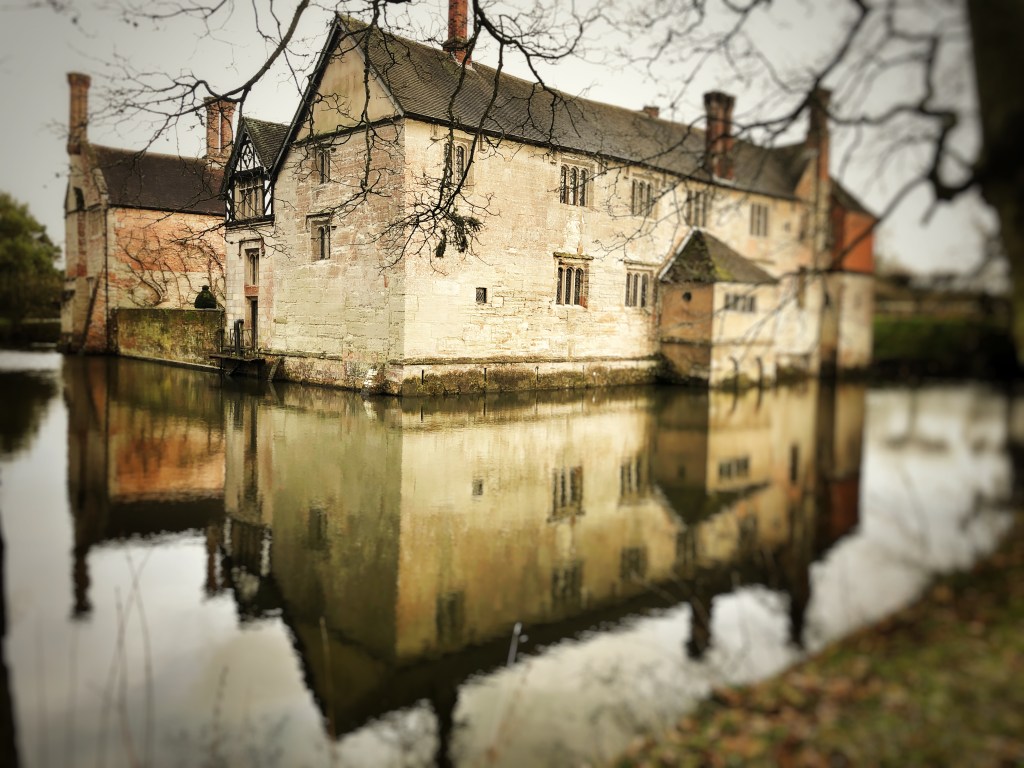
South elevation, view to the north-east.
Photo © Wayne Perkins 2024.
Baddesley Clinton Hall is a medieval moated site (List Entry Number: 1013155) and is a rare example of this class of monument, as the site survives in a near-complete condition, with the house intact within the moat. It is a Scheduled Ancient Monument, now in the care of the National Trust. It is located within the county of Warwickshire (Historic England 2024).
According to the Trust (2024), ‘the site has Saxon origins, although no buildings from the time remain. A man called Baeddi, Badde or Bade drove his cattle up to the Forest of Arden and made a clearing in the wood for extra grazing. It would have been protected from predators with a ditch and wooden palisade. Such a clearing was known as a ‘leah’ or ‘ley’ – hence Badde’s Ley.’
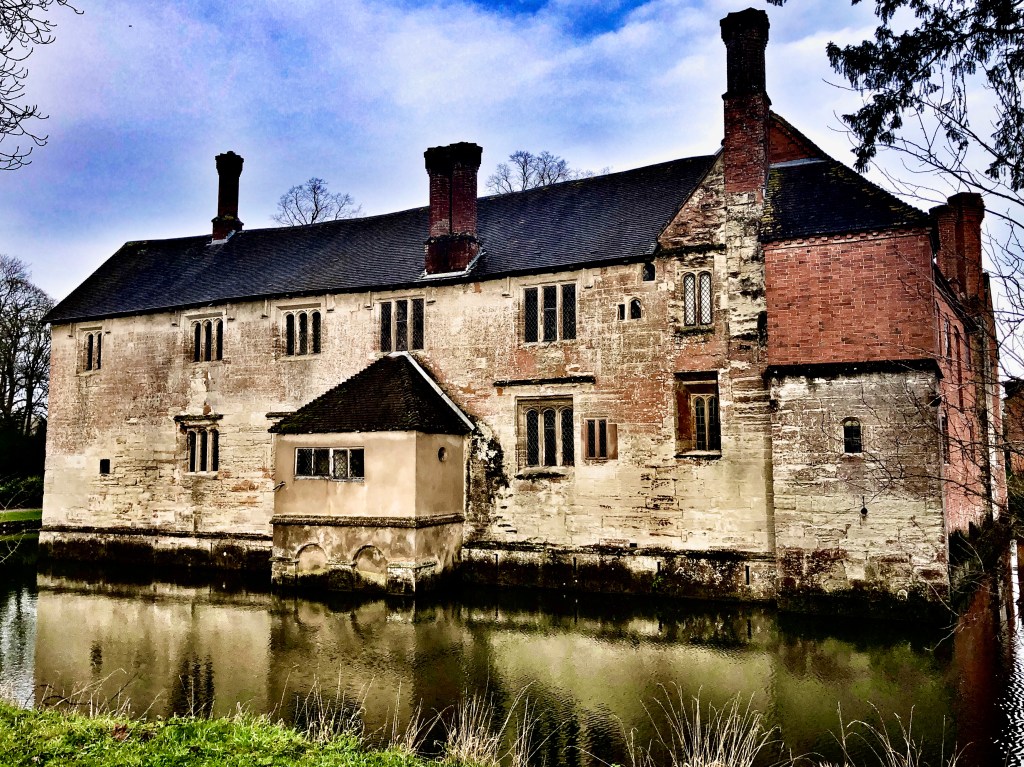
South elevation, view to the north.
Photo © Wayne Perkins 2024.
After the Norman Conquest the estate was granted to Geoffrey de Wirce, considered to be ‘of noble birth’ and later to Nigel d’Albini, ‘an Andegavanian knighte.’ The manor then passed through numerous hands; Around 1100 Roger de Mowbray gave the Baddesley the estate to Walter de Bisege (Salzman 1947). It then passed to Sir Thomas de Clinton in about 1290, and the name of the estate became Baddesley Clinton (NT 2024). Next came the Bromes and then the Ferrers through marriage. They were descended from Henri de Ferrières, a nobleman who was Master of the Horse to William the Conqueror at the Battle of Hastings. It became their home for 500 years. A full list of the owners can be found on the National Trust website and a detailed inventory and description of the house can be found on the Historic England’s relevant webpage.
The hall has been described as a, ‘semi-fortified manor-house surrounded by a moat, and approached by a drawbridge. It now consists of three sides (or ranges) of an approximate rectangle, having lost its west range. The internal courtyard was originally about 57 ft. north to south and 37 ft. east to west, and was not a true rectangle, the west and north sides being a little longer than those opposite them; the ranges are roughly 25 ft. deep. The moat averages about 30 ft. in width on three sides and about half that width on the east. The entrance front with a gatehouse is towards the north. All the ranges are of two stories’ (Salzman 1947).
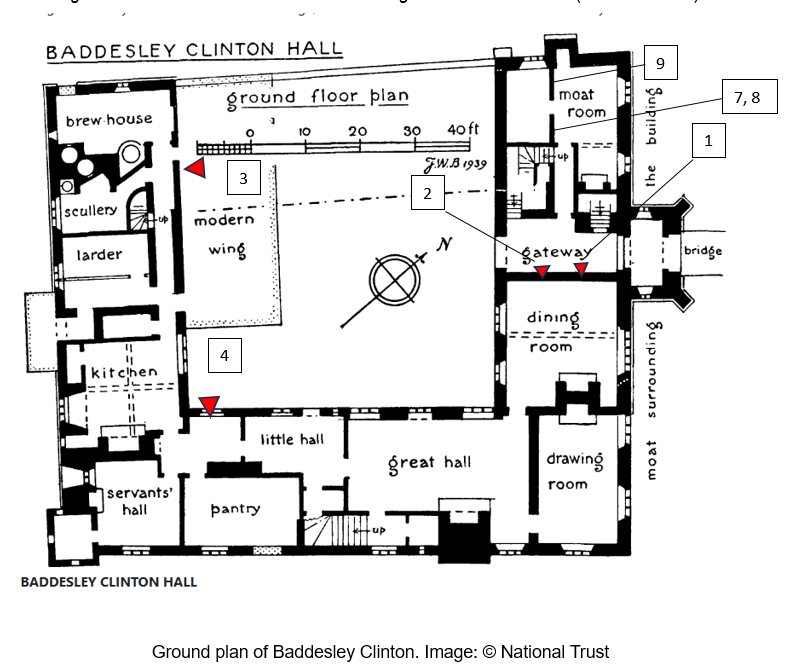
The house is now entered by the 18th century brick-built bridge which replaced the former drawbridge. It leads directly to the Gatehouse which was built to guard the entrance to the central courtyard. Several apotropaic devices have been added to the masonry of the interior, along with a series of palimpsests, comprising initials and other ineligible symbols.
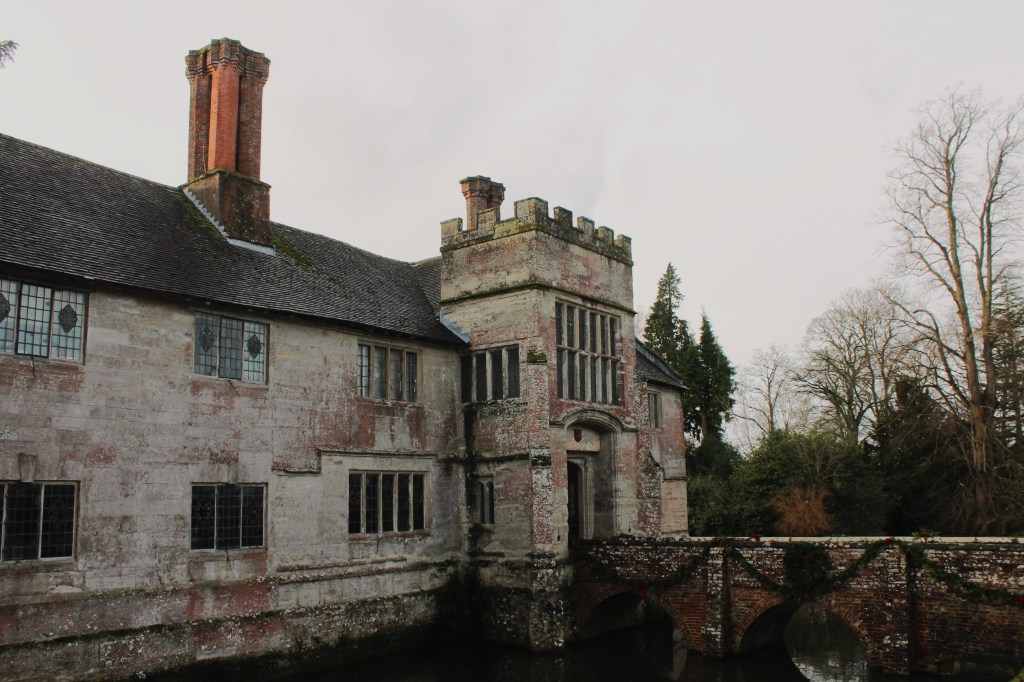
Bridge over the moat leading to Gatehouse Baddesley Clinton.
Photo © Wayne Perkins 2024.
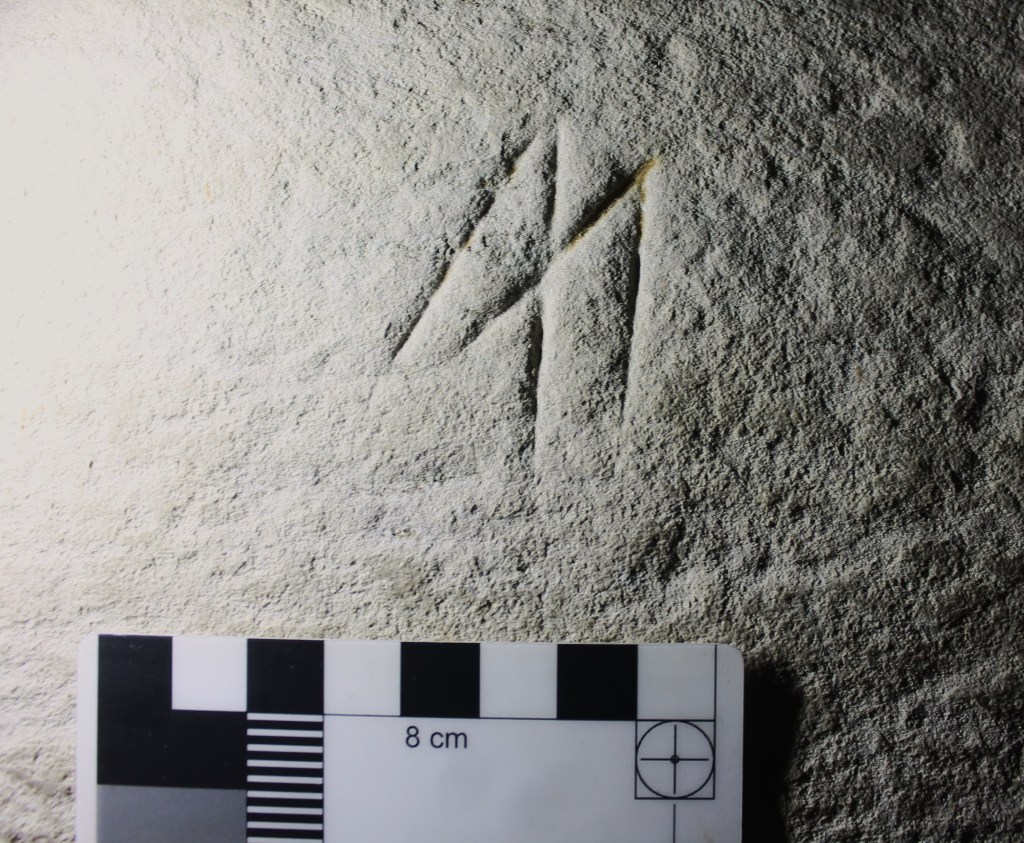
[1]. The masonry wall between the gatehouse and the Courtyard bears a number of apotropaic markings including this deeply (although small) Marian mark1. Most are located along the left-hand side (south-east wall).
Photo © Wayne Perkins 2024.
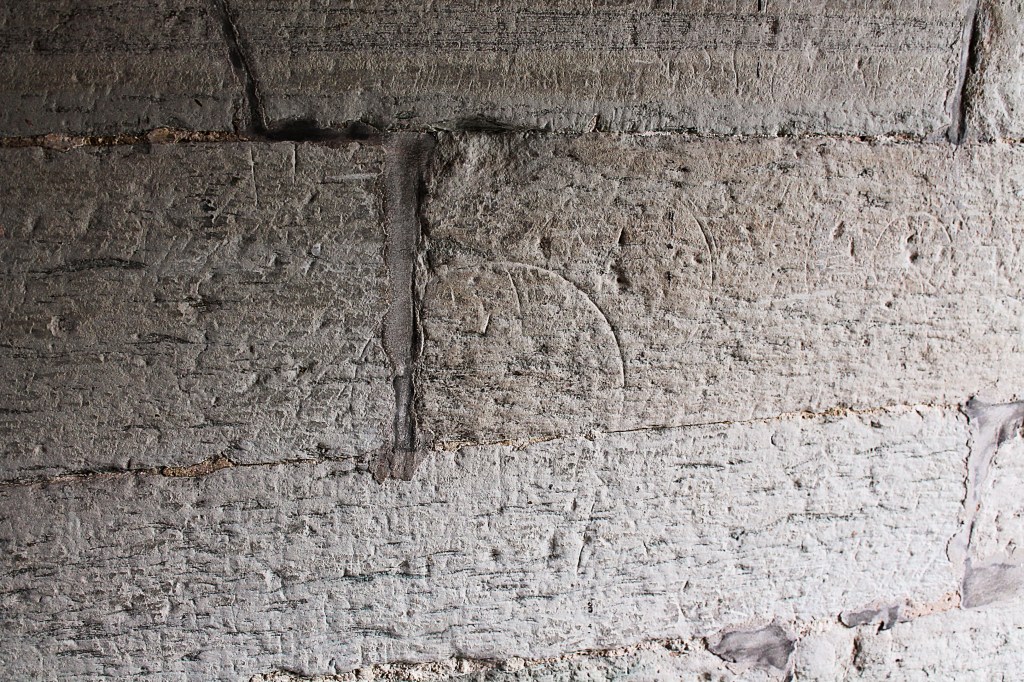
[2]. Also on the left-hand side of the entrance corridor are a number of compass-drawn circles of large size (Type 1a), the one on the left is about 20cm in diameter, some are concentric circles (Type 1b)2. A longer discussion about the apotropaic merits of compass drawn circles has been published by the author3.
Photo © Wayne Perkins 2024.
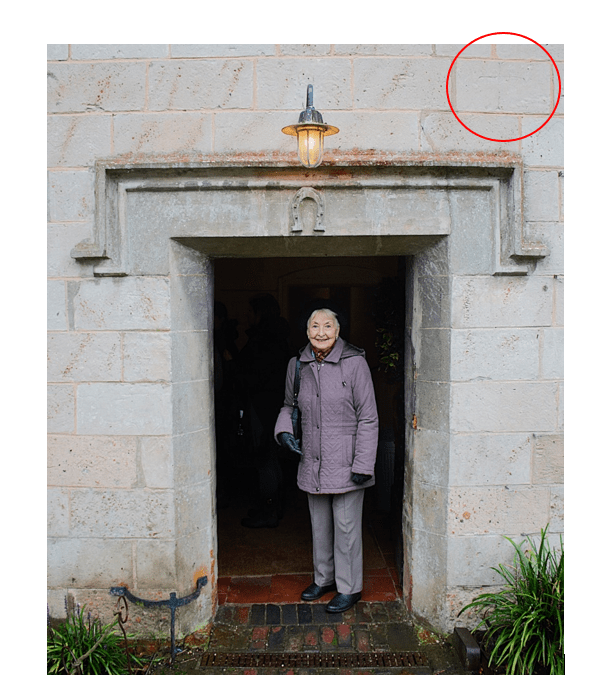
[3] The carved stone lintel above the door features a horseshoe in bas-relief, part of the Ferrers coat of arms. The word derived from the French and is associated with blacksmithing and horse shoeing. An incomplete ‘cross moline’ has been cut into one of the blocks above the doorway. My 88-year-old mother, Myrna Perkins, is a keen graffiti aficionado and acts as a scale.
Photo © Wayne Perkins 2024.
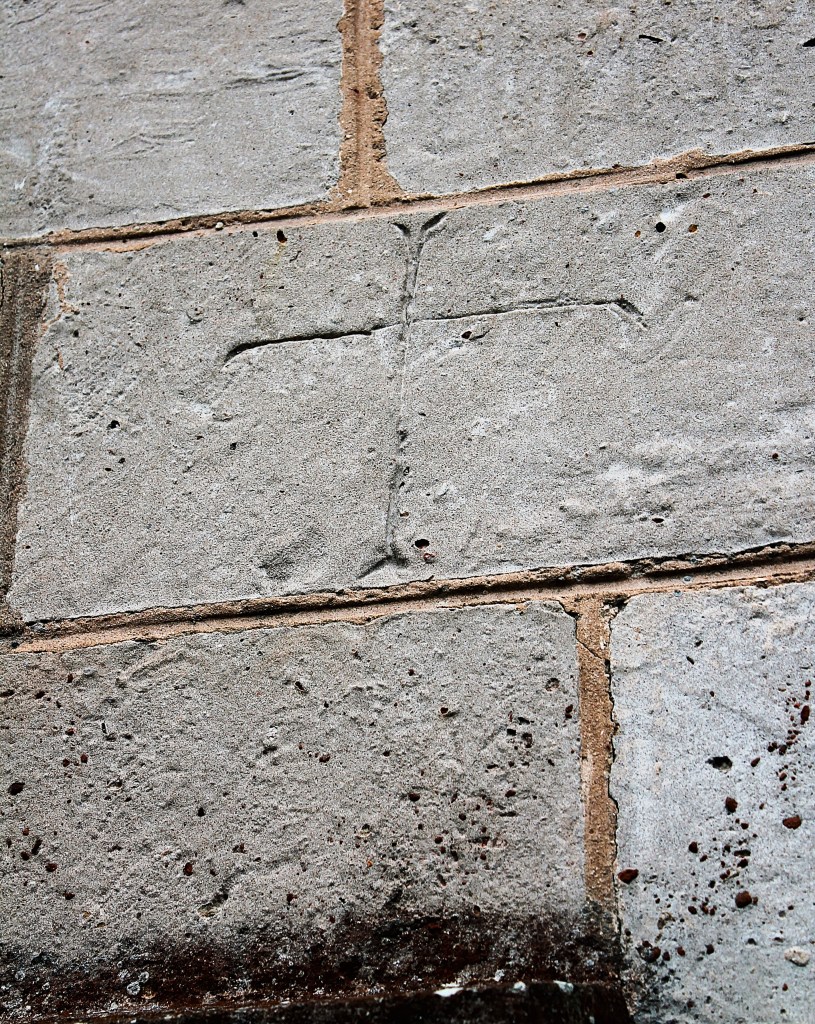
[3] Incomplete cross moline graffito4.
Photo © Wayne Perkins 2024.
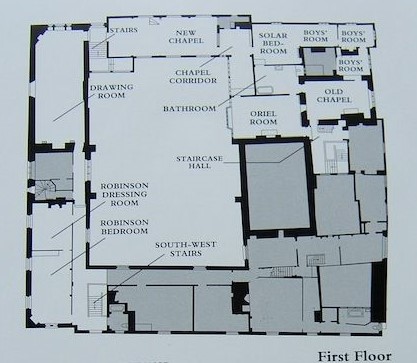
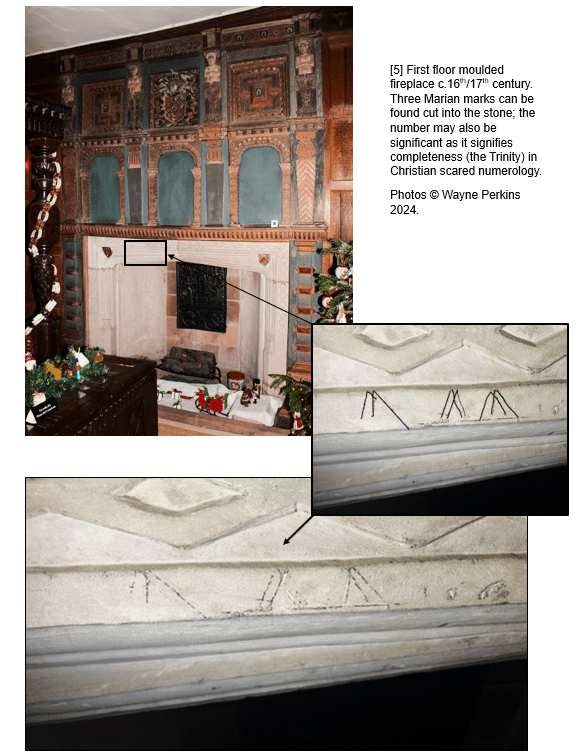
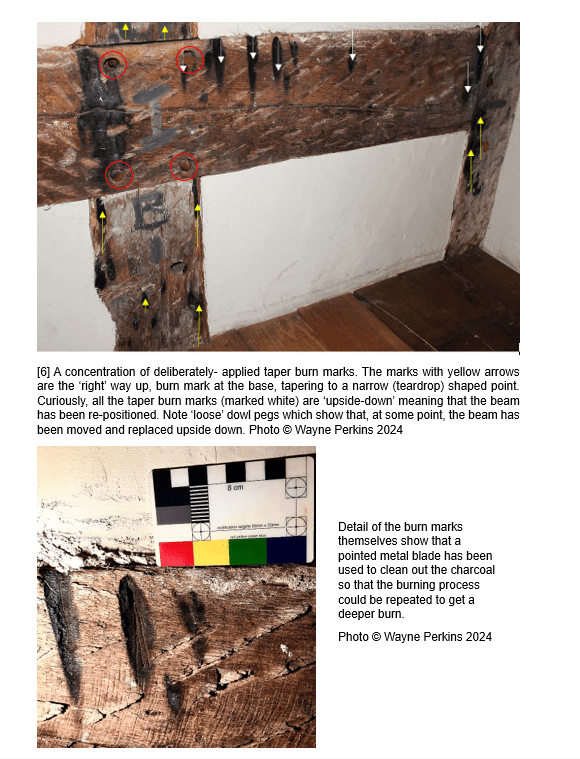
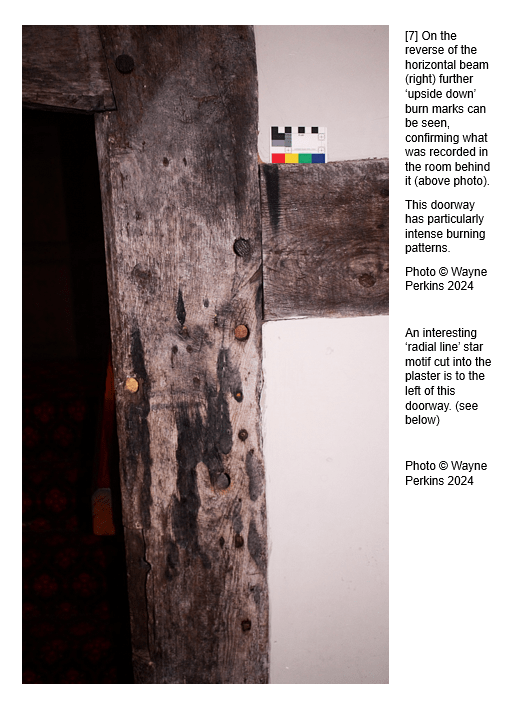
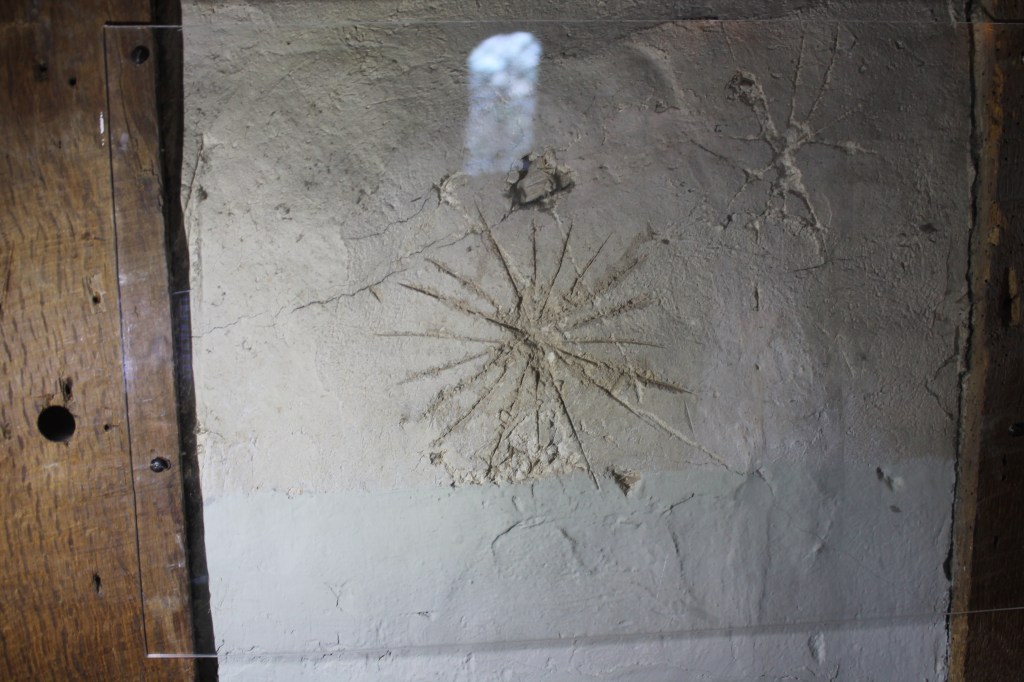
[8] Two sets of radiating lines (made through a central point), sometimes interpreted as a ‘star’ or solar motif. The larger of the two is composed of eighteen points (or nine strokes). The smaller of the two is poorly and less accurately executed.
Photo © Wayne Perkins 2024
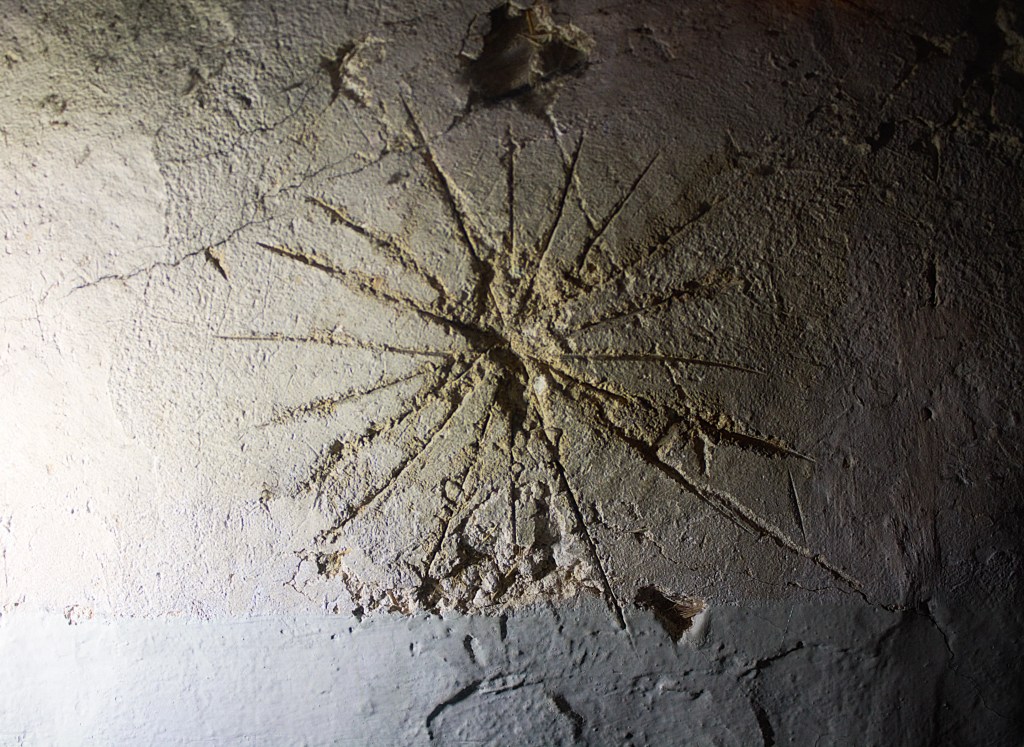
[8] The lines have clearly been cut with a pointed metal blade, probably a commonplace paring knife.
Photo © Wayne Perkins 2024
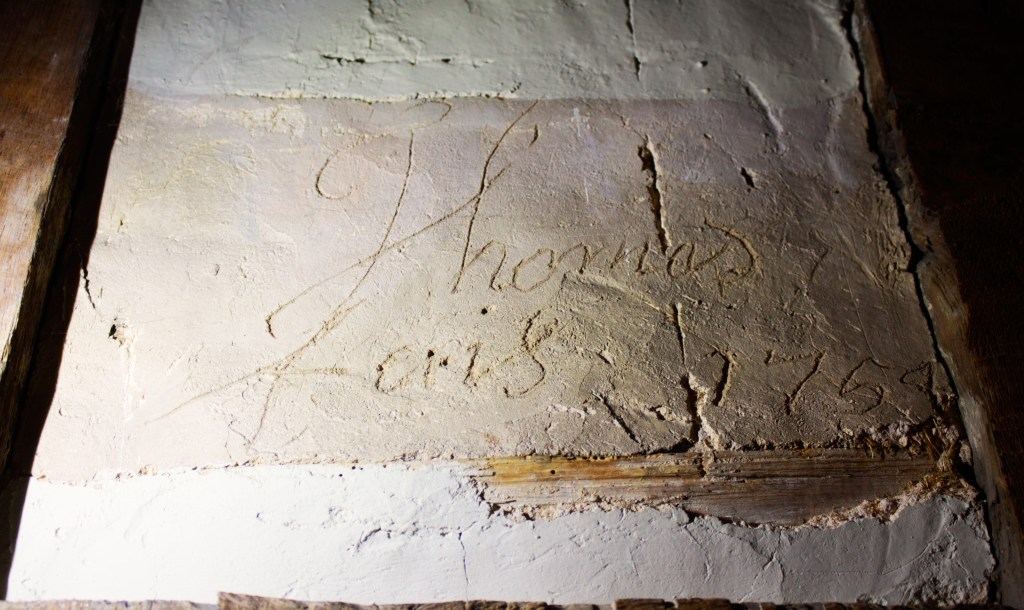
Directly above the motifs is the signature of one ‘Thomas (F?)aris/ fais (?) 1754. Enhanced version below.
Photo © Wayne Perkins 2024
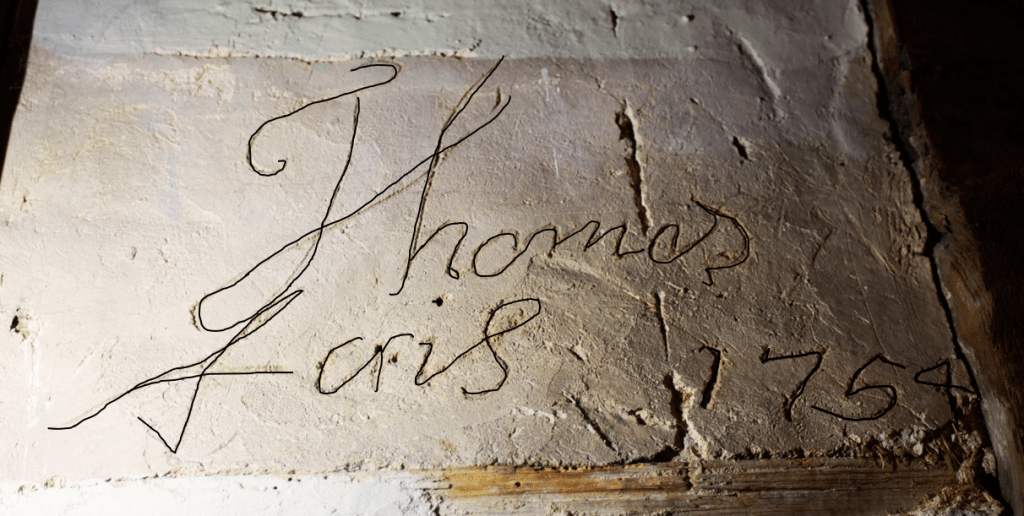
Enhanced version.
Photo © Wayne Perkins 2024
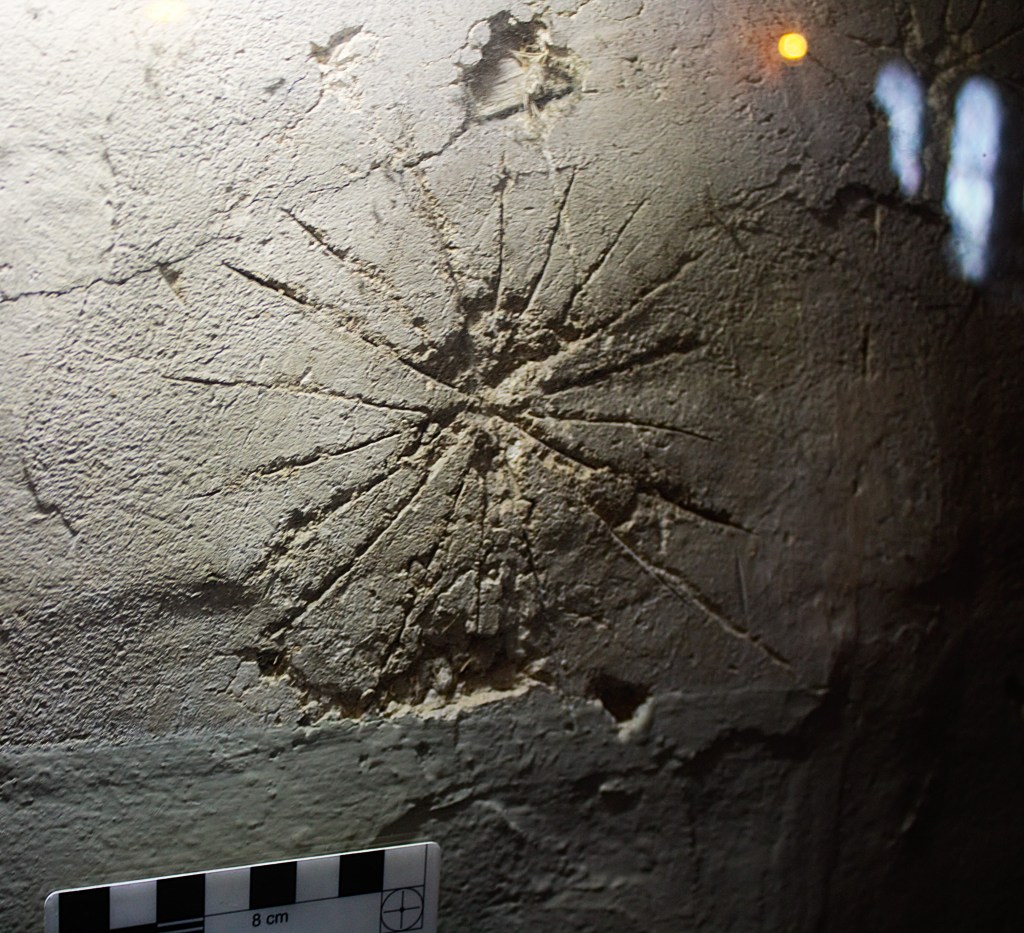
[8] The larger of the radial designs is c. 12cm in diameter and now under perspex. Scale 800mm.
Photo © Wayne Perkins 2024
Discussion
There is nothing particularly unusual nor unique in the corpus of graffiti or the assemblage of marks recorded at Baddesley Clinton. Almost identical marks have been found by the author at Ightham Mote (Perkins 2020) and similar results have been culled from Knole House (Wright 2015), Sissinghurst Castle (Champion 2017) (both in Kent) and from Llancaiach Fawr Manor in Wales (Hoggard & Jessup 2017). In nearly every case, it could be demonstrated that the majority of the marks belonged to the later, 16th-17th century components of the buildings.
The one motif which escapes identification is the one composed of radiating lines as it is crudely cut and asymmetrical, suggesting that it is an almost ad hoc addition cut into the plaster. Similar designs are known from graffiti studies but usually contained within a compass-drawn circle and which radiate out from a central point, resembling a mass/scratch dial. It is reminiscent of the alchemical symbol for salammoniac, which is a rare, naturally occurring mineral composed of ammonium chloride (Wikipedia 2024), but that may be an over interpretation.
In graffiti studies, many of the marks which have been recorded from Medieval contexts seem to re-appear in identical form during the Early Modern Period (c. AD 1450 – 1800). This has led to some interpretative confusion. Even though the same marks were being used, they were being deployed in two very different ‘social’ contexts. It is likely, therefore, that even though they may have retained some of their original qualities, their ‘meaning’ had changed for the individuals employing the marks. Today, it is this recontextualization of some of the key symbols within the corpora of graffiti which is occupying the minds of most researchers.
During the 16th/17th century, a shift had occurred, from a narrow repertoire of graffiti symbols being used almost exclusively in ecclesiastical buildings to them appearing in secular contexts. It appears to represent a period of the appropriation of ‘holy signs’ by the elite in society, taking them into their homes to protect their households. Research and surveys undertaken in domestic houses have shown that protective symbols were common in the homes of tenant farmers, merchants, artisans and the gentry (Wright 2016: 72).
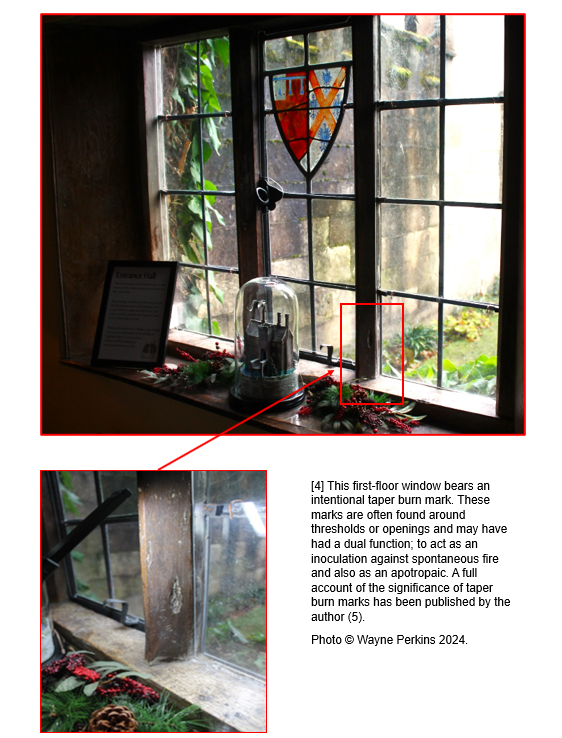
A survey of Sissinghurst Castle revealed a range of apotropaics, from graffiti to ritual taper burn marks, ‘In all cases the markings.. (were)…seen as ‘warding off’ evil – the non-specific and spiritual evils that threatened the peace of the household, and the very real evil of fire and thunderstorm. The distribution patterns observed across both the north and south wings do suggest that the markings are associated with areas of the building that might be considered vulnerable – chimneys, roof spaces and doorways’ (Champion 2017:34). At Knole House, Wright (2016:72) had also discovered that, ‘…in high status houses…clusters are found around windows, doors and fireplaces.’
It is a pattern repeated here, as Baddesley Clinton, which was an elite residence which had undergone repeated modification and restoration over the centuries. Most of the ritual protection marks were found relating to the thresholds, entrances and openings to the Hall.
The author recommends that a full buildings archaeology survey is undertaken at the Hall to include the symbols and marks included in this short article.
The ‘ritual’ marking of such high-status buildings is explored in my book, ‘A Consensus of Symbols: Patterns in Ritual Building Protection,’ which will be published in 2025.
N.B. This article is the result of a brief visit to the Hall and does not constitute an archaeological survey. However, a number of apotropaic devices were noted on the fabric of the building and on some of the architectural features within the residence.
Wayne Perkins
BA (Hons), Associate Member Chartered Institute for Archaeologists
December 2024.
Notes
- Marian marks have been found inscribed and decoratively carved into pew and bench-ends (Easton 2013a), cut into rood screens; on parish chests; used on craft men’s’ tools, incorporated into the raised designs on cast-iron fire-backs (Easton 2013); cut into the lead linings of fonts or the lead of church roofs (Easton 2013b); used as relief-design on pilgrims’ lead ampullae (Spencer 1990); incorporated into merchants’ marks on lead jetton and tokens; cut into the surface of medieval wall paintings and marked onto plaster ceilings using the tallow from candles (Easton 2013a) and chiselled into the walls of cave systems (Binding, Binding & Wilson 2004, 2010). As an ‘overt’ apotropaic it has been recorded as having been incorporated into taper burn marks (Perkins 2022:00) Its frequent deployment in a variety of contexts as well as its ubiquity in ritual protection mark assemblages led Champion to conclude that it is it is, ‘one of the three apotropaics (which), taken as a group, are considered to have represented (the core of) a level folk belief that permeated the whole of medieval society’ Champion (2015: 27-28).
- Graffiti typology follows that set out by Matthew Champion on the Norfolk Medieval Graffiti Survey website. http://www.medieval-graffiti.co.uk/page11.html
- Return To The Source https://ritualprotectionmarks.com/2022/11/15/return-to-the-source/
- A detailed explanation of this type of cross can be found on the Draw Shield website: https://drawshield.net/reference/parker/c/cross/moline.html
- Incendiary Behaviour
A taper burn mark can be identified by its ‘teardrop’ shape – not unlike that of a candle flame – being round at the base and narrowing to a point, which is the result of the way the flame was applied to the timber. Its characteristic shape is the result of a ‘controlled’ flame having been deliberately applied to a timber element within a building using a taper. A taper is a long, thin candle that was used for lighting fires, whose design was intended to create a long, steady flame. It is now generally agreed that the taper –rather than a candle or a rush light – was the most likely choice of ‘tool’ to affect the desired result.
Bibliography
Champion, M (2015) Medieval Graffiti. Ebury Press.
Champion, M (2017) Graffiti Survey Record: Sissinghurst Castle, Kent. Client: The National Trust. Analysis & Interpretation
Historic England (2024) Baddesley Clinton Hall moated site and fishponds List Entry Number: 1013155
Hoggard, B & Jessup, A (2017b) ‘Llancaiach Fawr Manor: Fortified Against Evil’ in, Hidden Charms 2: A Conference Held at the Medieval Rooms, Salisbury 2018. Northern Earth Publications.
National Trust (2024) Baddesley Clinton Hall: History
Perkins, W (2020) ‘Sealed Against Spirits: Evidence for Ritual Protection Marks & Practices at Ightham Mote, Kent.’ RPM Publishing, London. Treadwells Online https://www.treadwells-london.com/
Perkins, W (2022a) Return To The Source. Online article.
Perkins, W (2022b) Incendiary Behaviour! Online article
Perkins, W (2025) A Consensus of Symbols: Patterns in Ritual Building Protection. Small Press. Forthcoming
Salzman, L F (1947) ‘A History of the County of Warwick: Volume 4, Hemlingford Hundred’ in, Victoria County History.
Wikipedia (2024) Baddesley Clinton
Wright, J (2015) The Instruments of Darkness Tell Us Truths: Ritual protection Marks and Witchcraft at Knole, Kent. Transcript for a lecture given at the Museum of London, 19th October 2015. Gresham College.
Wright, W (2016) ‘Cultural Anxieties & Ritual Protection in High-Status Early Modern Houses’ in, Hidden Charms 2016 Proceedings. Northern Earth Publications
Online Resources
Baddesley Clinton Britain Express
Gundred de Ferrers
Witch Marks / Witch’s Mark
The author does not condone the erroneous term ‘witch marks’ currently being used to describe ritual protection marks, or more properly, apotropaics. The term ‘witch’s mark’ relates to the teat, blemish or protuberance that was believed to exist upon the body of a witch by which she would feed and nurture her familiar animal.


Thanks Wayne, we were up there last week….We often visit, so I’ll print this and go investigate! Happy New Year, Brad…….. By the way, BC has an awesome second hand bookshop. B
LikeLike