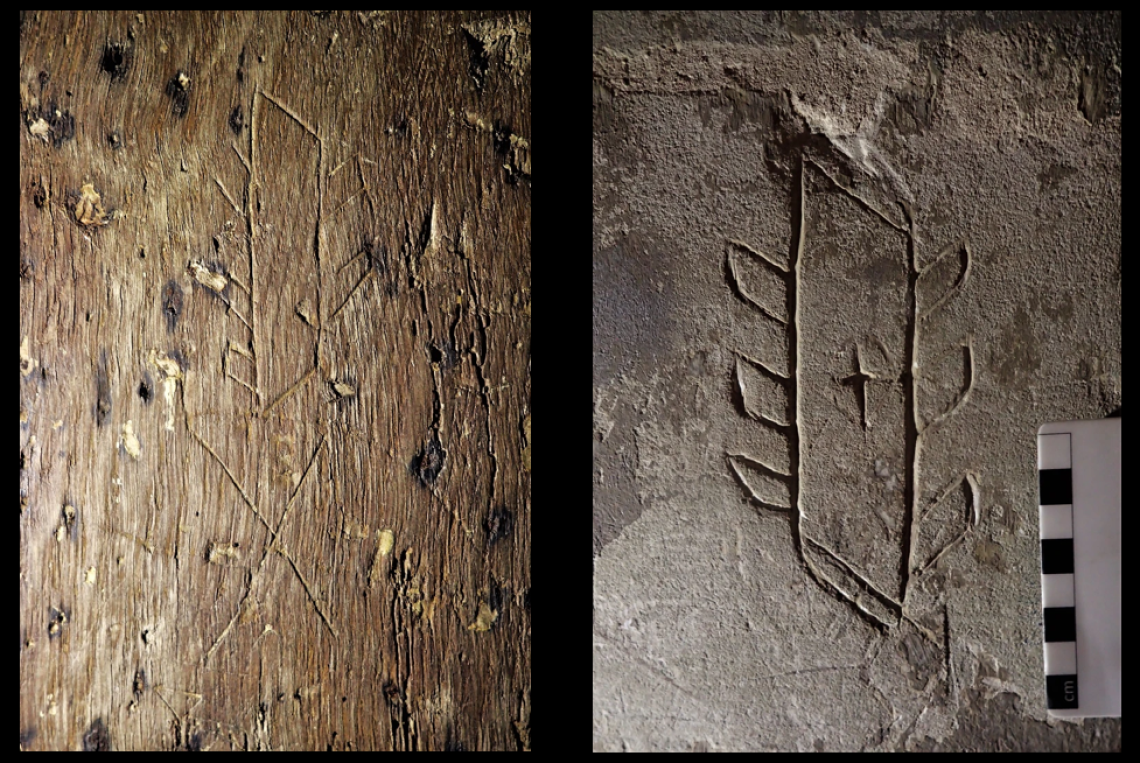

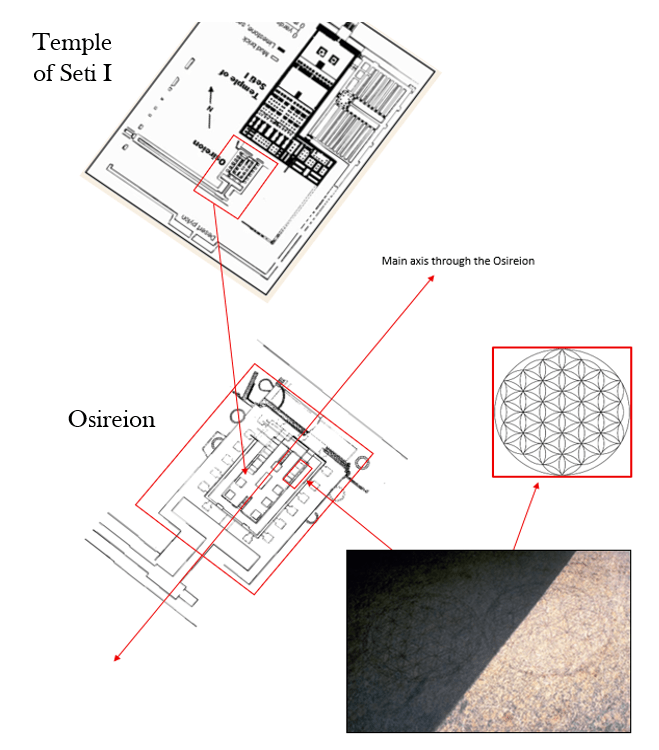
Some of the motifs collected in the corpora of Medieval graffiti are derived from ancient antecedents, which has led many researchers to try and trace their origins. The six-petal rosette (also known as the hexafoil or daisy wheel) is one of those motifs. When expanded to an overlapping grid of circles (or net) pattern, it is often referred to as the Flower of Life symbol. This is a term which is most often associated with the New Age movement of the 1990’s.
The identification of such a motif, rendered in red ochre on a trilithon within the Osireion in Abydos, Egypt, gave way to much speculation. It was believed that this was the earliest example of the six-petal rosette having been deployed within a religious context on an Egyptian monument. However, this interpretation soon came under question………
Differing reports have claimed that a number of rosette designs were present (eight or more of varying sizes), although the two largest are the clearest and reproduce on photographs with better clarity than the smaller versions.
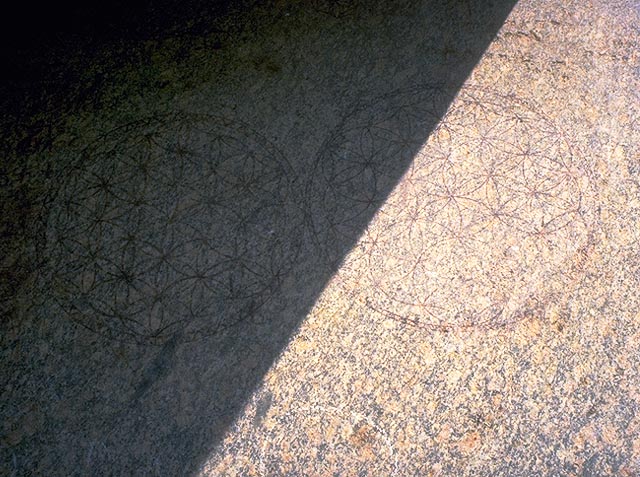
The motifs were to be found in one location within the complex and they were clearly not part of the original decorative scheme. Also, there were no known precedents in the Egyptian temple art recorded elsewhere. Additionally, they were located four meters from the temple’s floor (and off-set from centre), which suggested that they had been made when the structure had been abandoned and had filled with sand. Further investigation made it clear that they were associated with other graffiti on the trilithon which was clearly versions of early Greek.
The Osireion is part of a complex associated with the Temple of Seti I but many believe it may may have been built much earlier – even though the two structures appear to form a ‘complex.’ The former is believed to have been constructed as a cenotaph for Seti I, the latter built to commemorate the older Pharaohs of Egypt and the major gods of the Egyptian pantheon.
Flinders Petrie and Margaret Murray excavated there at the beginning of the 20th century and were just two of the many researchers to find that both buildings were covered in graffiti from different cultures which spanned centuries.
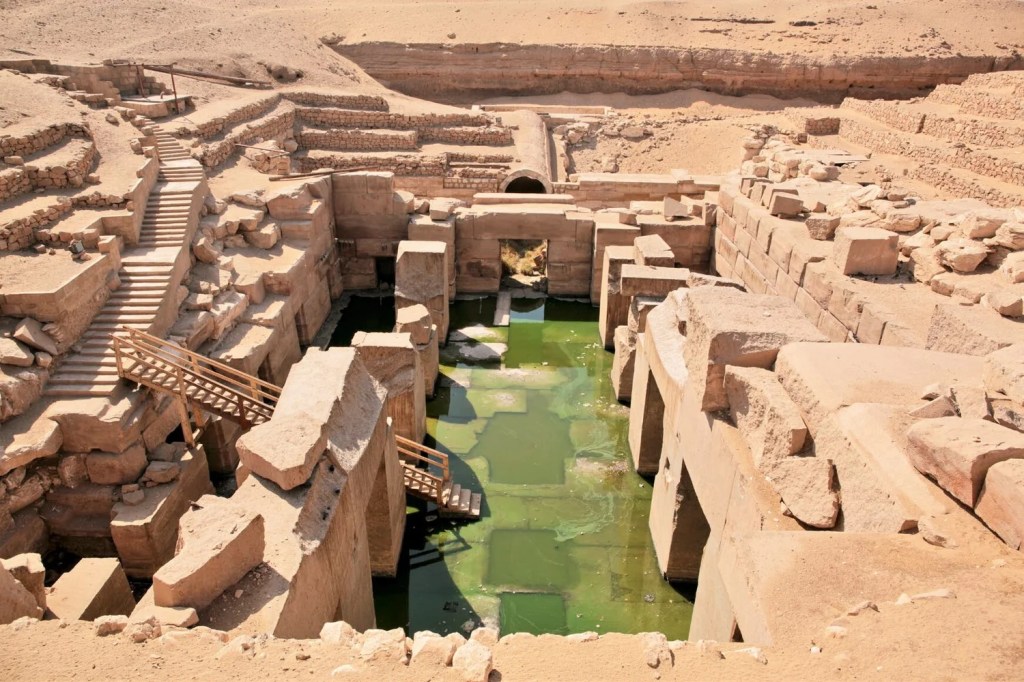
It has since become clear that the ‘Flower of Life’ symbols found at Abydos date to a much later period and were most likely added during the 1st century BC, possibly by Greek visitors (of which both Pythagoras and Strabo were believed to count among that number).
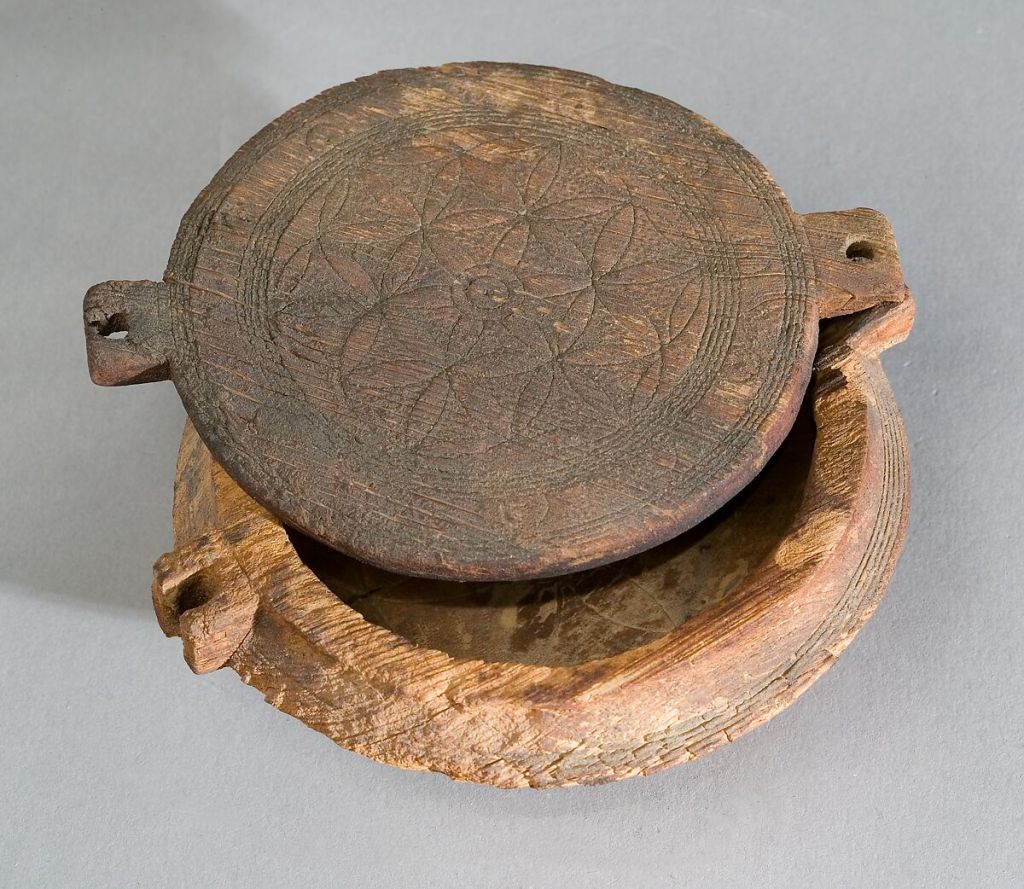
A much safer identification and date for the six-petal rosette in Egypt is in the form of a Cosmetic Box (New Kingdom ca.1550-1458 BC), recovered from the tomb of Hatnefer. The tomb was located below the chapel of Senenmut and excavated by the Egypt Expedition of 1916, which had found it placed near to the head of the burial. Tellingly, this dates from a period of known trading contacts between Egypt and the Greek world.
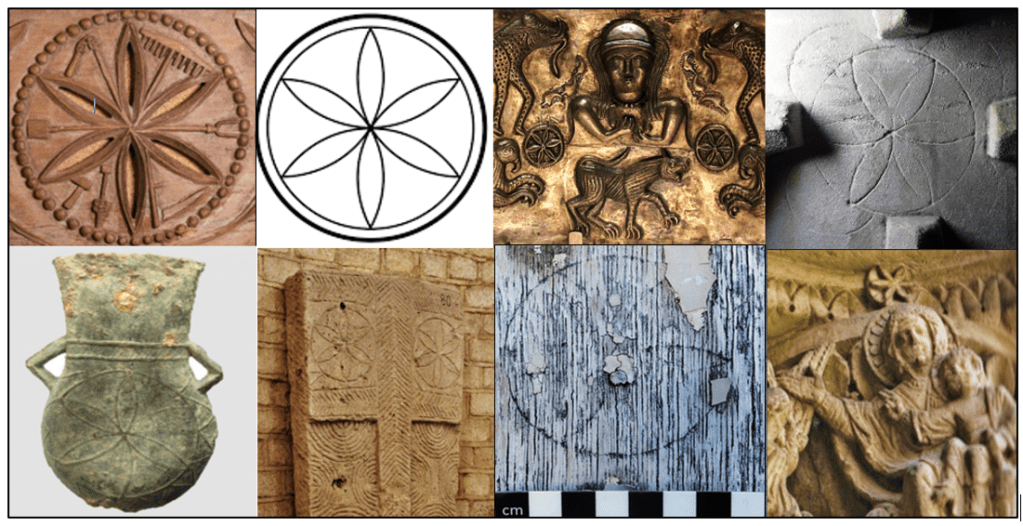
In the Mediterranean, there are securely dated examples of the six-petal rosette motif that have been found on artefacts from funerary deposits dating from the Late Bronze Age (ca. 1750 – 1050 BC) onwards. Although still a mystery, the birthplace for the motif is believed to originate somewhere in the Eastern Mediterranean and may be linked to the invention of the drawing compass (set of dividers).
The ‘Flower of Life’ – or where it existed as a single six-petal rosette – was a motif often associated with rebirth and found within funerary contexts. By the medieval period it was often deployed on fonts of early western European churches where it maintained its ‘positive’ connotations.
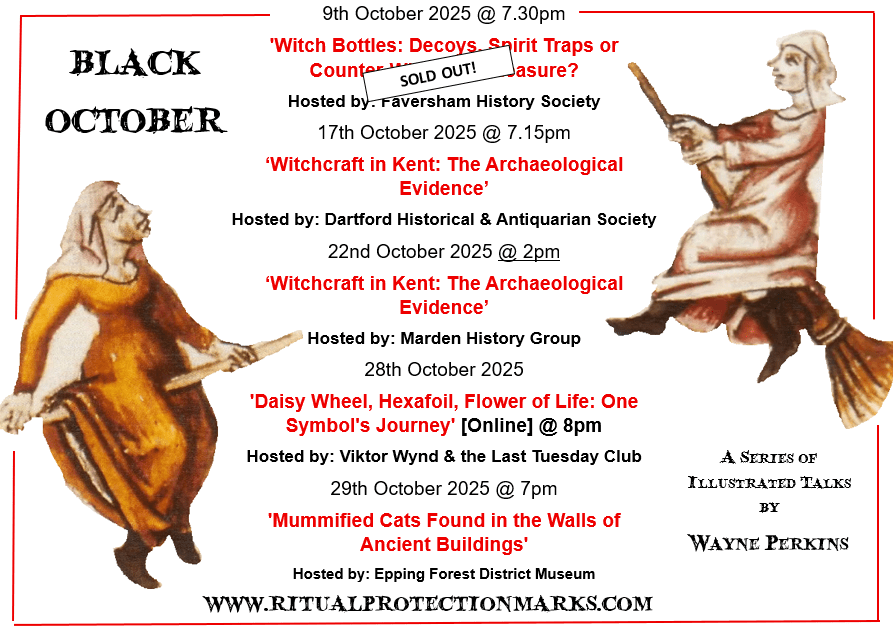
Join me on my next online talk for The Last Tuesday Society to learn more about this fascinating symbol….
Wayne Perkins
London, October 2025
Further reading
Cosmetic Box with a Swivel Top
New Kingdom
ca. 1550–1458 B.C.
https://www.metmuseum.org/art/collection/search/547031
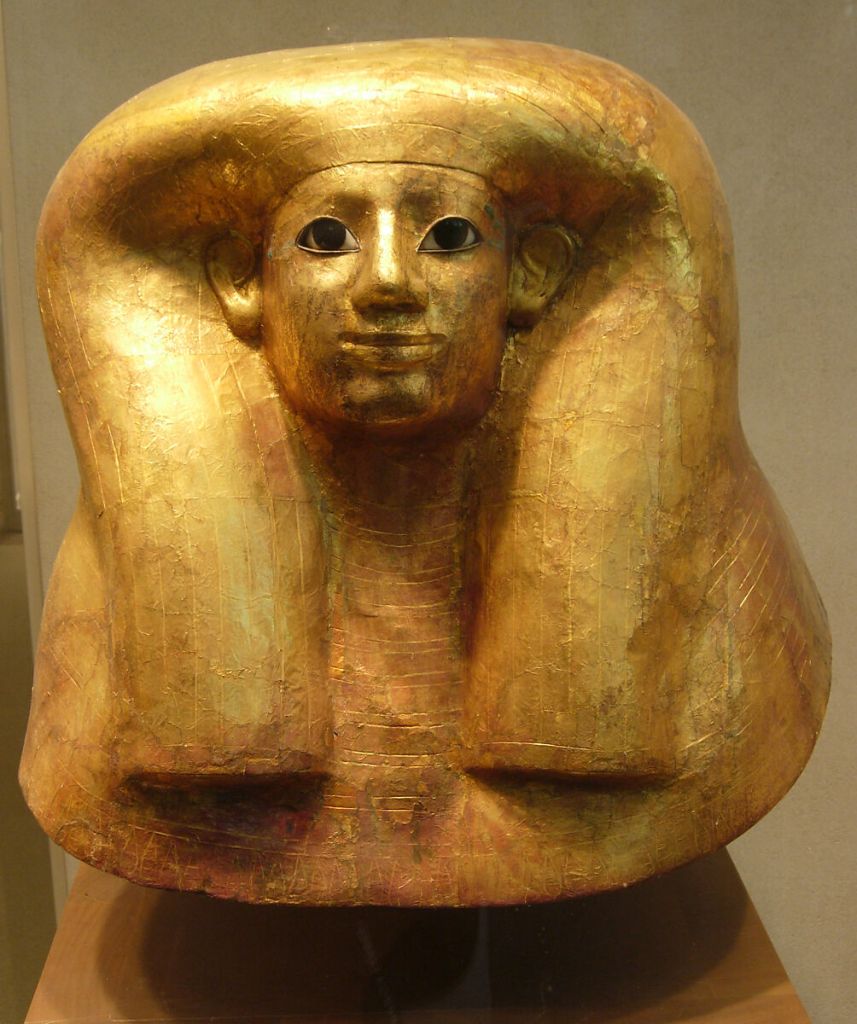
Funerary mask of Hatnefer
New Kingdom
ca. 1492–1473 B.C.
https://www.metmuseum.org/art/collection/search/545147
Ornament resembling the Flower of Life found at the Temple of Osiris at Abydos, Egypt
https://en.wikipedia.org/wiki/Overlapping_circles_grid#/media/File:Temple-of-Osiris_Flower-of-Life_02.jpg
Mysteries At Abydos In Egypt: Ancient Helicopter And Laser Etched Flower Of Life?

 Ritual Protection Marks & Ritual Practices
