
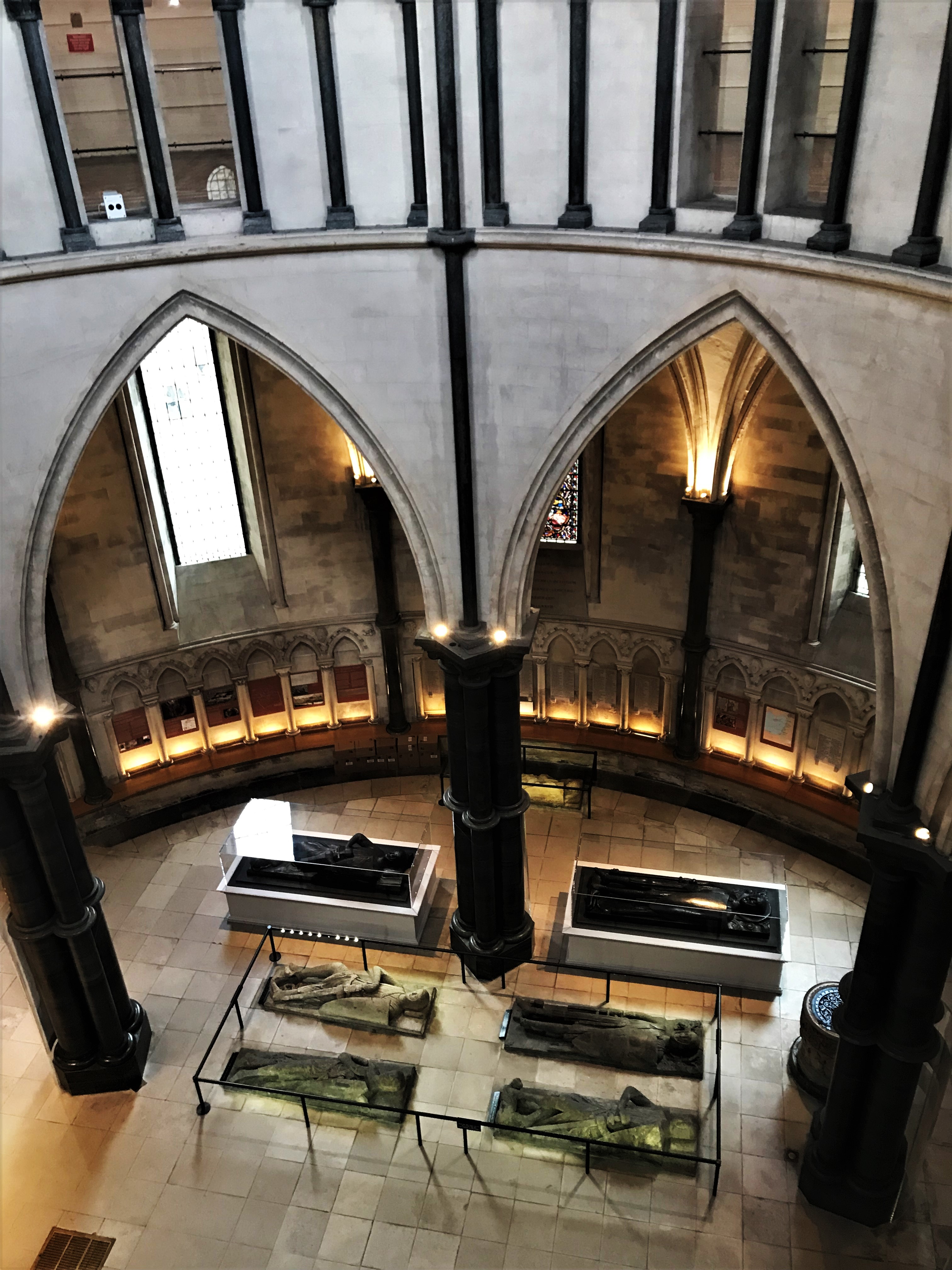
In 2023, I was able to make a preliminary survey of Temple Church to record any surviving graffiti. With the years of re-building, renovations and the damage sustained from two incendiary bombs in WWII, I was trepidatious to say the least. Was it possible that some of the medieval fabric had survived intact? Was it possible that any graffiti had survived the events of the past?
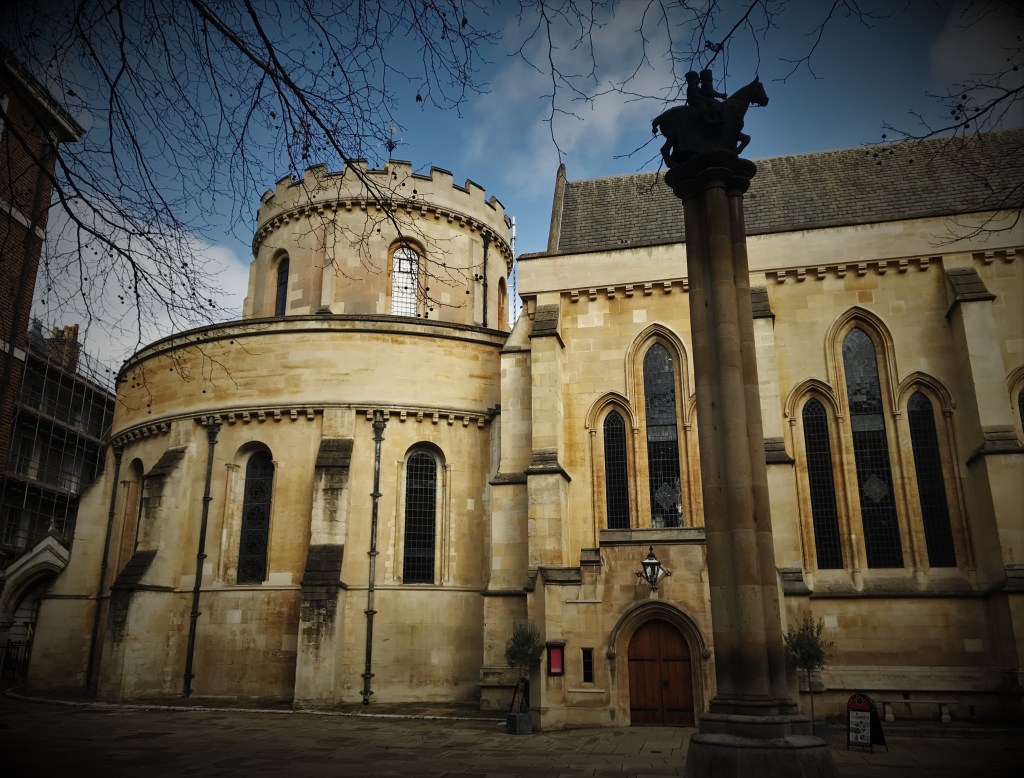
The Temple Church & the Blitz
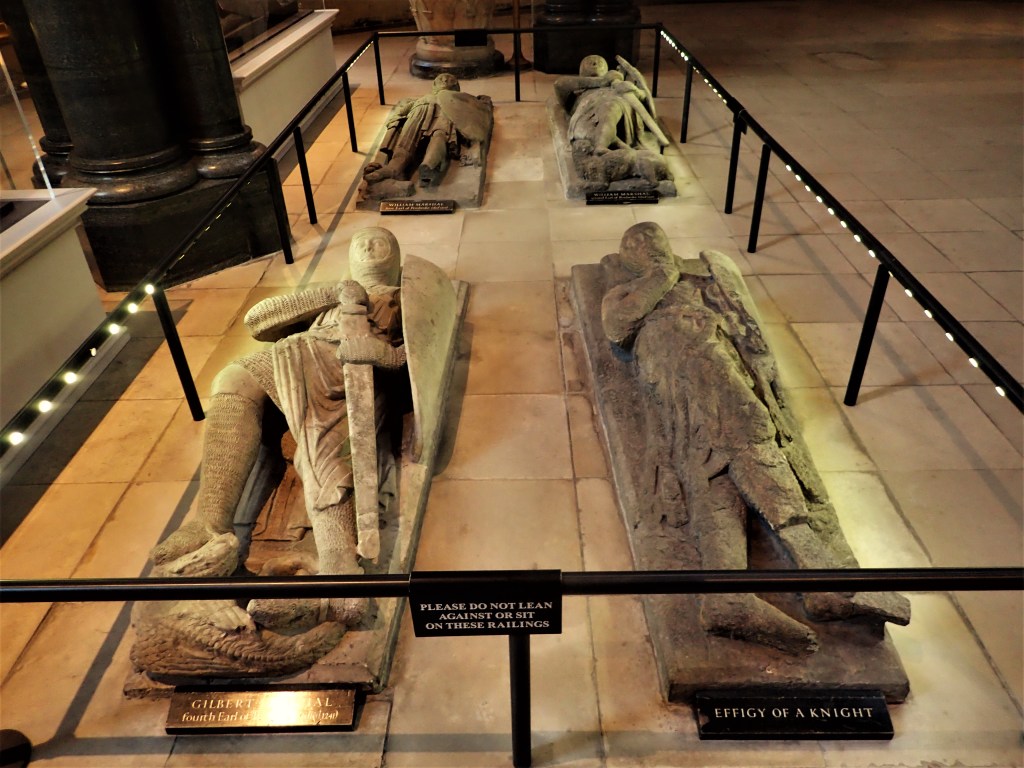
On the 10th May 1942 two incendiary bombs crashed through the roof of the Temple Church setting it on fire. The resulting conflagration was so intense that it cracked the purbeck marble pillars in the Round church. It was a bitter blow for a church that had survived the Great Fire of London of 1666. The damage to the pillars was so great that it weakened their integrity and they had to be replaced for safety reasons. The repairs and renovation of the church were directed by Walter Godfrey (TC 2023).
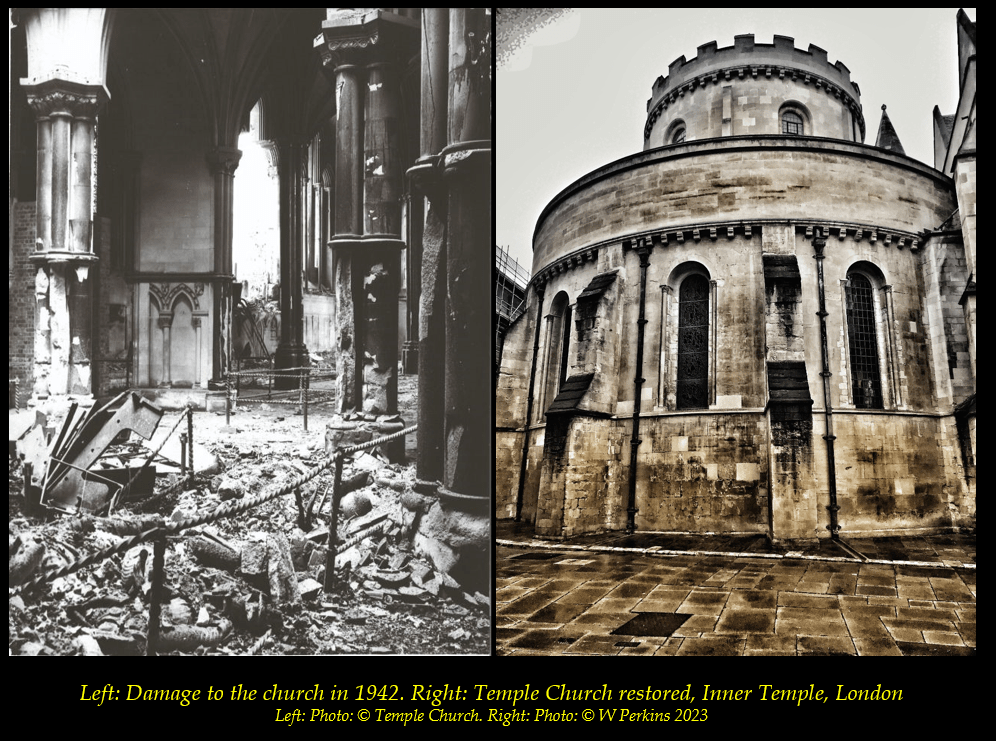
In this instance, the work was necessary but his repairs followed centuries of architectural changes which had been made to the the original fabric of the church, most often than not undertaken for aesthetic rather than structural reasons.
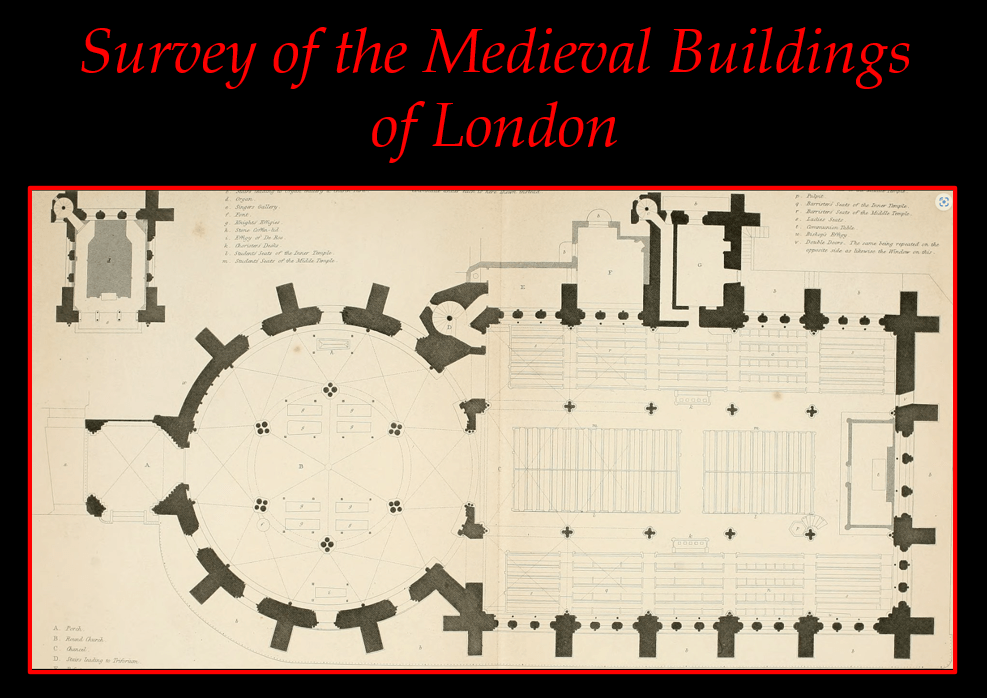
Addison’s 19th Century Survey
Charles G Addison’s survey in the 19th century noted that, ‘from the period of the reign of Charles the first down to our own times, the Temple church has remained sadly disfigured by incongruous innovations and modern embellishments which entirely changed the character and appearance of the building, and clouded and obscured its elegance and beauty” (1842:289)
His testimony and recoding of the church fabric is an important contribution as he made his survey after much of the clutter of the preceding years had been removed but before the damage wrought in World War II.
Following the Reformation, Protestant lawyers had covered the delicately painted ceiling, dumped layers of soil upon the tessellated floors (to receive a new floor of recycled gravestones) and destroyed the mouldings and carved marble ornaments with, ‘thick incrustations of whitewash’ (Addison 1842:289),
In the reign of Charles II the chancel had been choked with wooden pews, the walls covered eight feet from the ground with oak wainscoting and an oak screen erected which blocked the chancel arch. In the following years a huge organ case had been inserted and a reredos – in the bold baroque style – added to the east end which blocked out the natural light. In Addison’s mind, the ensemble had the effect of altering the church’s original character and had, ‘sadly marred its architectural beauty’ (Addison 1842:289). However, the Temple church – like many of its parish cousins – had seen many alterations and fashions change over time.
Church of the Holy Sepulchre: The First Sanctuary 4th Century AD
After seeing a vision of a cross in the sky prior to the Battle of the Milvonian bridge in 312, Constantine the Great increasingly favoroured Christianity and signed the Edict of Milan legalising the religion. Further proof of his ‘conversion’ was a medallion was issued at Ticinum in 315, which shows Constantine wearing a helmet emblazoned with the Chi Rho.

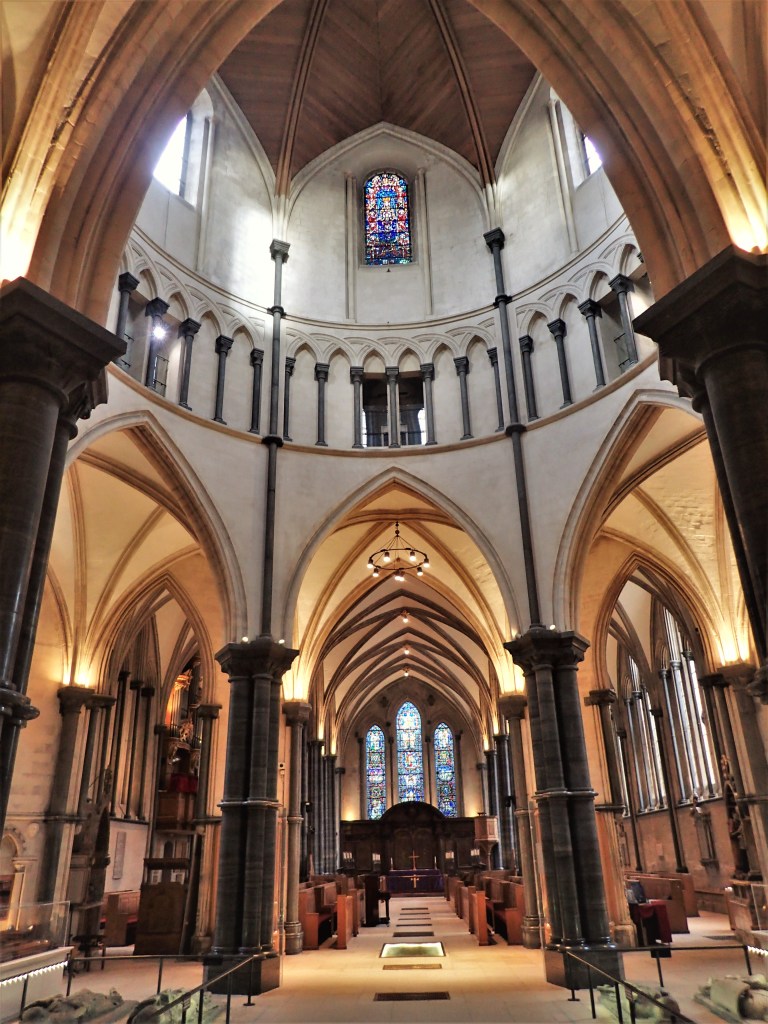
Around AD 325/6 he sent his mother, Helena, to Jerusalem to look for Christ’s tomb and three crosses were found near a tomb; one which allegedly cured people of death (which was presumed to be the True Cross Jesus was crucified on), leading the Romans to believe that they had found Calvary. Constantine ordered that the temple to Jupiter/Venus be replaced by a church. After the temple was torn down and its ruins removed, the soil was removed from the cave beneath, revealing a rock-cut tomb that Helena and Macarius identified as the burial site of Jesus. Over this empty grave Constantine built a round church, a mausoleum; the Church of the Holy Sepulchre. The round structure was built with Christ’s grave at its centre. As Jerusalem was considered to be at the centre of the Christian world, so the Sepulchre (Christ’s own burial) was the axis mundi of that world (TC 2023).
The Knight’s Templar in London
The Templars were founded in AD 1118-1119 by Hugh de Payns, a knight of Champagne who led his knights in the vows of poverty, chastity and obedience along with a fourth vow to protect pilgrims in the Holy Land. The Templars were given Aqsa Mosque as their headquarters, located on the Temple Mount which was believed to have been built on the Temple of Solomon – hence the name Templars (TC 2023).
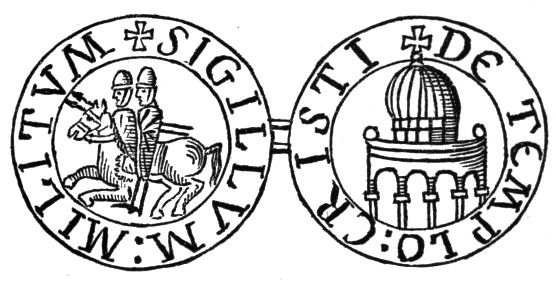
The Templars were established in London by the AD 1140’s in Holborn but soon moved to the present site of Temple Church and began to build their Round church – which was in use by AD 1163 (TC 2023).
Graffiti Survey
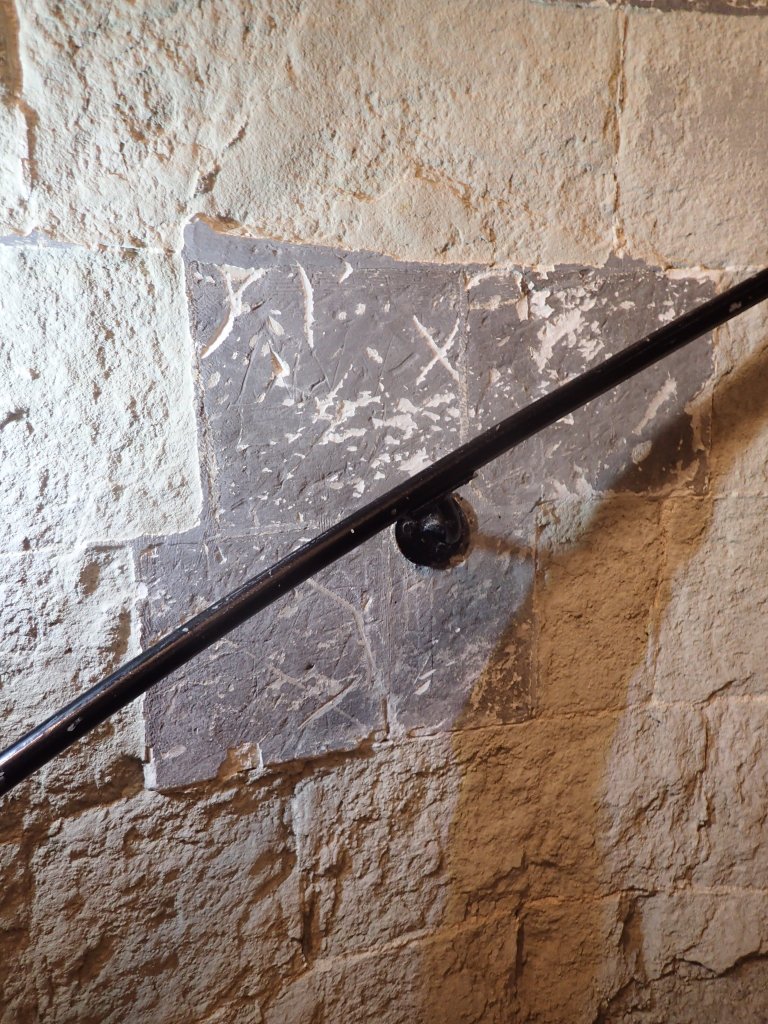
The results of a brief survey were very heartening, with a few survivals still visible on some of the earliest masonry. It recorded a Marian mark, several saltires (X) and one instance of architectural graffiti. The saltires, Marian mark and compass drawn circles can be viewed as ‘holy signs’ added as further blessings to the church or valued for their ‘apotropaic’ qualities.
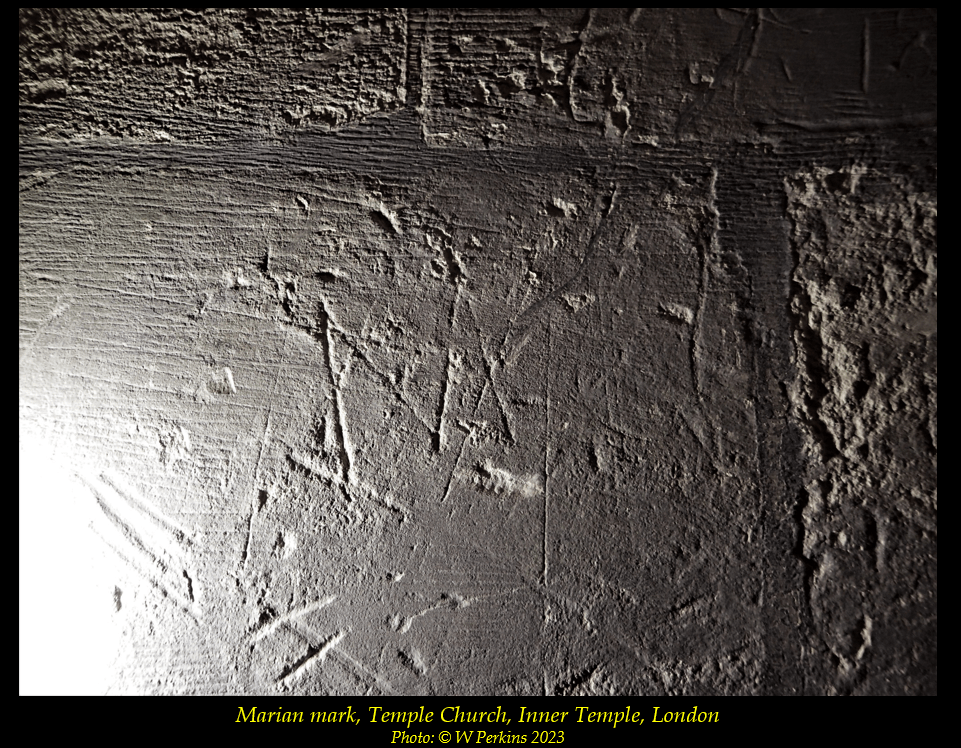
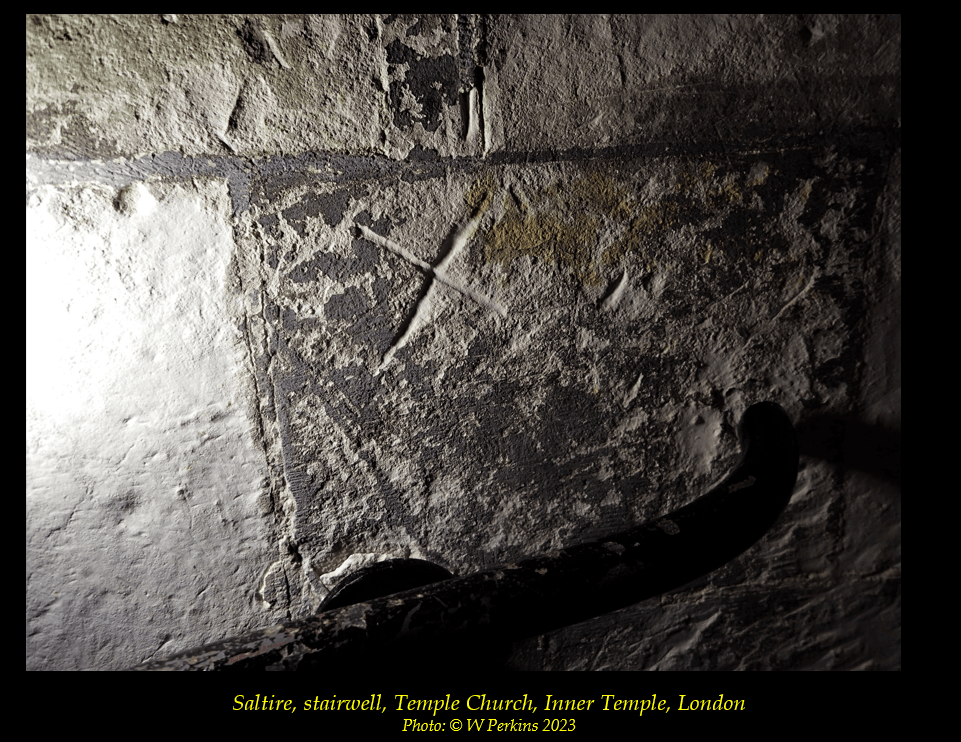
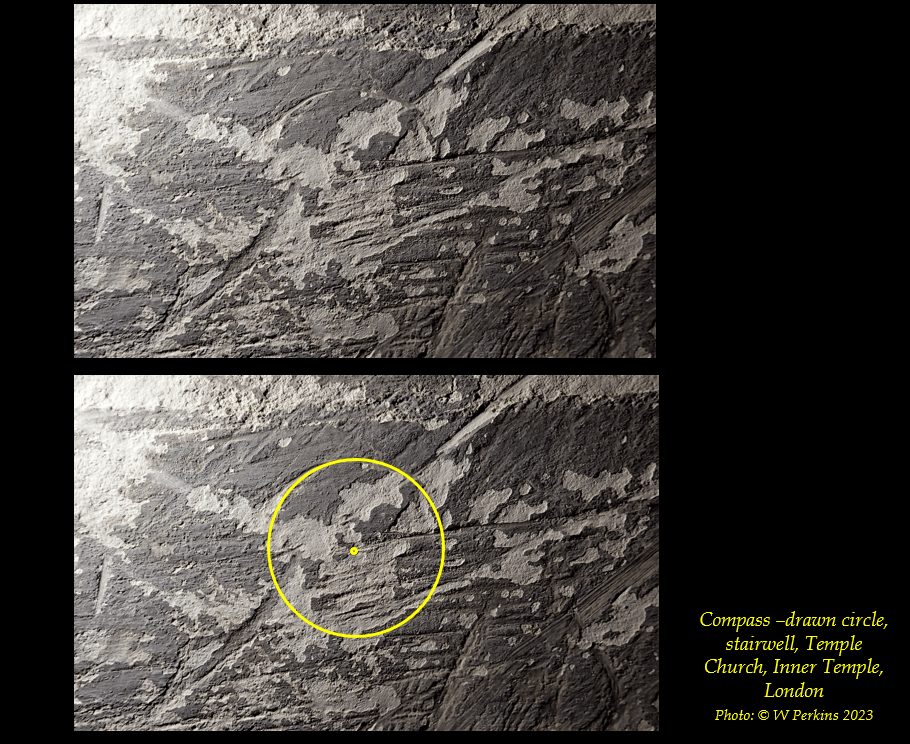
Two instances of compass drawn circles (Type 1a) were present, both on the stairwell and in the triforium. Both had been heavily damaged and had been partially eroded but the pinhole for the dividers were clear and some of their circumference arcs had survived.
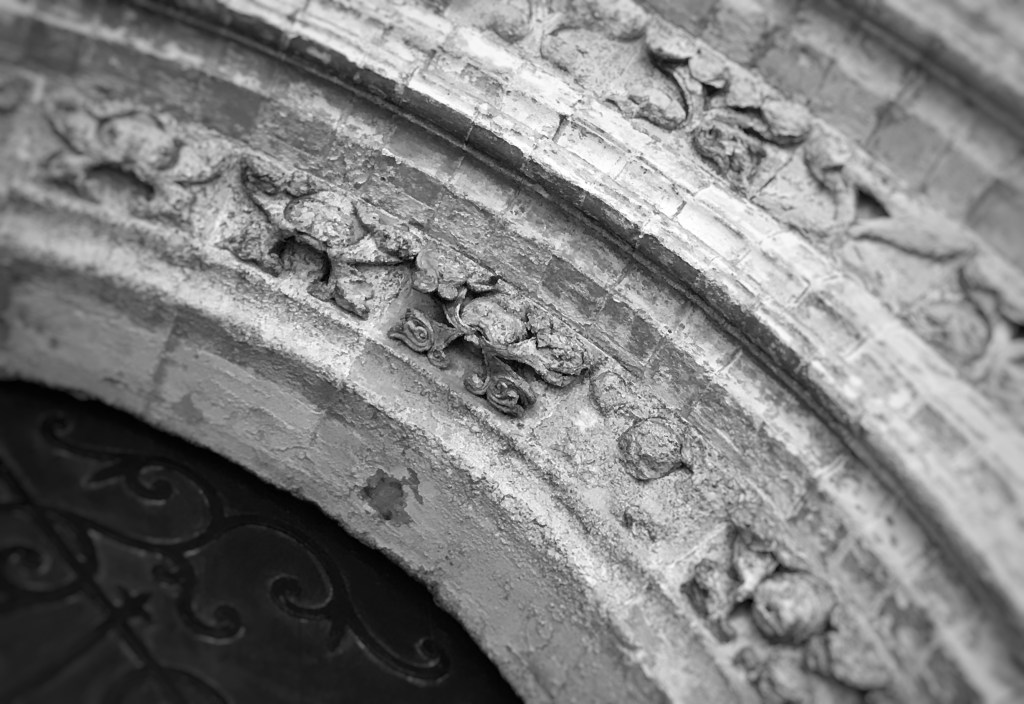
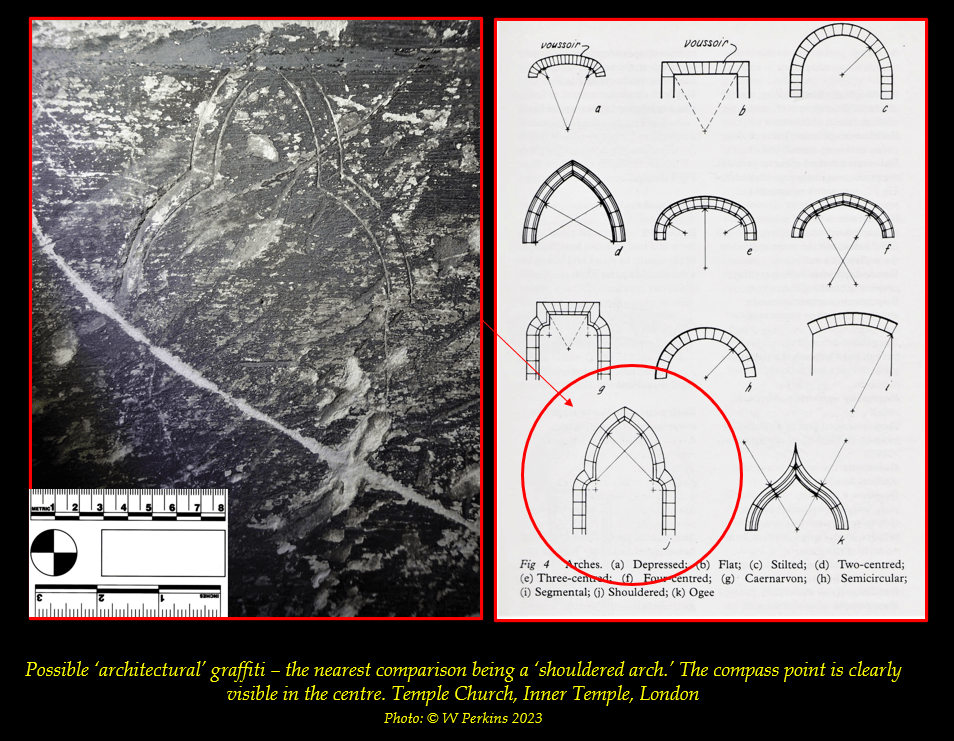
The architectural graffiti may have been meant as a ‘trial’ or practice’ run for a shouldered arch and was still relatively crisp -possibly a genuine survival of a freemason practising his art. The other examples of graffiti in the Temple are rather crudely executed and more likely the work of amateurs or added at a later point, post construction.
It would be profitable, therefore, to conduct a full survey of the Temple church as my access to the fabric was limited to a single visit of around one hour. However, it illustrated that, despite the blitz and the re-builds, some graffiti has survived!
© Wayne Perkins
February 2026
– – – – – – – – – – – – – – – – – – — – – – – – – – – – – – – – – – – – – – – – – – – — – – – – – – – – – – – – – –
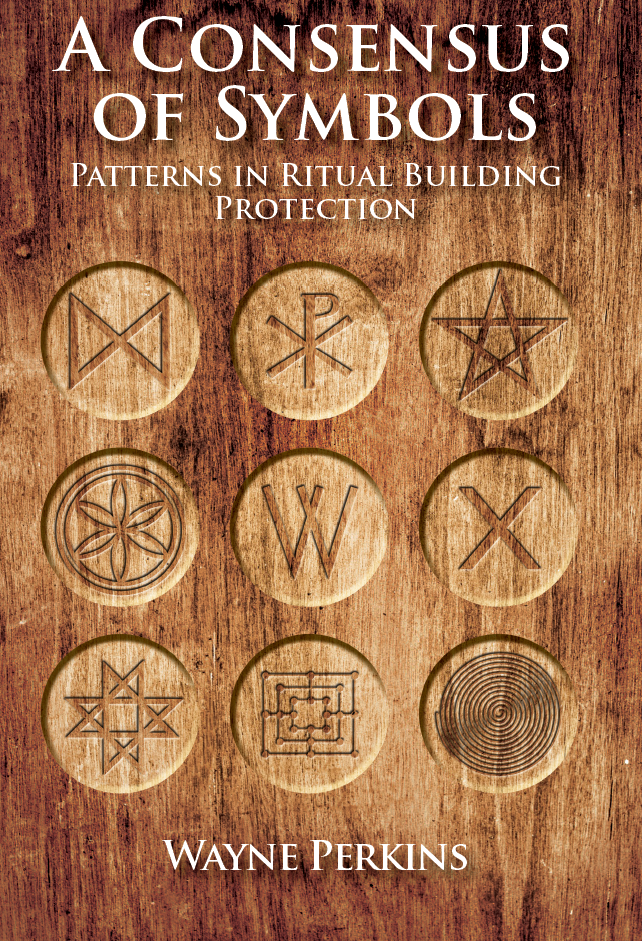
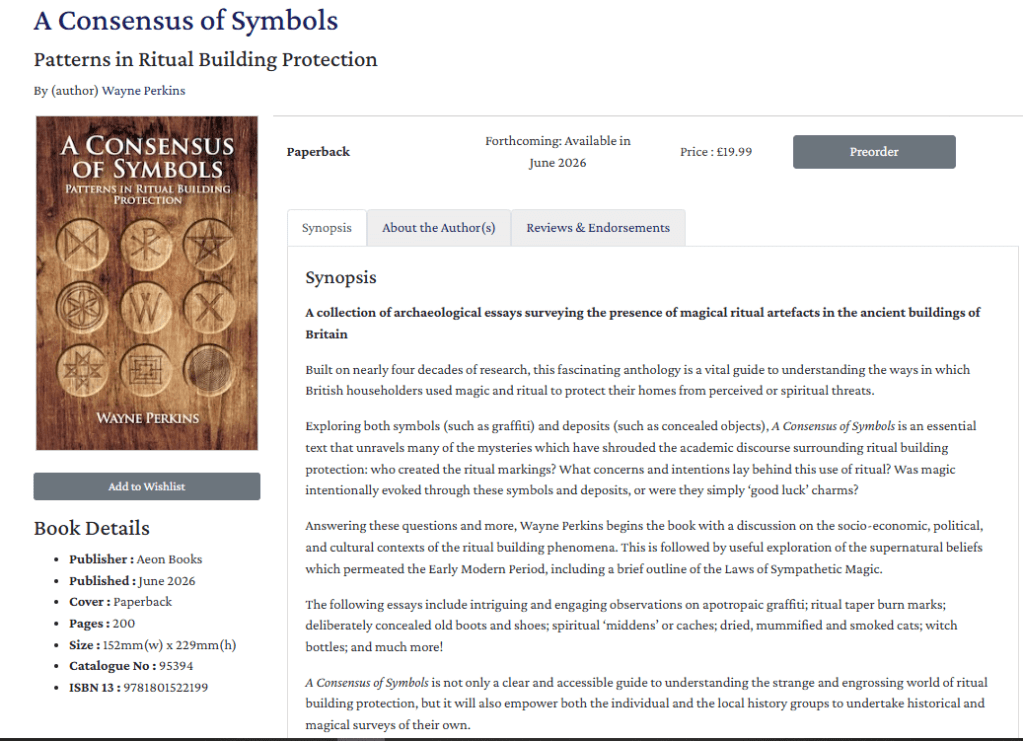
More in-depth explanations of the motifs discussed in this article can be found in my new book, now ready for pre-order!
References
Addison, C. G. (1842) The history of the Knights Templars : the Temple church, and the Temple
Archer, T A & Kingsford, C L (1894 ) The Crusades; the Story of the Latin kingdom of Jerusalem
Hamilton, R & Smirke, S (1845)The Temple Round Church. John Weale, London
https://archive.org/details/illustrationsofa00esse/page/n82/mode/1up
Temple Church (TC) (2023) History of the Temple Church.


Fascinating
LikeLike