
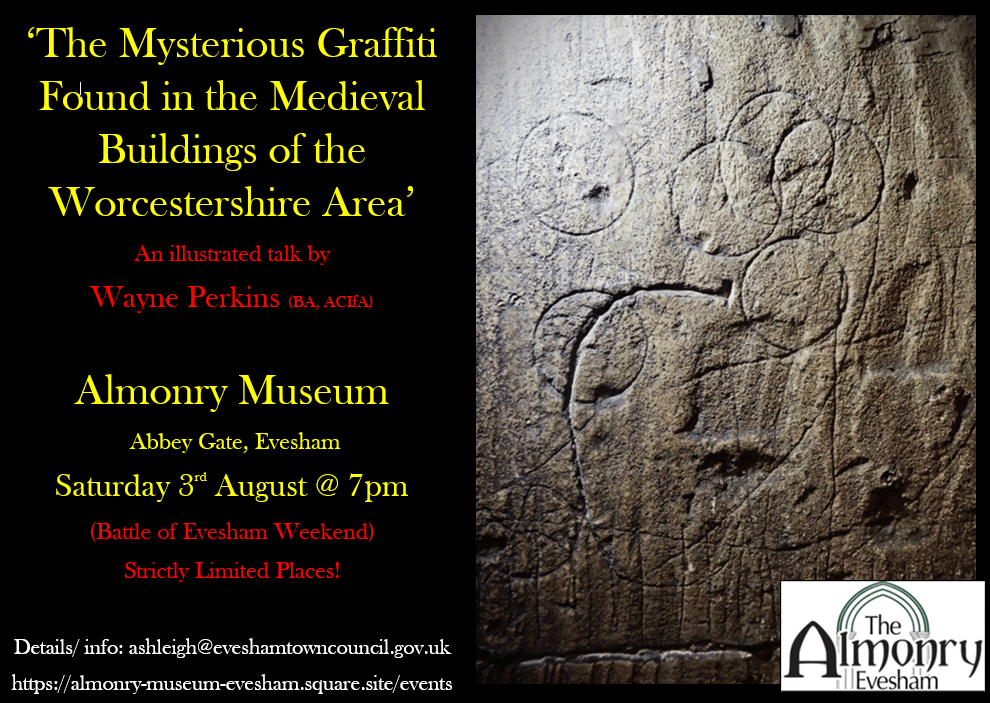
On Saturday 3rd August 2024 I will be presenting an illustrated talk on the ‘The Mysterious Graffiti found in the Medieval buildings of Worcestershire’ at the Almonry Museum during the ‘Battle of Evesham’ weekend (see details below).
The Almonry is a 14th century building which once belonged to the complex of buildings which comprised the Benedictine Abbey of Evesham. Prior to its destruction, the Abbey was considered to be the third largest in England (HE 2024b).

However, a number of satisfying structures remain, of which the Almonry – together with the adjacent buildings of the former Abbey Gatehouse (53 & 54 Merstow Green) -are the remains of some of the structures which have survived.
Works of Mercy
The former once attended to the needs of the visiting pilgrims and the town’s poor. The Almoner was the official distributor of alms and responsible for the ‘works of mercy’ which were considered a solemn religious duty by the church (Harper 2024).

The Almonry, like many buildings of a similar age, has seen a number of changes and architectural embellishments, with the insertion of later 17th century fenestration and other alterations (HE 2024c).
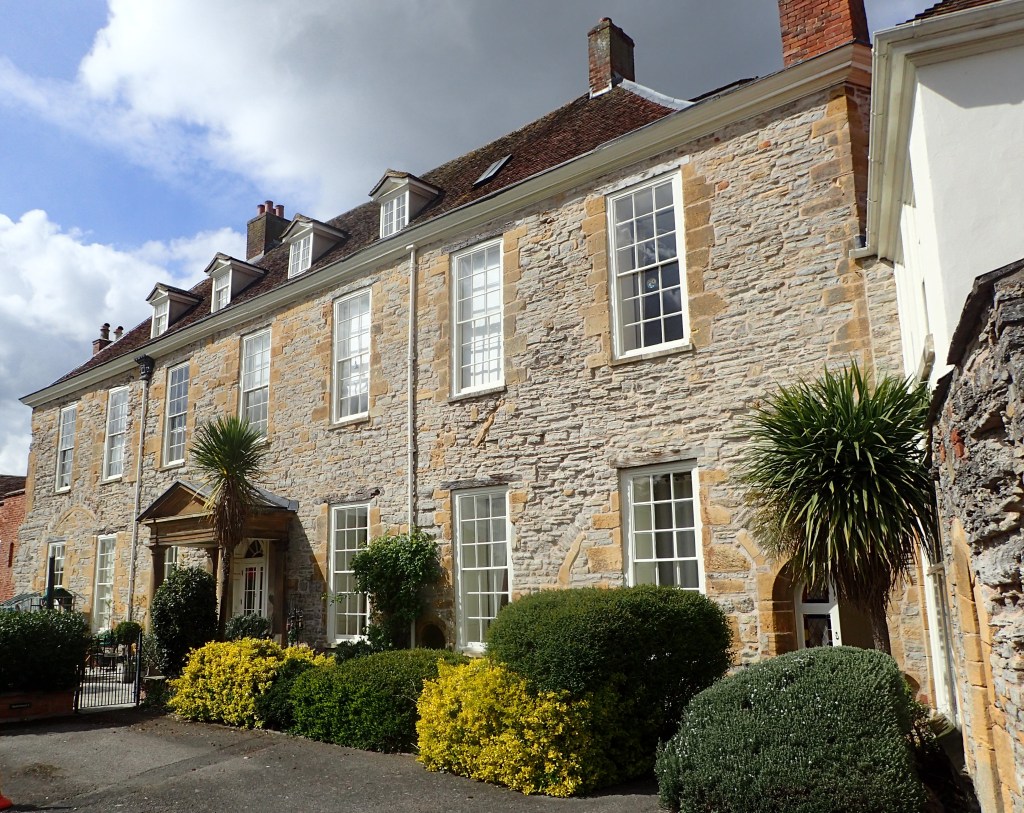
Likewise, No’s 53 and 54 form an L-shaped building house that incorporates elements of the former Gate House and Stables that once belonged to the abbey. They have also been subject to later additions when they were converted into a private residence, including the addition of a 17th century staircase and wall panelling (HE 2024c).
Historic Building Survey: Six-petalled Rosettes (Daisy Wheels)

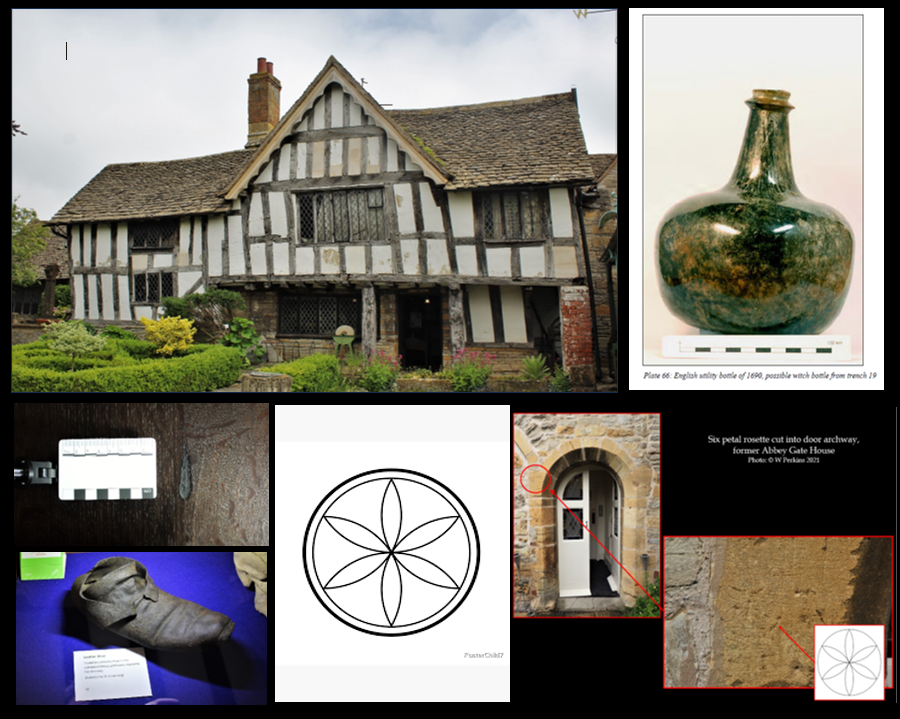
The author of this article recently found a heavily-weathered six-petalled rosette (or Daisy Wheel) cut into the exterior door archways as part of a preliminary survey of the buildings. This symbol had been deployed to confer good luck – and to avert malign forces – for the building and its inhabitants. These symbols are known as ‘apotopaics’ – from the Greek, apotropaois – ‘to turn away evil.’
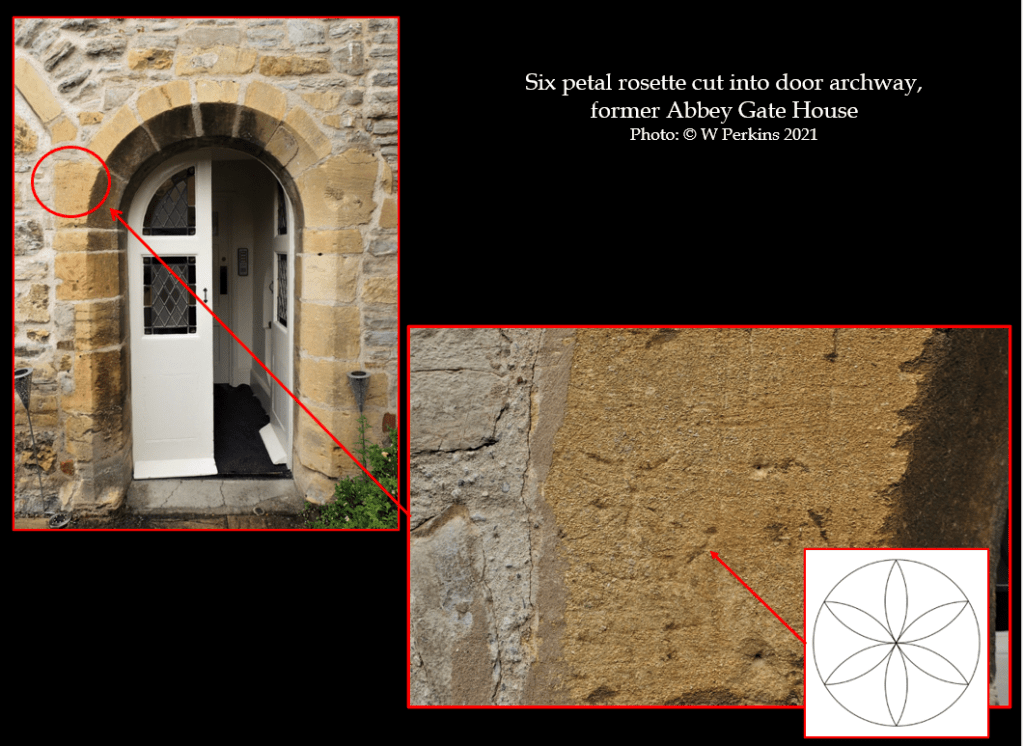
Photo: © W Perkins 2021.
Back in 2008, a buildings survey was undertaken by Worcester’s Historic Environment & Archaeology Service (Robson-Glyde 2008). A number of examples of ritual building protection marks and ritual practices came to light. This six-petalled rosette (or daisy wheel) was discovered within the Abbot’s Stables.

.
A Possible Witch Bottle?
The survey by the Worcester’s Historic Environment & Archaeology Service included the excavation of several trenches or sondages next to the building’s foundations. In Trench 19 they found a deliberately concealed glass bottle.

The excavator described the discovery, ‘a complete utility bottle was found in Trench 19 that was identical to … one (a witch bottle) …found in Reigate that still contained human urine. The bottle from trench 19 had unfortunately partly filled with soil because the cork had disintegrated. This bottle had been deliberately placed within the foundations of an early 18th century wall and was mortared onto the medieval wall it was abutting. Whilst the Abbey Gate bottle did not contain any urine due to the soil leaking into bottle, it did contain damson pips. These would not have the same effect as pins or thorns (used as counter-magic), but it would still make life uncomfortable for the witch (Robson-Glyde 2008).
It is believed that witch bottles were made as a counter-measure against maleficium (malignant magic)
An Intentionally Concealed Shoe

There is a long tradition of intentionally concealing old work boot and shoes within the voids of ancient buildings. The shoe from the Abbey gatehouse dates to the time that it was converted into a private residence and around the time of the ‘Witch craze’ in England. Personal items such as hair, nail pairings and personal items of adornment/ clothing were considered objects that could be used if they fell into the hands of a witch.
Deliberate Taper Burn Marks
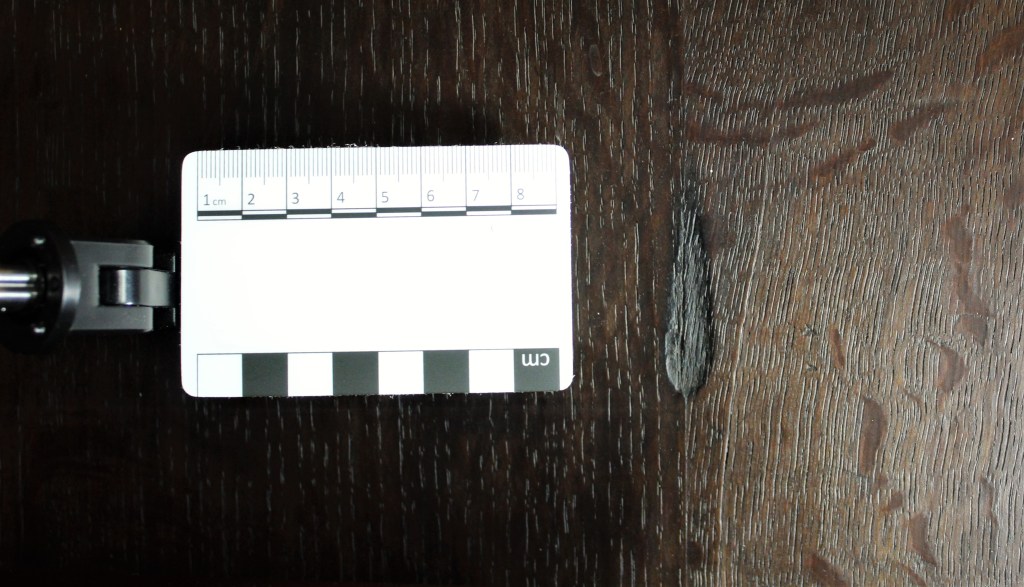
Why would someone intentionally burn a mark into the expensive oak panelling of the Almonry? several other burn marks on many of the s timber within the building. Archaeologists now believe that this was a form of ‘inoculating’ the building against fire and adding a layer of magical protection.
Apotropaic graffiti

Photo: © W Perkins 2021.
One of the fireplace lintels in the Almonry has a series of Marian marks (motifs used to invoke the protection of the Virgin Mary), compass drawn circles and drill holes (in the form of a cross). In the 16th & 17th centuries, the chimney opening was considered to be a vulnerable point in the house which was always open to the elements.
Acknowledgements
Worcestershire County Council have kindly given me permission to replicate a number of images from their report. With particular thanks to Shona Robson-Glyde whose meticulous buildings recording forms part of this post and has informed my reading of the Almonry and Abbey Gatehouse buildings.
Links
https://almonry-museum-evesham.square.site/events
Further Reading
Almonry, The (2024) The Almonry Restoration Project
https://www.almonryevesham.org/restoring-the-almonry/
Historic England (2024a) Heritage At Risk
https://historicengland.org.uk/advice/heritage-at-risk/search-register/list-entry/253063
Historic England (2024b) The Almonry, Merstow Green
https://historicengland.org.uk/listing/the-list/list-entry/1302722?section=official-list-entry
Historic England (2024c) 53 & 54 (Abbey Gate House)
https://historicengland.org.uk/listing/the-list/list-entry/1156720?section=official-list-entry
The Almonry Evesham (2024)
https://www.almonryevesham.org/about-us/
Harper, D (2024) Almoner in, Online Etymology Dictionary
https://www.etymonline.com/word/almoner
Robson-Glyde, S (2008) ABBEY GATE, MERSTOW GREEN, EVESHAM. Historic Environment and Archaeology Service, Worcestershire County Council


I love this blog, I always end up learning something new
LikeLike
Thank you MM, more original articles on their way soon!
LikeLike