
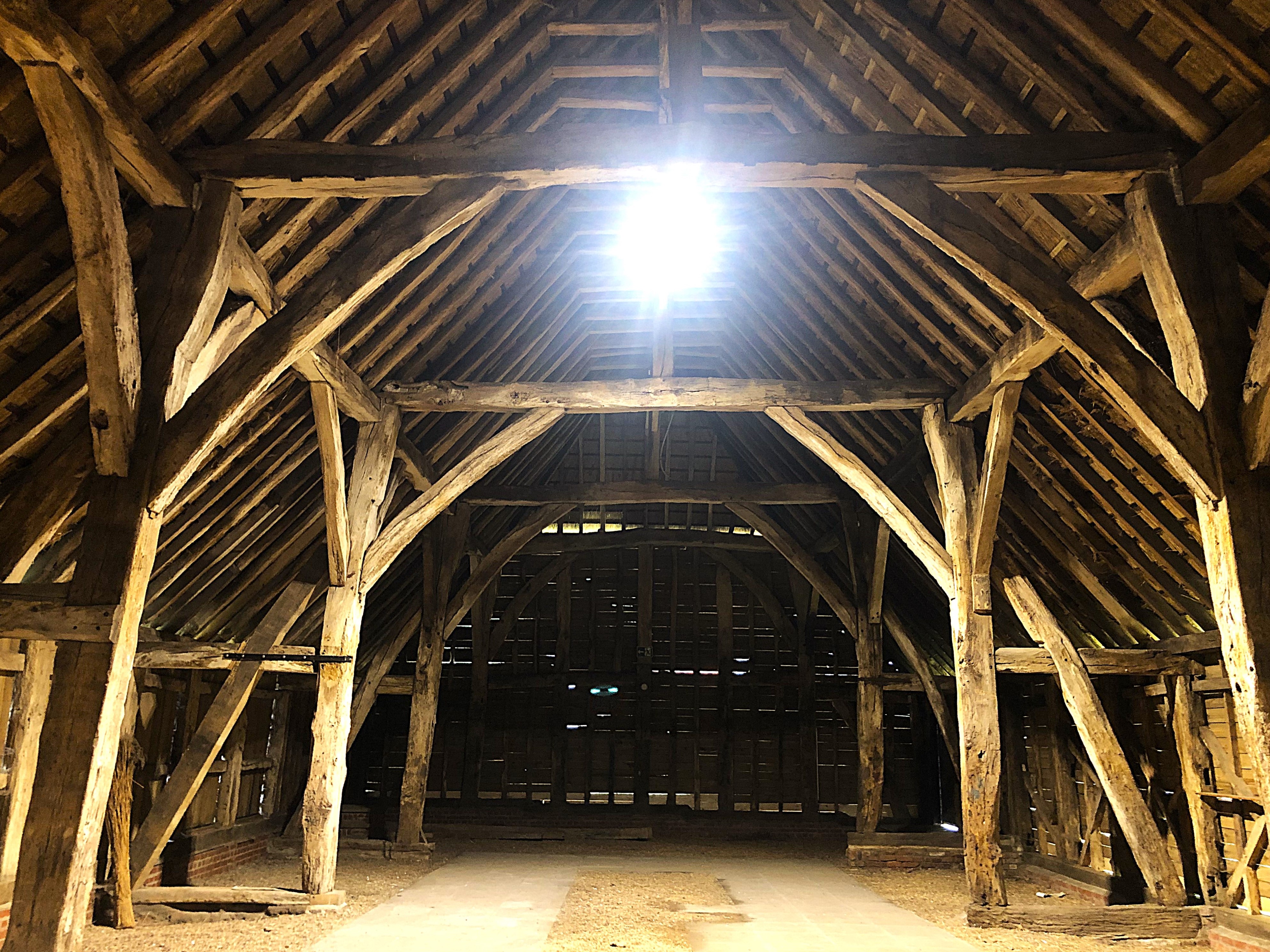
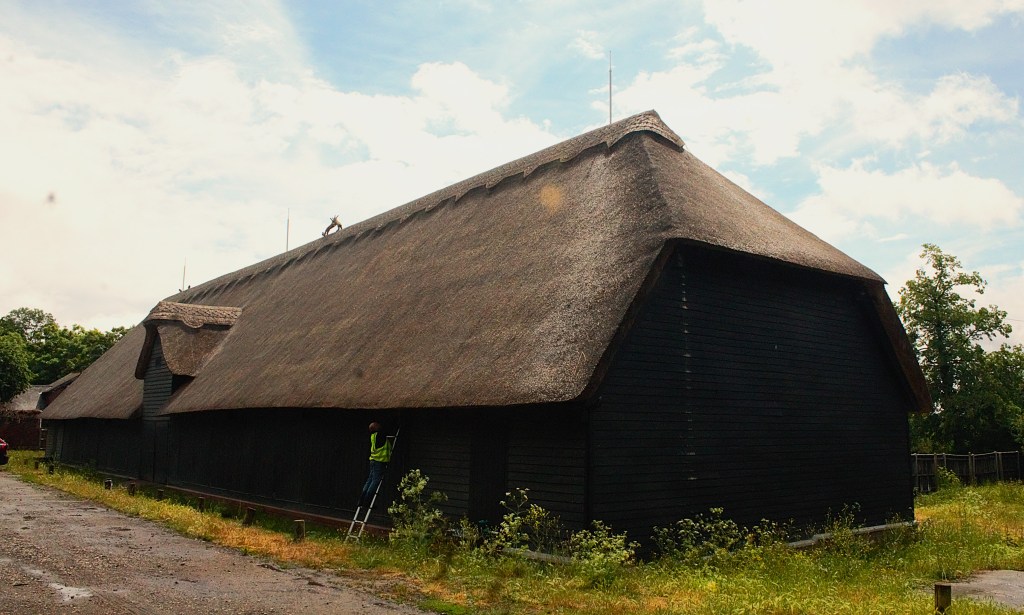
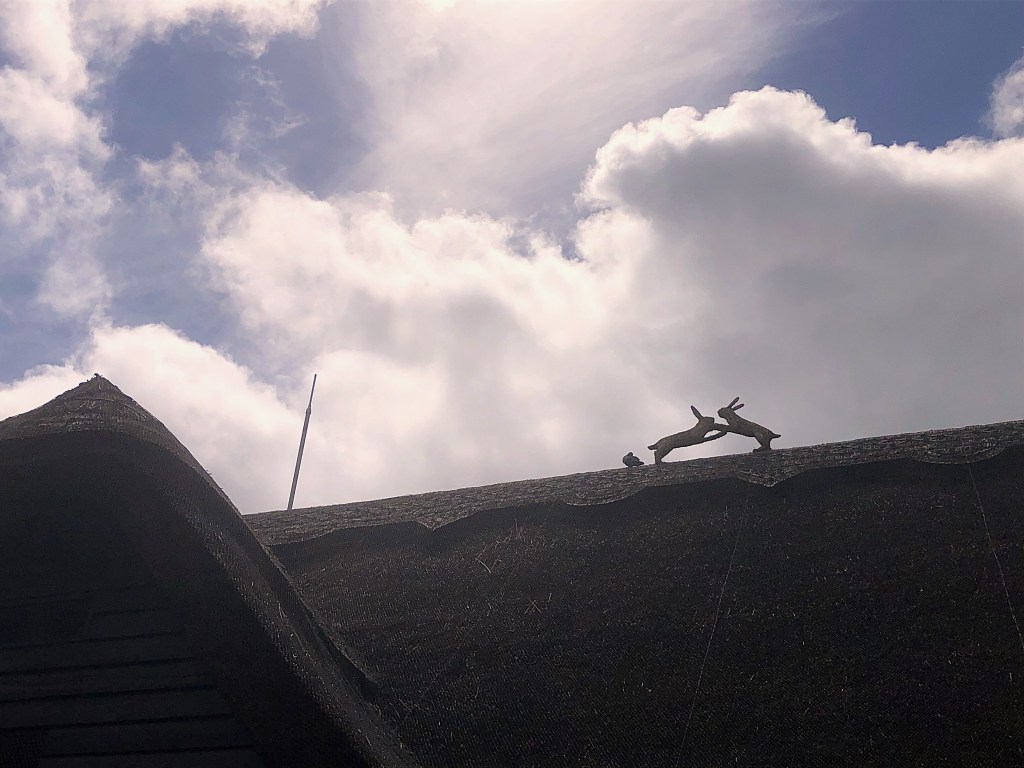
Upminster Tithe Barn was built c.1450 as part of the estate that supported Waltham Abbey. It has recently been restored to the tune of £650 000 thanks to a partnership with between the National Highways, Lower Thames Crossing and Historic England (Havering 2025). From the outside, perhaps its most striking feature is its thatched roof which has been recently completed using reeds imported from Turkey. The barn was constructed on a box frame comprising nine bays (Historic England 2026)
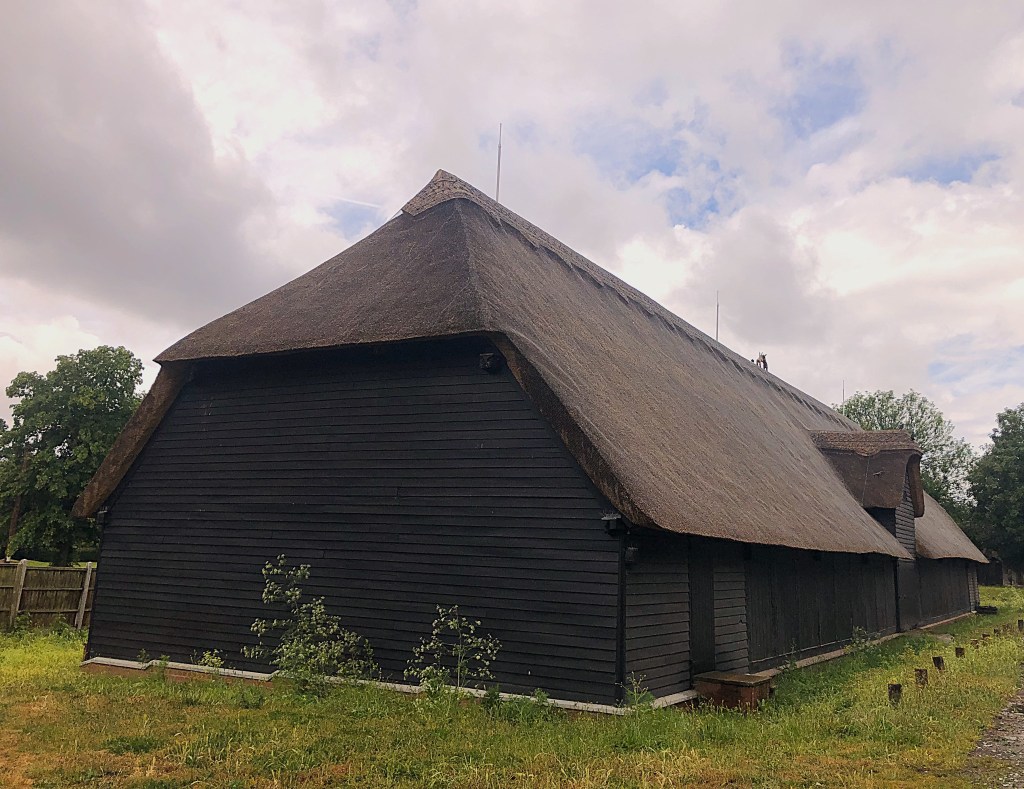
In fact, it should properly be called a ‘grange’ barn as there is no evidence that either Waltham Abbey or Upminster Hall had ever possessed the right to tithes (UTB 2026).
The Manor of Upminster was given by Earl Harold in (or before) 1062 to the Abbey of Waltham on land provisioned as a ‘retiring place’ or hunting seat for the Abbot (UTB 2026).
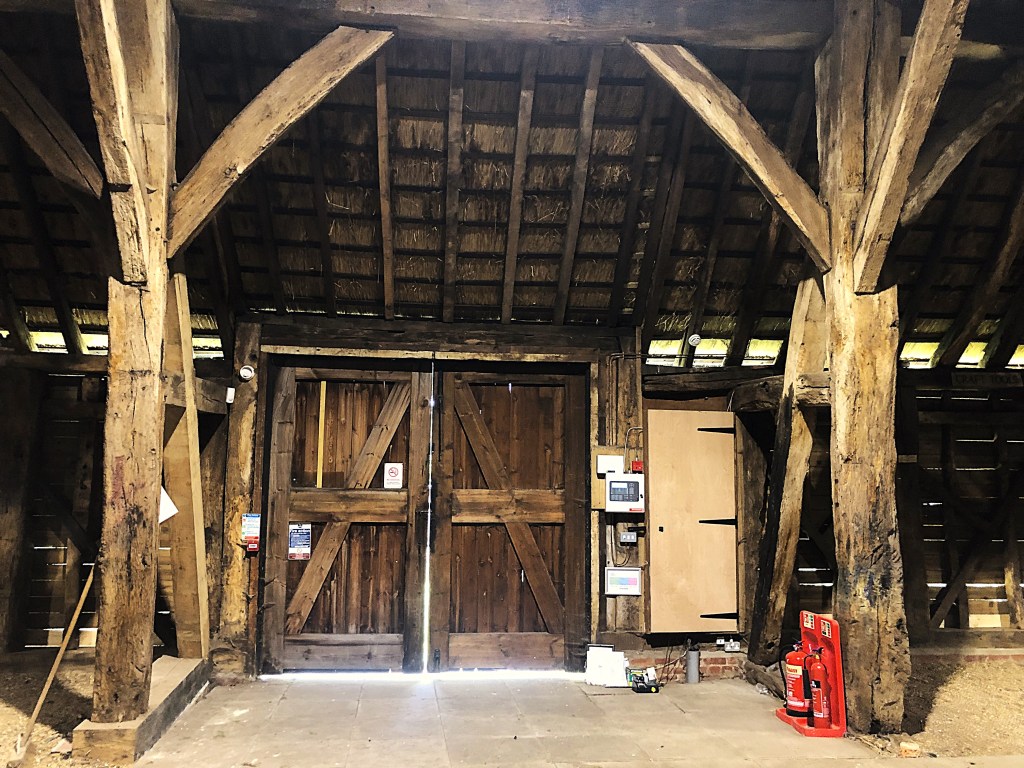
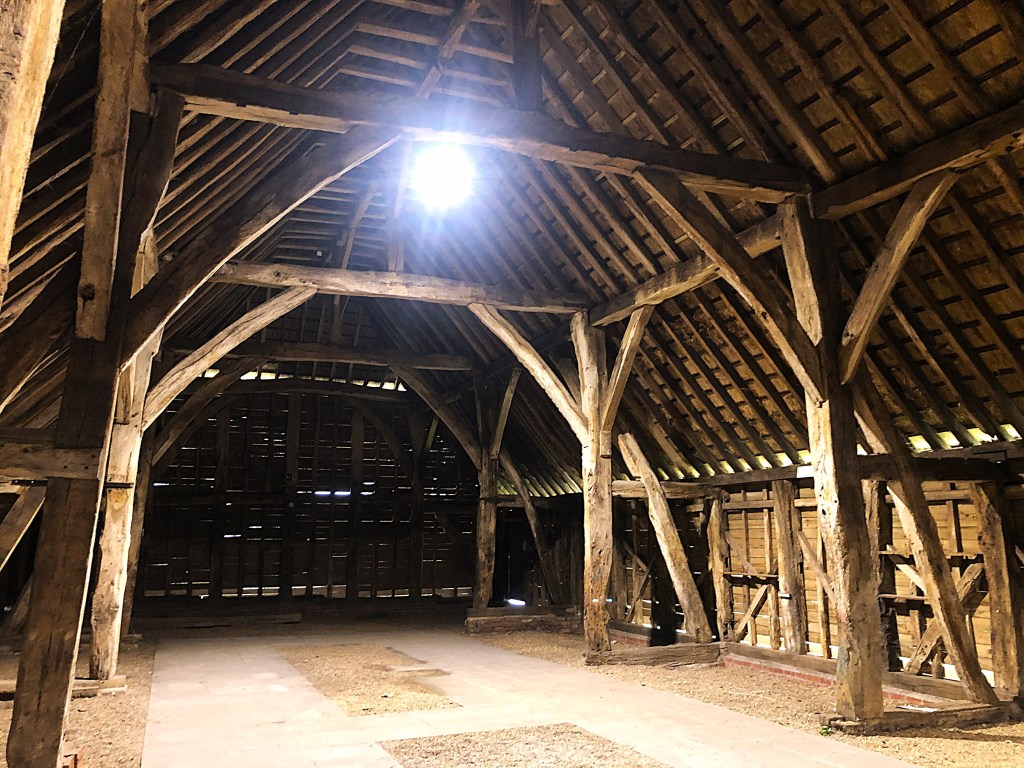
The barn is an aisled barn of Crown Post construction, measuring 44m long by 11m wide with a gabled entrance on the north side. Dendrochronological samples from the structural timbers projected a tree-ring chronology for the period AD 1276-1414 with a date for tree-felling around AD 1423-1440 (Tyers 1997, Historic England 2026).
Following the Dissolution of 1540, it was granted to Thomas Cromwell until his fall from grace and execution whereby it reverted to the Crown (UTB 2026).
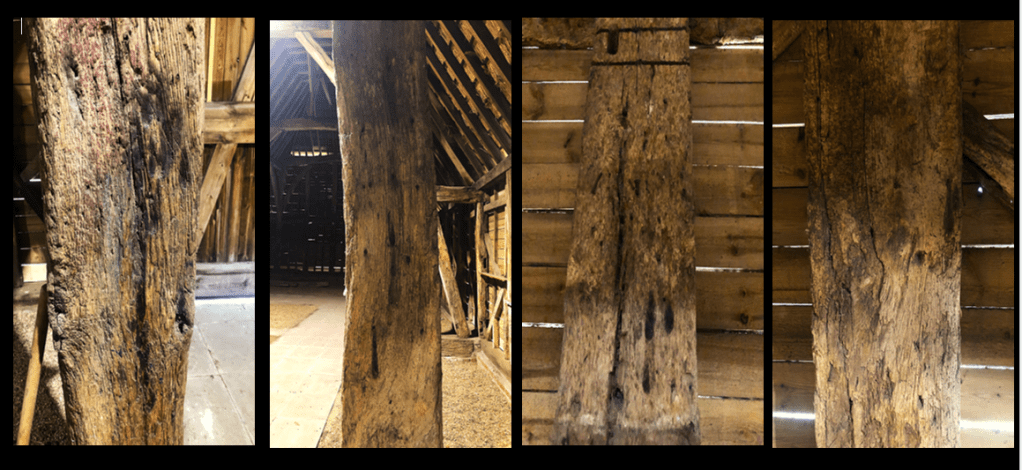
Although I did not have time to complete a full survey, it was possible to observe that many of the timbers bore ritual taper burn marks.
Over the last twenty-five years, archaeologists have been recording
taper burn marks on medieval and later building timbers. Once
thought to be the result of random accidents, they are now
understood to be the material trace of applied “pyro-technology”—an
act intended to protect the building and occupants from harm.
Taper burn marks: morphology, defining characteristics
A taper burn mark can be identified by its “tear drop” shape—not unlike
that of a candle flame—being round at the base and narrowing to a
point, which is the result of the way the flame was applied to the timber.
Its characteristic shape is the archaeological
trace of a “controlled” flame having been deliberately applied to a timber
element repeatedly, using a taper. A taper was a long, thin candle
used mainly for lighting fires, whose design was intended to create a
long, steady flame. It is now generally agreed that it was the taper—
rather than a candle or a rush light—that was the most likely choice of
“tool” to effect the desired result
Taper burn marks can vary in size, from a few millimetres in length
to those of several centimetres and can be found either as single burns or in overlapping multiples.
One distinct characteristic of the burn mark is the depth to which the flame has been allowed to burn into the timber, which can be up to several millimetres. They are commonly found on fireplace lintels (bressummers) as well as around thresholds and openings such as timber doors and windows.
In other instances, they have been found in inaccessible locations within a building, such as behind panelling or even under floorboards, suggesting covert application.
Wayne Perkins June 2026.
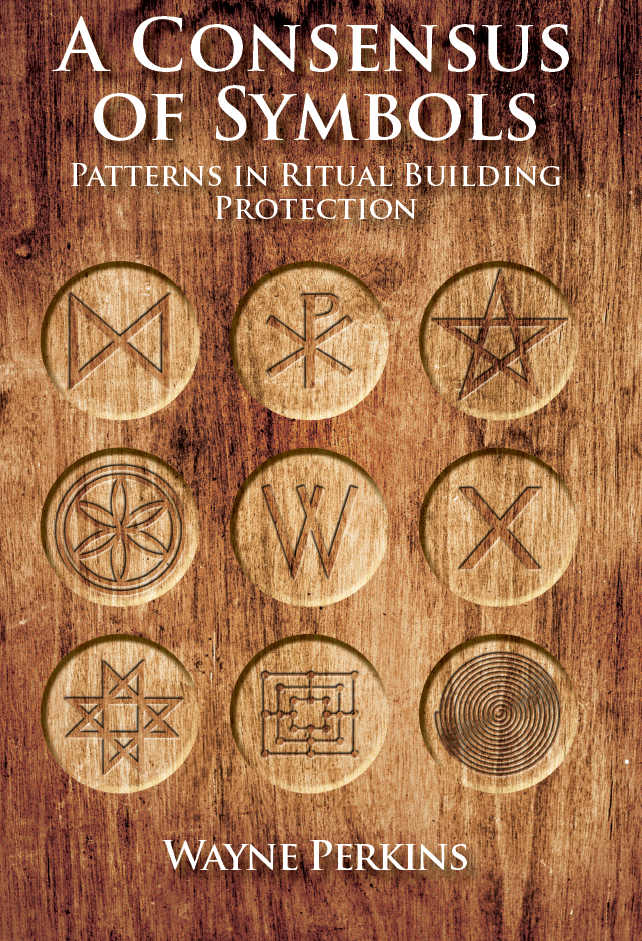
You can learn more about the mysterious ritual taper burn marks in Chapter 4 of my book – out in June 2026!!
I have written on the subject of apotropaics in tithe barns and farm buildings twice in the past (Perkins 2022a&b) See below –
Further Reading
Havering London Borough (2025) Re-thatching history: Tithe Barn
https://www.havering.gov.uk/news/article/1481/re-thatching-history-tithe-barn
Historic England (2026) Upminster Tithe Barn.
http://www.historicengland.org.uk
Tyers, I (1997) Tree-Ring Analysis of Upminster Tithe barn, Greater London. Ancient Monuments Laboratory Report 79/97
Upminster Tithe Barn (2026) Upminster Tithe Barn: History of the barn.
http://www.upminstertithebarn.co.uk
Forthcoming Talks;


