
Wayne Perkins 18th July 2026
This short blog is a response to the recent article in the Guardian, published on the 9th July 2026 wherein architectural historian Jennifer Alexander made claims contra to the prevailing thought regarding medieval graffiti, masons’ marks and apotropaics…see link to article below

The Antiquarian Ideal
History has shown us that the claims by antiquarians, archaeologists and architectural historians that there once existed a systematic, regulated use of masons’ marks in use in England have often been dashed upon the rocks of disappointment and controversy.
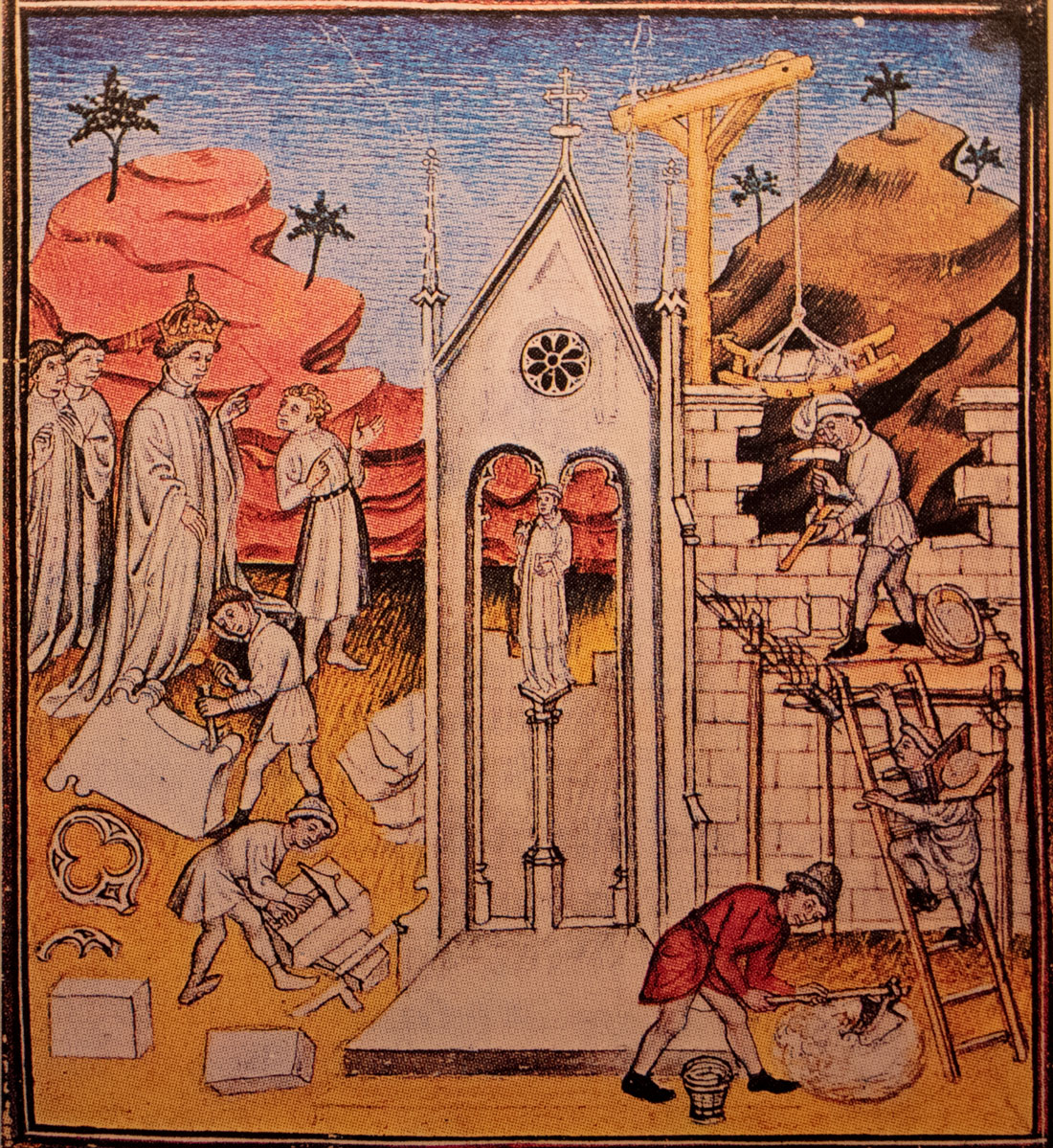
Since the mid-19th century, a general belief had persisted among antiquarians that, as a way of ensuring payment, stonemasons had marked each stone block as a system of authorship.
On the face of it, the suggestion presents an idea so simplistic and common-sense that it seems almost self-evident. Yet, in reality, the truth of this hypothesis has never been borne out by the evidence on the stones themselves, which sometimes bear evidence to the contrary.
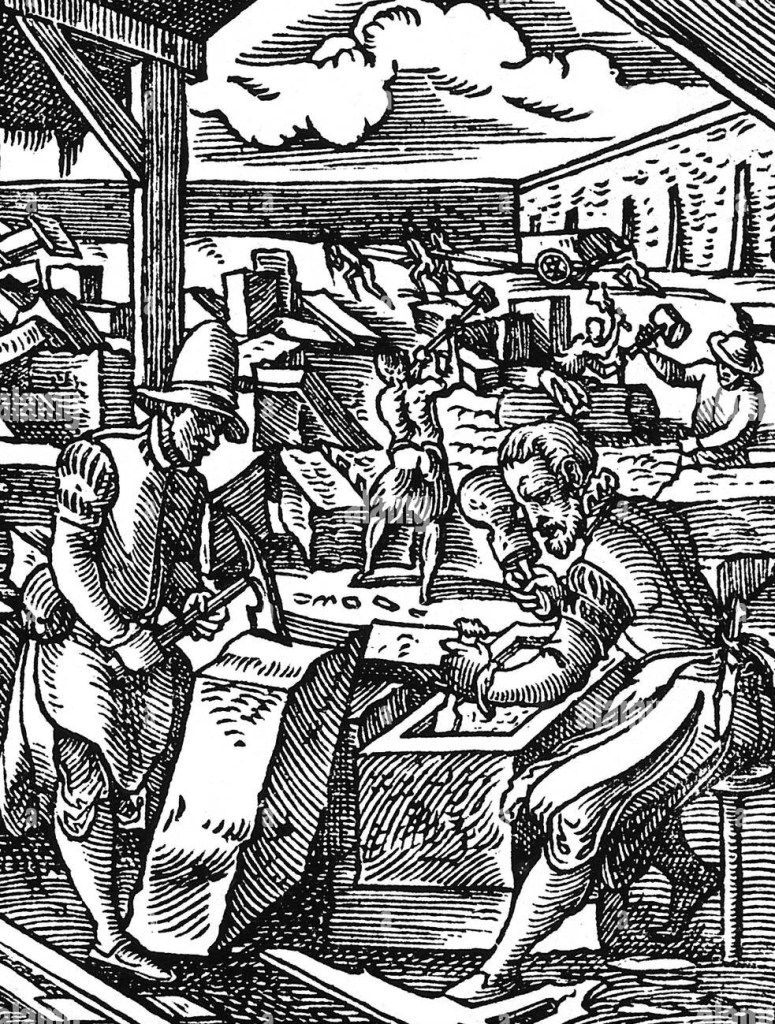
Once stated, the hypothesis gained traction almost immediately among antiquarians and soon began to circulate as ‘fact.’ The idea of ‘proprietary’ marks made by stone masons had embedded itself in most of the literature from the late 19th century. Problematically, those who followed in their footsteps worked hard at trying to prove the hypothesis, as opposed to questioning it.
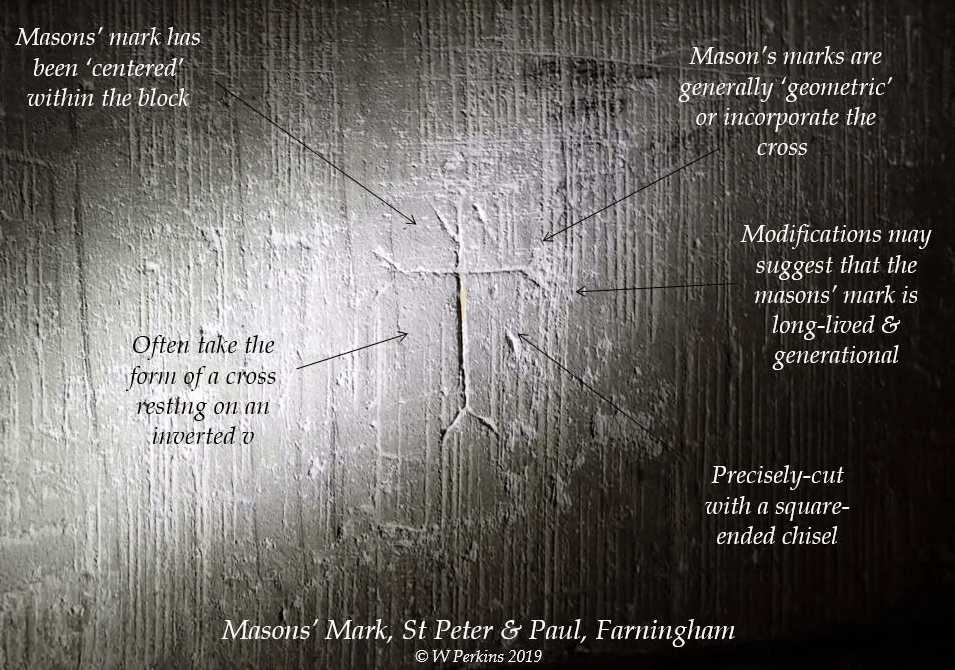
Freemasons’ Lodges & the Registration of Masons’ Marks.
Under scrutiny, however, the reality on the ground (or rather, on the walls) has shown a general absence of masons’ marks on cut stone. Often, there are multiple marks on a single block or the marks which are present do not conform to the diagnostic traits of a mason’s mark. The marks which were recorded may well have been ‘graffiti’ (as we now know it), marks or symbols added to the stone’s surface post construction.
Therefore, any further claims that the benefits of recording masons’ marks can include charting the movements of itinerant masons (as well as dating the building’s architectural progress) is based solely upon the interpretation of the archaeologist in question.
Much of this work seems to have worked upon a presumption that, in early medieval England, mason’s lodges (along with the official registration of masons’ marks) had occurred in tandem with those in Europe and Scotland. This has proven not to be the case and the situation is far more complex than it first seems. Even leading graffiti expert Matthew Champion has struggled to cast new light on this hoary old problem but has also taken the time to outline the problems with this avenue of research (Champion 2016).
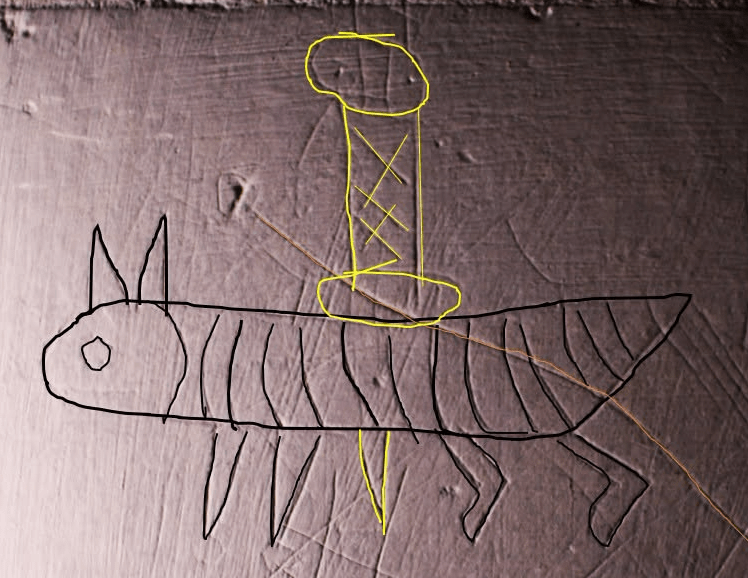
Photo © W Perkins 2025
Processual Archaeology
In terms of the methodologies by which researchers have recorded masons’ marks, it has rarely been asked, by what criteria does one judge a mark or symbol which constitutes a masons’ mark? In general, architectural historians have not set out the strict parameters by which such marks are identified. In the past, surveys have included a range of marks and motifs including isolated letters, sets of initials, abstract symbols and figurative graffiti – all cited as examples of masons’ marks. It would seem that, rather than looking at the corpus of graffiti from a particular building and then placing each mark in context, either a selective reading of the marks has sometimes been applied or every mark has been considered to be the cipher of a mason.
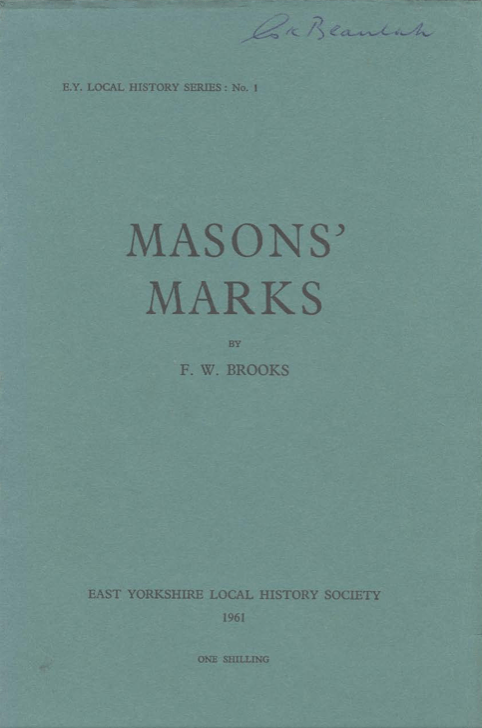
In general, nearly all the antiquarians of the 19th century (and those through to the architectural historians of the 20th century) have applied a pragmatic, processual archaeology to the problem with very little nuance with regards to the intention or agency of the graffitist in their studies.

The study of masons’ marks has thrown up a number of questions –
What if the marks are absent from a stone block?
What do you do when there are multiple marks on a single block?
Do you include marks that are cut over the mortar beds of several stones?
Do isolated letters, initials or abstract symbols count?
I’ve gone back to a paper which rang some alarm bells when I first read it over a decade ago, ‘The Introduction and Use of Masons’ Marks in Romanesque Buildings in England’ by Jennifer Alexander and published in Society for Medieval Archaeology, issue 51, 2007.

The aim of the paper was to identify the date at which the use of masons’ marks was introduced into England. It concluded that it may have been linked to the improvement of cutting techniques which were introduced at the end of the 11th century, when preparing ashlar blocks. It was also suggested that, in turn, this information would allow archaeologist to chart the movement of itinerant masons and to help date the construction phases of the building under study.
The paper identified two types of mark most commonly found on dressed masonry –
Bankers’ marks – made on the block by the person who had dressed the stone into an ashlar block (the stone mason)
Assembly marks – (like a carpenter’s mark) which facilitates the positioning of the stone on site
In other studies, this is normally preceded by the first stage of marking – the quarry mark – made at the time of the removal of the stone from its geological bed, to either identify its source or to identify its destination. However, it is presumed that these marks are generally lost during the stone ‘dressing’ stage.
Methodology & Caveats
What is potentially problematic in this report is that there is no mention of the corpus of marks and symbols collected at each site, nor is there any reference as to the criteria by which the mason’s marks were identified. This then, would appear to have been a subjective process by the author.
In the report, further issues rear their head once it is found that the marks do not fall easily into the suggested masons’ marks ‘system’ and a number of caveats are introduced to make it work. Alexander does not question the original hypothesis of how the stones were believed to have been marked but does admit that the question of ‘authorship’ is a difficult one. She does, at least, admit that there is no extant documentation to support it. Further, as a way of trying to make the evidence fit, she suggests that it may have been the case that, ‘the systems were not monolithic and therefore, may have varied from site to site’ (Alexander 2007: 64).
Further caveats include the concession that multiples or the repetition of marks may have occurred as, ‘simple’ marks can be duplicated; or that the presence/absence of marks can vary according to differing ‘remuneration regimes’ set by the senior paymaster; or that marking may have been ‘dropped’ on small projects (as ad hoc systems would have been introduced) and where mason’s were paid ‘regular wages’ no marks were used; or, in the production of ‘irregular’ blocks she posited that it may have not required an assembly mark system; or, with reused stone, ‘there would have not have been the same need for masons to mark the stones’ (Alexander 2007: 64-65.74). Some list.
In the report, the absence of marks on the finished stones were further explained as losses, ‘possibly’ due to the restoration of the buildings, rebuilding / enhancement projects and to partial destruction. ‘At Blythe Priory only 20% of the stonework was marked; ‘few’ stones were marked at York Minster; on the west front at Lincoln Cathedral weathering may have removed some marks and at Winchester there were only ‘isolated occurrences’ of marks (Alexander 2007: 67). This must have been a disappointing result as the hypothesis which suggests the systematic marking of stone by the mason’s had not been as uniform as once believed.
However, the report makes clear that there were marks – sometimes in large number – located in specific areas of the buildings that were the subject of the study. At Worcester the stair turrets contained marks in ‘large number’ and in the choir of Hereford Cathedral a ‘high proportion’ of the stones were marked. At Tewkesbury, there were ‘considerably more marks on the Nave piers’ and at Westminster Hall, ‘on the exterior north wall marks appeared in large quantities’(Alexander 2007: 69-70). In no case is a correlation made between these locations and the access by the public to these spaces. Fewer marks were found in those areas of the church only accessible to the clergy.
At St Laurence’s in Bradford-on-Avon, her survey found only ‘simple saltires’ (described as, ‘two-line crosses’) in seven locations. My preliminary survey of the same site recorded various marks, including a pentangle, several compass-drawn circles and a partially completed six-petal rosette in the chancel (Perkins 2022). Were these marks missed or ignored?
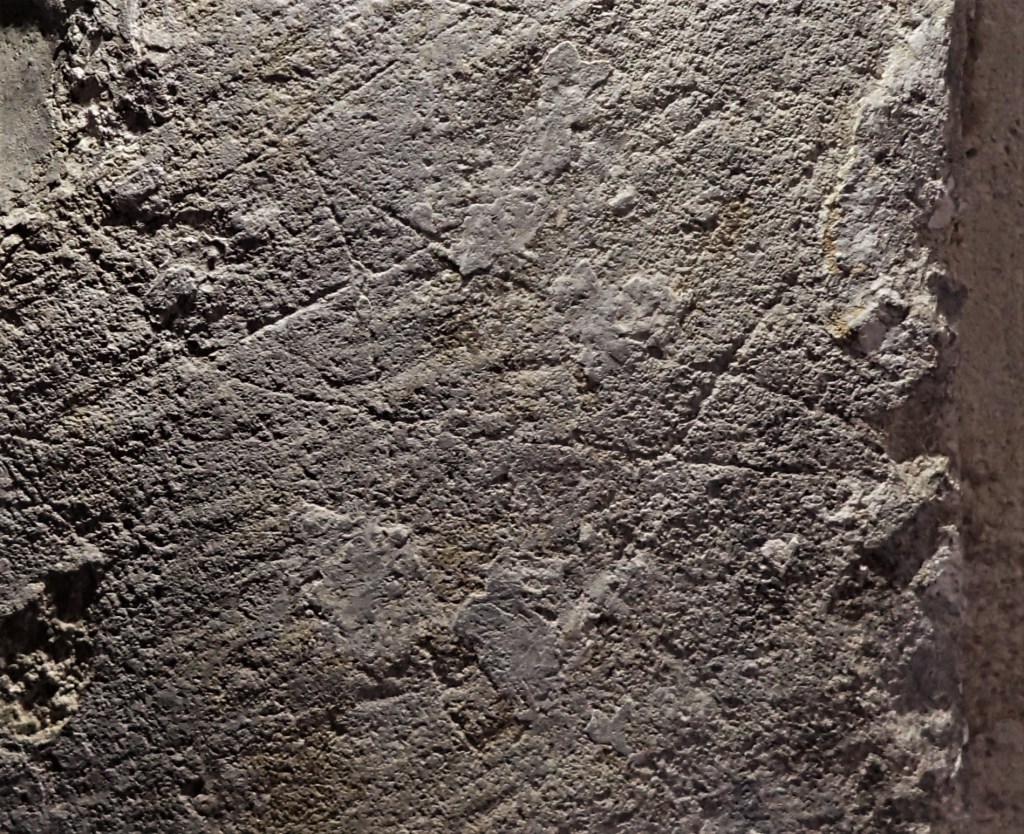
At the Abbaye de Jumièges in France other marks were recorded, described as, ‘arrows, crosses, diamonds, the letters C and X,’ which were interpreted as bankers’ marks (Alexander 2007: 80). I would respectfully suggest that these were more likely to have been examples of tourist, devotional and apotropaic graffiti. The first mentioned on that list, arrow motifs are likely to be examples of Plague arrows, a common motif found in medieval churches (Perkins 2024).

Finally, although not explicitly stated, the hypothesis seems to have relied too much upon the expectation that fully formed Freemason’s Lodges had already been established in the early medieval period in England. The idea among antiquarians that such lodges were already administering sanctioned registers of masons’ marks around the same time of the construction of early medieval buildings is highly unlikely. In fact, it is more probable that the German Ordinances of 1462 were the first written laws regulating the subject of propriety marks (Grand Lodge 2026).
Alexander was on much safer ground six years later in her ‘Signed in Stone’ article for Country Life magazine. Highlighting the work of 17th century stonemason Samson Frisby (1597-c.1656), she was able to provide documentation bearing his mason’s mark which had come to light. The main point of difference being that it focussed upon a stonemason operating five hundred years later than the article under scrutiny here. Nevertheless, the short piece was still riddled with her concerns regarding the inconsistencies surrounding the actual registration and application of mason’s marks in practice.
A year later, her study of the masons’ marks in the 14th century church of St Mary in Nottingham was plagued with caveats, including a perceived ‘variation in execution and miss-cutting of marks’ that had confused the identification and reading of the building (Alexander & Monckton 2014: 51-53). It seems nothing is plain sailing in the world of mason’s marks….
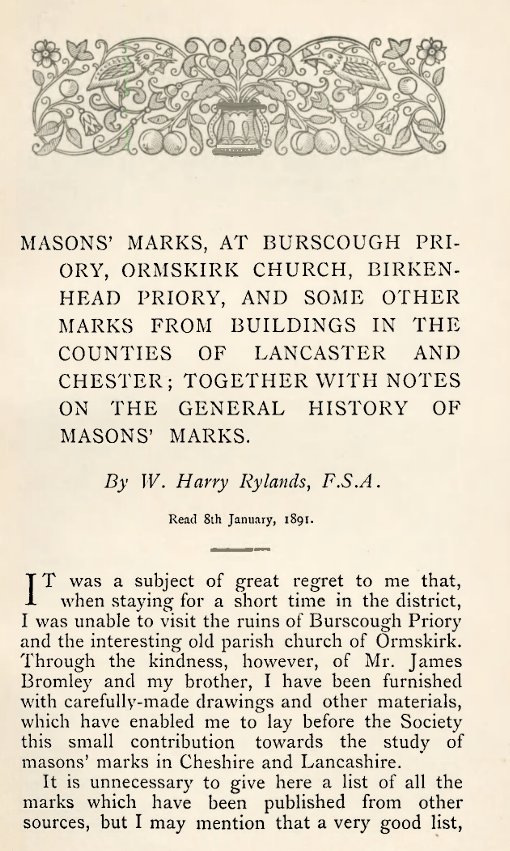

Alexander has been battling with the same problems that the antiquarians in the 19th century had encountered when they were initially drawn to the study of masons’ marks. They too claimed that the absence of marked stones could be due to ‘accident’ (Street 1914), that their absence was due to, ‘stones cut by ‘non-Guild’ masons or that, ‘marks only appeared upon ‘significant’ stones‘ (Silva 1868); or that unmarked stones were only ‘apprentice pieces’ (Whitley 1888); or that marks may have been, ‘eroded or erased or defaced’ or the even preposterous idea was posited that stonemasons had, ‘stopped using chiselled marks and painted their marks on the stone instead’ (Rylands 1891). Ye Gods!
As you can see, the mason’s mark hypothesis doesn’t really work well in practice….
This short blog has been adapted from a much longer article due to be published later this year. In the meantime, church crawlers, happy hunting!
References
Alexander, J S (2007) ‘The Introduction and Use of Masons’ Marks in Romanesque Buildings in England’ in, Society for Medieval Archaeology, 51.
Alexander J S (2013) ‘Signed in Stone’ in, Country Life Magazine No.60.
Alexander, J S & Monkton, L (2014) ‘Excellent, New And Uniforme Yn Work’, St Mary’s Nottingham, An Architectural And Archaeological Study.’
Champion, M (2016) Marking the stones: medieval mason’s and a bunch of bankers…
https://medieval-graffiti.blogspot.com/2016/06/marking-stones-medieval-masons-and.html
Grand Lodge of British Columbia & Yukon(2026) Masons’ and Freemasons’ Marks
https://freemasonry.bcy.ca/history/marks/freemasonsmarks.html
Perkins, W (2022) A Discovery of Angels: How an Anglo-Saxon Chapel Gave up Its Secrets
https://ritualprotectionmarks.com/2022/12/23/a-discovery-of-angels-how-an-anglo-saxon-chapel-gave-up-its-secrets/
Perkins, W (2024) Shoot That Poison Arrow: Apotropaics to Counter the Plague.
Link
https://ritualprotectionmarks.com/2026/02/27/illustrated-talks-guided-tours-2026/


