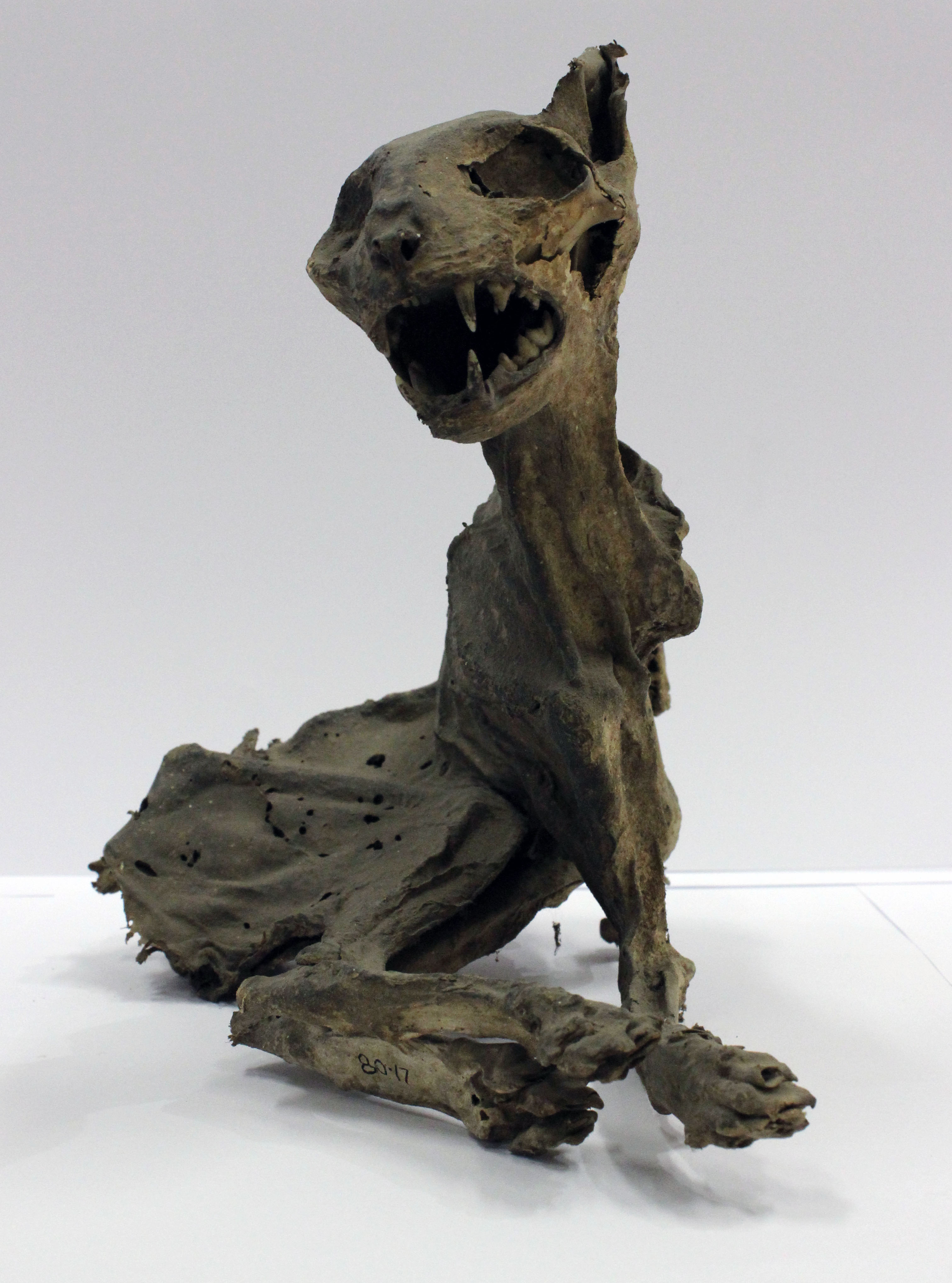
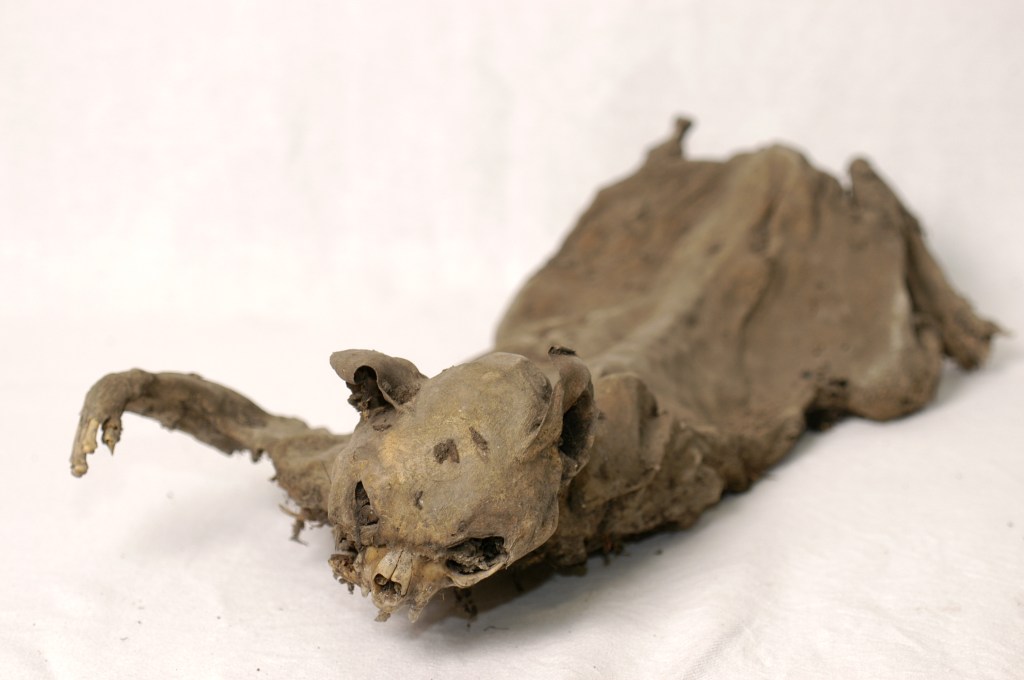
Main image: Mummified cat from the collection held by the ‘Museum in the Park,’ Stroud, Gloucestershire collection

In 1951, Margaret M. Howard outlined the key traits relating to deposits
of intentionally immured felines in her article, “Dried cats”. She
proposed three interpretations for the phenomena:
that the cats had
been placed in the buildings as a foundation sacrifice;
that they had
been accidentally enclosed or trapped in the wall cavities or underneath
floorboards,
or that they had been intended as vermin scarers
(Howard, 1951, p. 149).
However, re-examination of these deposits using modern archaeological
techniques has revealed that none of those interpretations
adequately explains the circumstances in which many of the cats had
been immured. The prosaic explanation of a cat voluntarily entering a
void in the building fabric to die has long been dismissed.
On the contrary, evidence has shown that, in some cases, the cats had been posed
into hunting scenes (Merrifield, 1987, p. 129), “pegged” into place
(Howard, 1951, p. 149), affixed with wire or inserted into the wall cavity
“post mortem”—which had allowed for posing and placement prior
to rigor mortis (Manning, 2014, p. 65). In some examples, it is apparent that there had been an attempt to desiccate or smoke the cats prior to their insertion (Merrifield, 1987, p. 129), or that they had been placed with other mummified animals such as rats and mice (V. Hart, 2013).
This is a short excerpt from ‘A Consensus of Symbols: patterns in Ritual Building Protection’ out now, published by Aeon Books. Please refer to that book for the references.
https://spirit.aeonbooks.co.uk/product/consensus-of-symbols/95394